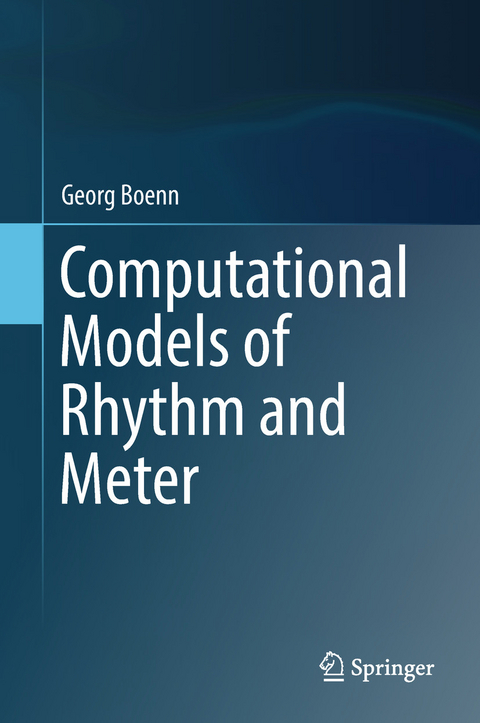
Computational Models of Rhythm and Meter (eBook)
XII, 187 Seiten
Springer International Publishing (Verlag)
978-3-319-76285-2 (ISBN)
This book presents the latest computational models of rhythm and meter that are based on number theory, combinatorics and pattern matching. Two computational models of rhythm and meter are evaluated: The first one explores a relatively new field in Mathematics, namely Combinatorics on Words, specifically Christoffel Words and the Burrows-Wheeler Transform, together with integer partitions. The second model uses filtered Farey Sequences in combination with specific weights that are assigned to inter-onset ratios. This work is assessed within the context of the current state of the art of tempo tracking and computational music transcription. Furthermore, the author discusses various representations of musical rhythm, which lead to the development of a new shorthand notation that will be useful for musicologists and composers.
Computational Models of Rhythm and Meter also contains numerous investigations into the timing structures of human rhythm and metre perception carried out within the last decade. Our solution to the transcription problem has been tested using a wide range of musical styles, and in particular using two recordings of J.S. Bach's Goldberg Variations by Glenn Gould. The technology is capable of modelling musical rhythm and meter by using Farey Sequences, and by detecting duration classes in a windowed analysis, which also detects the underlying tempo. The outcomes represent human performances of music as accurate as possible within Western score notation.
Preface.-Introduction.- Phenomenology of Rhythm and Meter.- A Shorthand Notation for Musical Rhythm.- Partitions and Musical Sentences.- The Use of the Burrows-Wheeler Transform for Analysis and Composition.- Christoffel Rhythms.- The Farey Sequence as a Model for Musical Rhythm and Meter.- Introduction to Quantization.- Rhythm Quantization.- Future Work.- Conclusion.- References.
| Erscheint lt. Verlag | 20.6.2018 |
|---|---|
| Zusatzinfo | XII, 187 p. 47 illus., 3 illus. in color. |
| Verlagsort | Cham |
| Sprache | englisch |
| Themenwelt | Mathematik / Informatik ► Informatik |
| Mathematik / Informatik ► Mathematik | |
| Schlagworte | Cognition • Composition • Mathematics • Music analysis • music transcription |
| ISBN-10 | 3-319-76285-0 / 3319762850 |
| ISBN-13 | 978-3-319-76285-2 / 9783319762852 |
| Informationen gemäß Produktsicherheitsverordnung (GPSR) | |
| Haben Sie eine Frage zum Produkt? |
 PDF (Wasserzeichen)
DRM: Digitales Wasserzeichen
Dieses eBook enthält ein digitales Wasserzeichen und ist damit für Sie personalisiert. Bei einer missbräuchlichen Weitergabe des eBooks an Dritte ist eine Rückverfolgung an die Quelle möglich.
Dateiformat: PDF (Portable Document Format)
Mit einem festen Seitenlayout eignet sich die PDF besonders für Fachbücher mit Spalten, Tabellen und Abbildungen. Eine PDF kann auf fast allen Geräten angezeigt werden, ist aber für kleine Displays (Smartphone, eReader) nur eingeschränkt geeignet.
Systemvoraussetzungen:
PC/Mac: Mit einem PC oder Mac können Sie dieses eBook lesen. Sie benötigen dafür einen PDF-Viewer - z.B. den Adobe Reader oder Adobe Digital Editions.
eReader: Dieses eBook kann mit (fast) allen eBook-Readern gelesen werden. Mit dem amazon-Kindle ist es aber nicht kompatibel.
Smartphone/Tablet: Egal ob Apple oder Android, dieses eBook können Sie lesen. Sie benötigen dafür einen PDF-Viewer - z.B. die kostenlose Adobe Digital Editions-App.
Buying eBooks from abroad
For tax law reasons we can sell eBooks just within Germany and Switzerland. Regrettably we cannot fulfill eBook-orders from other countries.
aus dem Bereich