


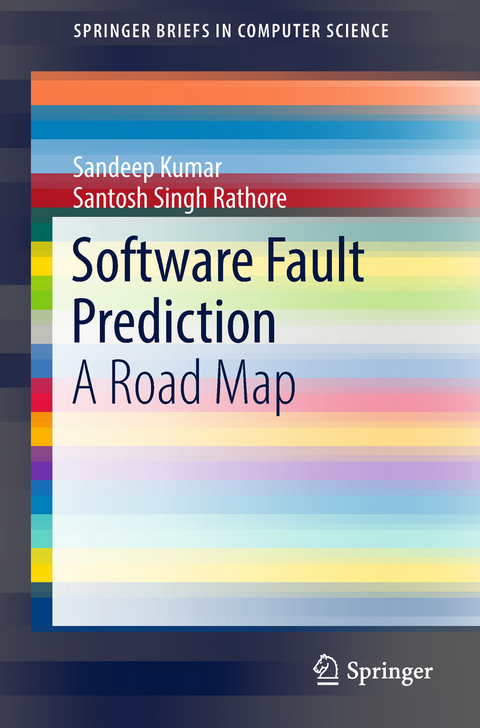
Software Fault Prediction (eBook)
XI, 72 Seiten
Springer Singapore (Verlag)
978-981-10-8715-8 (ISBN)
This book focuses on exploring the use of software fault prediction in building reliable and robust software systems. It is divided into the following chapters: Chapter 1 presents an introduction to the study and also introduces basic concepts of software fault prediction. Chapter 2 explains the generalized architecture of the software fault prediction process and discusses its various components. In turn, Chapter 3 provides detailed information on types of fault prediction models and discusses the latest literature on each model. Chapter 4 describes the software fault datasets and diverse issues concerning fault datasets when building fault prediction models. Chapter 5 presents a study evaluating different techniques on the basis of their performance for software fault prediction. Chapter 6 presents another study evaluating techniques for predicting the number of faults in the software modules. In closing, Chapter 7 provides a summary of the topics discussed.
The book will be of immense benefit to all readers who are interested in starting research in this area. In addition, it offers experienced researchers a valuable overview of the latest work in this area.Dr Sandeep Kumar is currently working as an Assistant Professor at the Department of Computer Science and Engineering, Indian Institute of Technology (IIT) Roorkee, India. His areas of interest include Semantic Web, Web Services, and Software Engineering. He has supervised many Ph.D. students and filed two patents for his work done along with students. He is currently handling multiple national and international research/consultancy projects and has many accolades to his credit-Young Faculty Research Fellowship of MeitY (Govt. of India), NSF/TCPP early adopter award-2014, 2015, ITS Travel Award 2011 and 2013 and others. He is a member of the ACM and senior member of the IEEE. His name has also been listed in major directories such as Marquis Who's Who, IBC and others.
Dr Santosh Singh Rathore is currently working as an Assistant Professor in the Department of Computer Science and Engineering, National Institute of Technology (NIT) Jalandhar, India. He received his PhD degree from the Indian Institute of Technology Roorkee (IITR) and his master's degree (M.Tech.) from the Indian Institute of Information Technology Design and Manufacturing (IIITDM) Jabalpur, India. His research interests include Software Fault Prediction, Software Quality Assurance, Empirical Software Engineering, Object-Oriented Software Development and Object-Oriented Metrics. He has published research papers in various peer-reviewed journals and international conference proceedings.
This book focuses on exploring the use of software fault prediction in building reliable and robust software systems. It is divided into the following chapters: Chapter 1 presents an introduction to the study and also introduces basic concepts of software fault prediction. Chapter 2 explains the generalized architecture of the software fault prediction process and discusses its various components. In turn, Chapter 3 provides detailed information on types of fault prediction models and discusses the latest literature on each model. Chapter 4 describes the software fault datasets and diverse issues concerning fault datasets when building fault prediction models. Chapter 5 presents a study evaluating different techniques on the basis of their performance for software fault prediction. Chapter 6 presents another study evaluating techniques for predicting the number of faults in the software modules. In closing, Chapter 7 provides a summary of the topics discussed. The book will beof immense benefit to all readers who are interested in starting research in this area. In addition, it offers experienced researchers a valuable overview of the latest work in this area.
Dr Sandeep Kumar is currently working as an Assistant Professor at the Department of Computer Science and Engineering, Indian Institute of Technology (IIT) Roorkee, India. His areas of interest include Semantic Web, Web Services, and Software Engineering. He has supervised many Ph.D. students and filed two patents for his work done along with students. He is currently handling multiple national and international research/consultancy projects and has many accolades to his credit—Young Faculty Research Fellowship of MeitY (Govt. of India), NSF/TCPP early adopter award-2014, 2015, ITS Travel Award 2011 and 2013 and others. He is a member of the ACM and senior member of the IEEE. His name has also been listed in major directories such as Marquis Who’s Who, IBC and others. Dr Santosh Singh Rathore is currently working as an Assistant Professor in the Department of Computer Science and Engineering, National Institute of Technology (NIT) Jalandhar, India. He received his PhD degree from the Indian Institute of Technology Roorkee (IITR) and his master’s degree (M.Tech.) from the Indian Institute of Information Technology Design and Manufacturing (IIITDM) Jabalpur, India. His research interests include Software Fault Prediction, Software Quality Assurance, Empirical Software Engineering, Object-Oriented Software Development and Object-Oriented Metrics. He has published research papers in various peer-reviewed journals and international conference proceedings.
Chapter 1. Introduction.- Chapter 2. Software Fault Prediction Process.- Chapter 3. Types of Software Fault Prediction.- Chapter 4. Software Fault Dataset.- Chapter 5. Evaluation of Techniques for Binary Class Prediction.- Chapter 6. Number of Fault Prediction.- Chapter 7. Conclusions.
| Erscheint lt. Verlag | 6.6.2018 |
|---|---|
| Reihe/Serie | SpringerBriefs in Computer Science | SpringerBriefs in Computer Science |
| Zusatzinfo | XI, 72 p. 8 illus., 1 illus. in color. |
| Verlagsort | Singapore |
| Sprache | englisch |
| Themenwelt | Mathematik / Informatik ► Informatik ► Datenbanken |
| Mathematik / Informatik ► Informatik ► Software Entwicklung | |
| Schlagworte | Earning models • Quality assurance • Soft computing and machine learning • Software engineering • software fault prediction • Testing |
| ISBN-10 | 981-10-8715-6 / 9811087156 |
| ISBN-13 | 978-981-10-8715-8 / 9789811087158 |
| Informationen gemäß Produktsicherheitsverordnung (GPSR) | |
| Haben Sie eine Frage zum Produkt? |
 PDF (Wasserzeichen)
DRM: Digitales Wasserzeichen
Dieses eBook enthält ein digitales Wasserzeichen und ist damit für Sie personalisiert. Bei einer missbräuchlichen Weitergabe des eBooks an Dritte ist eine Rückverfolgung an die Quelle möglich.
Dateiformat: PDF (Portable Document Format)
Mit einem festen Seitenlayout eignet sich die PDF besonders für Fachbücher mit Spalten, Tabellen und Abbildungen. Eine PDF kann auf fast allen Geräten angezeigt werden, ist aber für kleine Displays (Smartphone, eReader) nur eingeschränkt geeignet.
Systemvoraussetzungen:
PC/Mac: Mit einem PC oder Mac können Sie dieses eBook lesen. Sie benötigen dafür einen PDF-Viewer - z.B. den Adobe Reader oder Adobe Digital Editions.
eReader: Dieses eBook kann mit (fast) allen eBook-Readern gelesen werden. Mit dem amazon-Kindle ist es aber nicht kompatibel.
Smartphone/Tablet: Egal ob Apple oder Android, dieses eBook können Sie lesen. Sie benötigen dafür einen PDF-Viewer - z.B. die kostenlose Adobe Digital Editions-App.
Buying eBooks from abroad
For tax law reasons we can sell eBooks just within Germany and Switzerland. Regrettably we cannot fulfill eBook-orders from other countries.
aus dem Bereich


