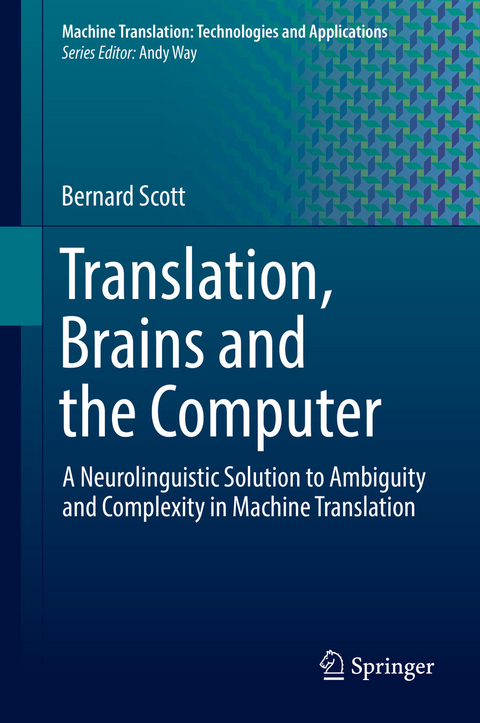
Translation, Brains and the Computer (eBook)
XVI, 241 Seiten
Springer International Publishing (Verlag)
9783319766294 (ISBN)
This book is about machine translation (MT) and the classic problems associated with this language technology. It examines the causes of these problems and, for linguistic, rule-based systems, attributes the cause to language's ambiguity and complexity and their interplay in logic-driven processes. For non-linguistic, data-driven systems, the book attributes translation shortcomings to the very lack of linguistics. It then proposes a demonstrable way to relieve these drawbacks in the shape of a working translation model (Logos Model) that has taken its inspiration from key assumptions about psycholinguistic and neurolinguistic function. The book suggests that this brain-based mechanism is effective precisely because it bridges both linguistically driven and data-driven methodologies. It shows how simulation of this cerebral mechanism has freed this one MT model from the all-important, classic problem of complexity when coping with the ambiguities of language. Logos Model accomplishes this by a data-driven process that does not sacrifice linguistic knowledge, but that, like the brain, integrates linguistics within a data-driven process. As a consequence, the book suggests that the brain-like mechanism embedded in this model has the potential to contribute to further advances in machine translation in all its technological instantiations.
1 Introduction.- 2 Background.- Logos Model Beginnings.- Advent of Statistical MT.- Overview of Logos Model Translation Process.- Psycholinguistic and Neurolinguistic Assumptions.- On Language and Grammar.- Conclusion.- 3 – Language and Ambiguity: Psycholinguistic Perspectives.- Levels of Ambiguity.- Language Acquisition and Translation.- Psycholinguistic Bases of Language Skills.- Practical Implications for Machine Translation.- Psycholinguistics in a Machine.- Conclusion.- 4– Language and Complexity: Neurolinguistic Perspectives .- Cognitive Complexity.- A Role for Semantic Abstraction.- Connectionism and Brain Simulation.- Logos Model as a Neural Network.- Language Processing in the Brain.- MT Performance and Underlying Competence.- Conclusion.- 5 – Syntax and Semantics: Dichotomy or Integration? .- Syntax versus Semantics: Is There a Third, Semantico- Syntactic Perspective?.- Recent Views of the Cerebral Process.- Syntax and Semantics: How Do They Relate?.- Conclusion.- 6 –Logos Model: Design and Performance.- The Translation Problem.- How Do You Represent Natural Language?.- How Do You Store Linguistic Knowledge?.- How Do You Apply Stored Knowledge To The Input Stream?.- How do you Effect Target Transfer and Generation?.- How Do You Deal with Complexity Issues?.- Conclusion.- 7 – Some limits on Translation Quality.- First Example.- Second Example.- Other Translation Examples.- Balancing the Picture.- Conclusion.- 8 – Deep Learning MT and Logos Model.- Points of Similarity and Differences.- Deep Learning, Logos Model and the Brain.- On Learning.- The Hippocampus Again.- Conclusion.- Part II.- The SAL Representation Language.- SAL Nouns.- SAL Verbs.- SAL Adjectives.- SAL Adverbs.
| Erscheint lt. Verlag | 6.6.2018 |
|---|---|
| Reihe/Serie | Machine Translation: Technologies and Applications | Machine Translation: Technologies and Applications |
| Zusatzinfo | XVI, 241 p. 55 illus. |
| Verlagsort | Cham |
| Sprache | englisch |
| Themenwelt | Mathematik / Informatik ► Informatik |
| Schlagworte | Computer science with interest in NLP • Foreign language departments • language acquisition and translation • language and the brain • natural language representation • Neural machine translation NMT • Semantico-syntactic representation • Semantic processing |
| ISBN-13 | 9783319766294 / 9783319766294 |
| Informationen gemäß Produktsicherheitsverordnung (GPSR) | |
| Haben Sie eine Frage zum Produkt? |
 PDF (Wasserzeichen)
DRM: Digitales Wasserzeichen
Dieses eBook enthält ein digitales Wasserzeichen und ist damit für Sie personalisiert. Bei einer missbräuchlichen Weitergabe des eBooks an Dritte ist eine Rückverfolgung an die Quelle möglich.
Dateiformat: PDF (Portable Document Format)
Mit einem festen Seitenlayout eignet sich die PDF besonders für Fachbücher mit Spalten, Tabellen und Abbildungen. Eine PDF kann auf fast allen Geräten angezeigt werden, ist aber für kleine Displays (Smartphone, eReader) nur eingeschränkt geeignet.
Systemvoraussetzungen:
PC/Mac: Mit einem PC oder Mac können Sie dieses eBook lesen. Sie benötigen dafür einen PDF-Viewer - z.B. den Adobe Reader oder Adobe Digital Editions.
eReader: Dieses eBook kann mit (fast) allen eBook-Readern gelesen werden. Mit dem amazon-Kindle ist es aber nicht kompatibel.
Smartphone/Tablet: Egal ob Apple oder Android, dieses eBook können Sie lesen. Sie benötigen dafür einen PDF-Viewer - z.B. die kostenlose Adobe Digital Editions-App.
Buying eBooks from abroad
For tax law reasons we can sell eBooks just within Germany and Switzerland. Regrettably we cannot fulfill eBook-orders from other countries.
aus dem Bereich