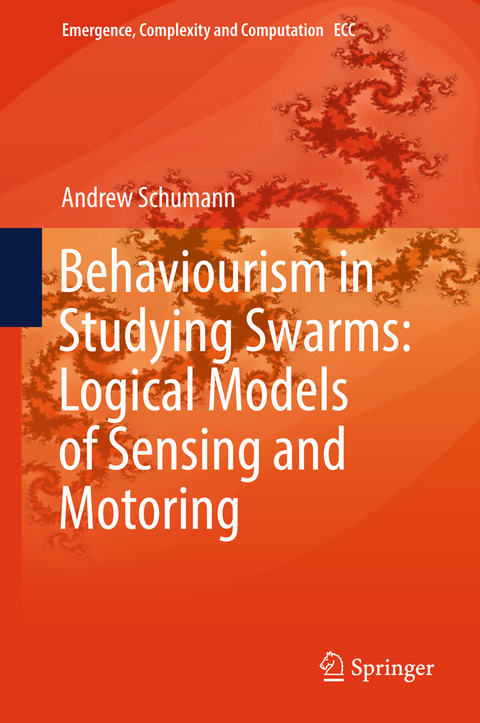
Behaviourism in Studying Swarms: Logical Models of Sensing and Motoring (eBook)
XI, 468 Seiten
Springer International Publishing (Verlag)
978-3-319-91542-5 (ISBN)
This book presents fundamental theoretical results for designing object-oriented programming languages for controlling swarms. It studies the logics of swarm behaviours. According to behaviourism, all behaviours can be controlled or even managed by stimuli in the environment: attractants (motivational reinforcement) and repellents (motivational punishment). At the same time, there are two main stages in reactions to stimuli: sensing (perceiving signals) and motoring (appropriate direct reactions to signals). This book examines the strict limits of behaviourism from the point of view of symbolic logic and algebraic mathematics: how far can animal behaviours be controlled by the topology of stimuli? On the one hand, we can try to design reversible logic gates in which the number of inputs is the same as the number of outputs. In this case, the behaviouristic stimuli are inputs in swarm computing and appropriate reactions at the motoring stage are its outputs. On the other hand, the problem is that even at the sensing stage each unicellular organism can be regarded as a logic gate in which the number of outputs (means of perceiving signals) greatly exceeds the number of inputs (signals).
Introduction.- Actin Filament Networks.- Unconventional Computers Designed on Swarm Behaviours.- Conventional and Unconventional Automata on Swarm Behaviours.- Non-Archimedean Valued Fuzzy and Probability Logics.- Individual-Collective Duality in Swarm Behaviours.- Syllogistic Systems of Swarm Propagation.- Context-Based Games of Swarms.
| Erscheint lt. Verlag | 25.5.2018 |
|---|---|
| Reihe/Serie | Emergence, Complexity and Computation | Emergence, Complexity and Computation |
| Zusatzinfo | XI, 468 p. 117 illus., 25 illus. in color. |
| Verlagsort | Cham |
| Sprache | englisch |
| Themenwelt | Informatik ► Theorie / Studium ► Künstliche Intelligenz / Robotik |
| Technik | |
| Schlagworte | Agent Based Computation • Amoeba Proteus • Analogic Computing • Artificial Life • behaviourism • Bio-Inspired Game Theory, Actin Filament Networks • Cellular Automata • Complex Systems • Emergence • Fuzzy Logics, Many-Valued Logics • Multiagent Systems • Non-Classical Logics • Physarum Polycephalum, Slime Mould • Reaction-Diffusion Computing • Reflexive Games • Social Behaviour • Swarm Behaviour • swarm computing • Swarm intelligence • Trichobilharzia Szidati, Schistosomatidae |
| ISBN-10 | 3-319-91542-8 / 3319915428 |
| ISBN-13 | 978-3-319-91542-5 / 9783319915425 |
| Informationen gemäß Produktsicherheitsverordnung (GPSR) | |
| Haben Sie eine Frage zum Produkt? |
 PDF (Wasserzeichen)
DRM: Digitales Wasserzeichen
Dieses eBook enthält ein digitales Wasserzeichen und ist damit für Sie personalisiert. Bei einer missbräuchlichen Weitergabe des eBooks an Dritte ist eine Rückverfolgung an die Quelle möglich.
Dateiformat: PDF (Portable Document Format)
Mit einem festen Seitenlayout eignet sich die PDF besonders für Fachbücher mit Spalten, Tabellen und Abbildungen. Eine PDF kann auf fast allen Geräten angezeigt werden, ist aber für kleine Displays (Smartphone, eReader) nur eingeschränkt geeignet.
Systemvoraussetzungen:
PC/Mac: Mit einem PC oder Mac können Sie dieses eBook lesen. Sie benötigen dafür einen PDF-Viewer - z.B. den Adobe Reader oder Adobe Digital Editions.
eReader: Dieses eBook kann mit (fast) allen eBook-Readern gelesen werden. Mit dem amazon-Kindle ist es aber nicht kompatibel.
Smartphone/Tablet: Egal ob Apple oder Android, dieses eBook können Sie lesen. Sie benötigen dafür einen PDF-Viewer - z.B. die kostenlose Adobe Digital Editions-App.
Buying eBooks from abroad
For tax law reasons we can sell eBooks just within Germany and Switzerland. Regrettably we cannot fulfill eBook-orders from other countries.
aus dem Bereich