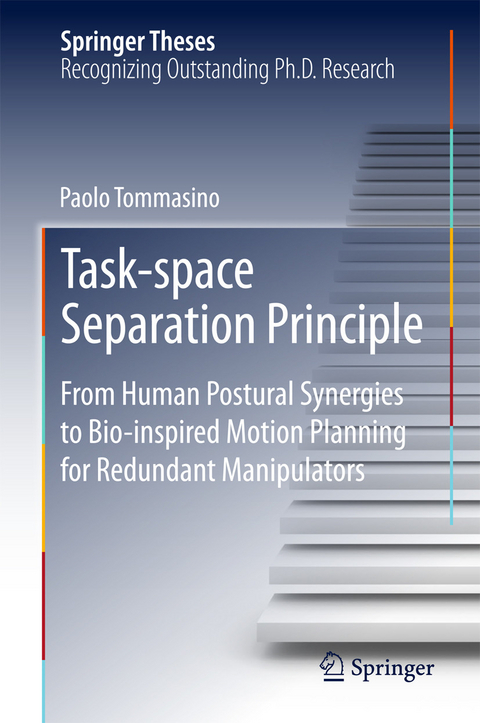
Task-space Separation Principle (eBook)
105 Seiten
Springer Singapore (Verlag)
978-981-13-0353-1 (ISBN)
This book addresses two fundamental issues of motor control for both humans and robots: kinematic redundancy and the posture/movement problem. It blends traditional robotic constrained-optimal approaches with neuroscientific and evidence-based principles, proposing a "e;Task-space Separation Principle,"e; a novel scheme for planning both posture and movement in redundant manipulators. The proposed framework is first tested in simulation and then compared with experimental motor strategies displayed by humans during redundant pointing tasks. The book also shows how this model builds on and expands traditional formulations such as the Passive Motion Paradigm and the Equilibrium Point Theory. Lastly, breaking with the neuroscientific tradition of planar movements and linear(ized) kinematics, the theoretical formulation and experimental scenarios are set in the nonlinear space of 3D rotations which are essential for wrist motions, a somewhat neglected area despite its importance in daily tasks.
| Erscheint lt. Verlag | 26.5.2018 |
|---|---|
| Sprache | englisch |
| Themenwelt | Informatik ► Theorie / Studium ► Künstliche Intelligenz / Robotik |
| Studium ► 1. Studienabschnitt (Vorklinik) ► Physiologie | |
| Naturwissenschaften ► Biologie | |
| Naturwissenschaften ► Physik / Astronomie ► Angewandte Physik | |
| Technik ► Bauwesen | |
| Technik ► Elektrotechnik / Energietechnik | |
| Technik ► Maschinenbau | |
| ISBN-10 | 981-13-0353-3 / 9811303533 |
| ISBN-13 | 978-981-13-0353-1 / 9789811303531 |
| Informationen gemäß Produktsicherheitsverordnung (GPSR) | |
| Haben Sie eine Frage zum Produkt? |
 PDF (Wasserzeichen)
Größe: 5,9 MB
DRM: Digitales Wasserzeichen
Dieses eBook enthält ein digitales Wasserzeichen und ist damit für Sie personalisiert. Bei einer missbräuchlichen Weitergabe des eBooks an Dritte ist eine Rückverfolgung an die Quelle möglich.
Dateiformat: PDF (Portable Document Format)
Mit einem festen Seitenlayout eignet sich die PDF besonders für Fachbücher mit Spalten, Tabellen und Abbildungen. Eine PDF kann auf fast allen Geräten angezeigt werden, ist aber für kleine Displays (Smartphone, eReader) nur eingeschränkt geeignet.
Systemvoraussetzungen:
PC/Mac: Mit einem PC oder Mac können Sie dieses eBook lesen. Sie benötigen dafür einen PDF-Viewer - z.B. den Adobe Reader oder Adobe Digital Editions.
eReader: Dieses eBook kann mit (fast) allen eBook-Readern gelesen werden. Mit dem amazon-Kindle ist es aber nicht kompatibel.
Smartphone/Tablet: Egal ob Apple oder Android, dieses eBook können Sie lesen. Sie benötigen dafür einen PDF-Viewer - z.B. die kostenlose Adobe Digital Editions-App.
Buying eBooks from abroad
For tax law reasons we can sell eBooks just within Germany and Switzerland. Regrettably we cannot fulfill eBook-orders from other countries.
aus dem Bereich