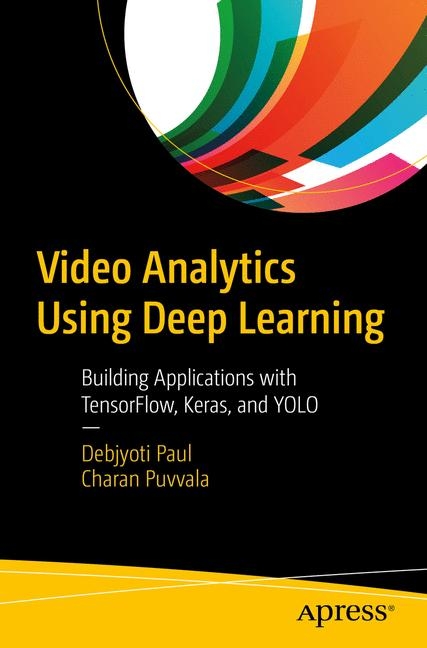
Video Analytics Using Deep Learning
Apress (Verlag)
978-1-4842-3792-2 (ISBN)
- Titel wird leider nicht erscheinen
- Artikel merken
The examples within the book cover topics from domains such as traffic recognition for self-driving cars; face recognition and emotion analysis for retail analytics; object and tamper detection for safety and security; and image filters and video masking for social networks and web applications. To enable you to make a smooth transition into deep learning, the book covers mathematical pre-requisites and includes an introduction to deep learning. You'll also cover topics such as storage of large video content for processing on the cloud and working with the connectors involved. All the code and samples in the book are provided as iPython.
What You Will Learn
Master TensorFlow, Keras, and YOLO
Work with face recognition, age detection, and gender identification
Apply CNN, RNN and generative models in deep learning
Use emotion analysis and gesture detection
Carry out traffic recognition in real-time
Who This Book Is For
Data scientists and machine learning developers looking to build applications based on video in finance, healthcare, automotive, transport, safety/security, and home automation.
Charan Puvvala is a team builder and is technology agnostic. He is a speaker and lead for Hyderabad Machine Learning Group. Currently, he's working on problems related to machine learning and deep learning, natural language understanding, conversational bots, video analytics, big data, data pipelines, and analytics. He has trained over 400 data engineers, data scientists, and software developers in corporate skill upgrade programs. His core competencies are deep learning/artificial neural networks, supervised learning, unsupervised learning, enterprise search architecture, large scale crawling, and natural language processing.
1. Deep learning :
Goal: Learn basic manipulation like assigning variables, matrix multiplication, transpose
of matrix, resizing vectors and matrices etc.
Pages: 20
1. Introduction to tensorflow/keras
1.a. Defining Tensors
1.b. Basic operation using tensorflow
1.c. Session logging and Variables
1.d. Tensor Board
1.e. Basic operation using keras
2. Introduction to neural network
Goal : Solve the problem beyond conventional algorithmic approach. In this chapter we will learn about the procedure that is used to compute gradients of a loss function (Backpropagation). We will learn new classification technique called neural network. We will also learn various loss function and optimization methods that helps to measure the quality of parameters and will help to find how much output is agreed with ground truth.
Pages : 50
2.a. Loss function
2.b. Optimization (SGD, RMSPROP, ADAM, Quantum Gradient Descent)
2.c. Backpropagation
2.d. MultiLayer Perceptron
3.e. Lets Build: A classifier on Fashion MNIST to classify the clothes
3. Introduction to convolution neural network
Goal: We will learn new pattern recognition techniques mainly for images that can be used for classification and segmentation.
Pages: 25
FC Vs CNN
3.a. Convolution Layer
3.b. Activation Layer
3.c. Pooling Layer
3.d. Dropout
3.e. Let's classify/recognise object using CNN
etc..
4. CNN architecture
Goal : To learn various deep learning framework with different depth of layers and size of
filter and its use case to increase the efficiency depending on requirements.
Pages: 75
4.a. AlexNet
4.b. Google LeNet
4.c. VGG16 (OxfordNet) architecture
4.d. Let's build model like Face recognition, Emotion analysis using above mentioned
architecture
etc..
5. Image captioning and Generative models
Goal : To learn the action from figure. In this chapter we will learn how to get textual
description of an image.In this chapter we will also learn Unsupervised learning and in particular Generative models. Given sample X and Y as input and output we will learn way to sample these X, Y pairs means from input data we can generate different types of probabilistic data. We will learn to generate new image, given input image
Pages: 90
5.a. RNN
5.b. LSTM
5.c. Let's find what picture tells us (Gesture Recognition or Traffic vision).
5.d. Density estimation and its types (how data is distributed, identifying hidden structure of data)
5.e. Generative adversarial network
5.f. Pixel RNN/CNN
5.g. Variational Autoencoders
5.h. With given input let's generate random faces using generative model
| Erscheint lt. Verlag | 13.1.2020 |
|---|---|
| Zusatzinfo | XV, 265 p. |
| Verlagsort | Berkley |
| Sprache | englisch |
| Maße | 178 x 254 mm |
| Themenwelt | Mathematik / Informatik ► Informatik ► Datenbanken |
| Mathematik / Informatik ► Informatik ► Programmiersprachen / -werkzeuge | |
| Mathematik / Informatik ► Informatik ► Software Entwicklung | |
| Informatik ► Theorie / Studium ► Künstliche Intelligenz / Robotik | |
| Schlagworte | Alexnet • convolutional neural network • Deep learning • generative models • GoogLenet • image captioning • Keras • Recurrent Neural Networks • tensorflow • Video Analytics |
| ISBN-10 | 1-4842-3792-7 / 1484237927 |
| ISBN-13 | 978-1-4842-3792-2 / 9781484237922 |
| Zustand | Neuware |
| Informationen gemäß Produktsicherheitsverordnung (GPSR) | |
| Haben Sie eine Frage zum Produkt? |
aus dem Bereich