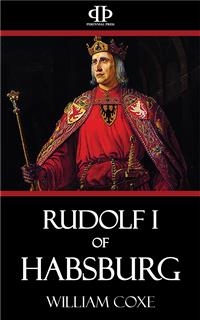
Rudolf I of Habsburg (eBook)
LXXVIII Seiten
Perennial Press (Verlag)
978-1-5183-6407-5 (ISBN)

In the confused accounts of the times, and amidst the perpetual changes of property and dignities, it is difficult to trace with accuracy the titles and possessions of the immediate descendants of Guntram. His son Kanzeline seems to have been designated as count of Altenburgh, and to have resided in the midst of his domains, not far from Windisch, the site of the Roman colony Vindonissa. Radebot, a son of Kanzeline, was called count of Cleggow, and married Ida, daughter of Gerard, third count of Alsace, and duke of Loraine. Another son, Werner, became bishop of Strasburg, and on an eminence above Windisch, built the castle of Habsburg, which became the residence of the future counts, and gave a new title to the descendants of Guntram. Otho, the eldest son of Radebot, dying in 1046 without issue, Werner, the second son, is first distinguished in ancient records as count of Habsburg.
The successors of Werner increased their family inheritance by marriages, donations from the emperors, and by becoming prefects, advocates, or administrators of the neighboring abbeys, towns, or districts, and his great grandson Albert III was possessor of no inconsiderable territories in Swabia, Alsace, and that part of Switzerland which is now called the Argau, and held the landgraviate of Upper Alsace.
His son, Rudolf, received from the emperor, in addition to his paternal inheritance, the town and district of Lauffenburgh, an imperial city on the Rhine. He acquired also a considerable accession of territory by obtaining the advocacy of Uri, Schweitz, and Underwalden, whose natives laid the foundation of the Helvetic Confederacy, by their union against the oppressions of feudal tyranny. A dispute arising between the natives ofSchweitz and the abbot of Einsidlin, concerning the property of some Alpine forests and pastures, these sturdy mountaineers renewed their confederacy with Uri and Underwalden, resisted the mandates of the Emperor Henry V, who put them under the ban of the empire, and despised the excommunications of the Bishop of Constance. They chose for their prefect Count Ulric of Lentzburgh, who succeeded in reconciling them with the Emperor Frederic I, the founder of a new dynasty in the House of Swabia; and the Swiss warriors, flocking to the Imperial standard, performed essential services in the wars which he and his successors maintained against the popes and the adherents of the Roman See...
| Erscheint lt. Verlag | 2.4.2018 |
|---|---|
| Sprache | englisch |
| Themenwelt | Geisteswissenschaften ► Geschichte |
| Mathematik / Informatik ► Informatik ► Web / Internet | |
| ISBN-10 | 1-5183-6407-1 / 1518364071 |
| ISBN-13 | 978-1-5183-6407-5 / 9781518364075 |
| Informationen gemäß Produktsicherheitsverordnung (GPSR) | |
| Haben Sie eine Frage zum Produkt? |
 EPUB (Ohne DRM)
Digital Rights Management: ohne DRM
Dieses eBook enthält kein DRM oder Kopierschutz. Eine Weitergabe an Dritte ist jedoch rechtlich nicht zulässig, weil Sie beim Kauf nur die Rechte an der persönlichen Nutzung erwerben.
Dateiformat: EPUB (Electronic Publication)
EPUB ist ein offener Standard für eBooks und eignet sich besonders zur Darstellung von Belletristik und Sachbüchern. Der Fließtext wird dynamisch an die Display- und Schriftgröße angepasst. Auch für mobile Lesegeräte ist EPUB daher gut geeignet.
Systemvoraussetzungen:
PC/Mac: Mit einem PC oder Mac können Sie dieses eBook lesen. Sie benötigen dafür die kostenlose Software Adobe Digital Editions.
eReader: Dieses eBook kann mit (fast) allen eBook-Readern gelesen werden. Mit dem amazon-Kindle ist es aber nicht kompatibel.
Smartphone/Tablet: Egal ob Apple oder Android, dieses eBook können Sie lesen. Sie benötigen dafür eine kostenlose App.
Geräteliste und zusätzliche Hinweise
Buying eBooks from abroad
For tax law reasons we can sell eBooks just within Germany and Switzerland. Regrettably we cannot fulfill eBook-orders from other countries.
aus dem Bereich