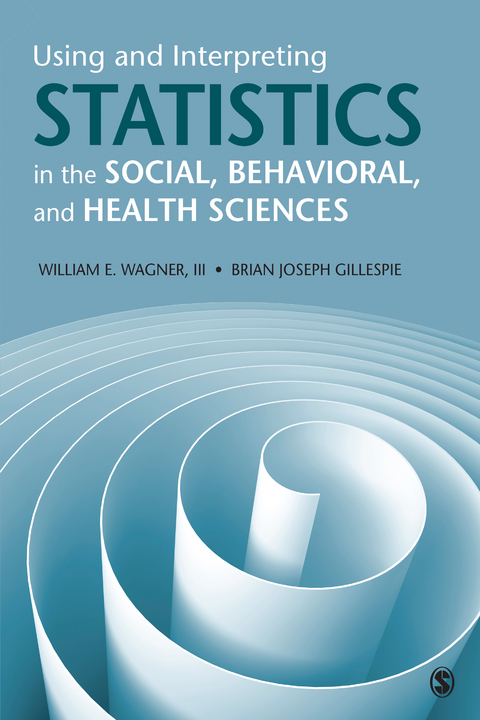
Using and Interpreting Statistics in the Social, Behavioral, and Health Sciences (eBook)
232 Seiten
Sage Publications, Inc (Verlag)
978-1-5443-2111-0 (ISBN)

Acknowledgments
Chapter 1: Brief Introduction to Research in the Social, Behavioral, and Health Sciences
What Is the Purpose of Research?
How Is Research Done?
Scientific Method and Hypothesis Testing
Inductive Research
Deductive Research
Research Designs
Chapter 2: Variables and Measurement
Variables and Data
Levels of Variable Measurement
Types of Relationships
Research Design and Measurement Quality
Chapter 3: How to Sample and Collect Data for Analysis
Why Use a Sample?
Probability Sampling Methods
Nonprobability Sampling Methods
Validating a Sample
Split Ballot Designs
How and Where Are Data Collected Today?
Chapter 4: Data Frequencies and Distributions
Univariate Frequencies and Relative Frequencies
Cumulative Percentages and Percentiles
Frequencies for Quantitative Data
Univariate Distributions
The Normal Distribution
Non-Normal Distribution Characteristics
Data Transformations for Dealing With Non-Normal Distributions
Bivariate Frequencies
Chapter 5: Using and Interpreting Univariate and Bivariate Visualizations
Univariate Data Visualization
Bivariate Data Visualization
Chapter 6: Central Tendency and Variability
Understanding How to Calculate and Interpret Measures of Central Tendency
Understanding How Individuals in a Distribution Vary Around a Central Tendency
Chapter 7: What Are z Scores, and Why Are They Important?
What Is a z Score?
How to Calculate a z Score
The Standard Normal Table
Working With the Standard Normal Distribution to Calculate z Scores, Raw Scores, and Percentiles
Confidence Intervals
Chapter 8: Hypothesis Testing and Statistical Significance
Null and Alternative Hypotheses
Statistical Significance
Test Statistic Distributions
Choosing a Test of Statistical Significance
The Chi-Square Test of Independence
The Independent Samples t Test
One-Way Analysis of Variance
Chapter 9: How to Measure the Relationship Between Nominal and Ordinal Variables
Choosing the Correct Measure of Association
Trying to Reduce Error (PRE Statistics)
Calculating and Interpreting Lambda
Calculating and Interpreting Gamma
Calculating and Interpreting Somers’ d
Calculating and Interpreting Kendall’s Tau-b
Interpreting PRE Statistics Overview
Chapter 10: Effect Size
Effect Size
Choosing an Effect Size
Chapter 11: How to Interpret and Report Regression Results
What Is a Regression?
Correlation
Bivariate Regression
Coefficient of Determination (r2)
Multiple Regression
Logistic Regression
Chapter 12: Indices, Typologies, and Scales
Indices, Typologies, and Scales Defined and Explained
Appendix A. The Standard Normal Table
Appendix B. Critical Values for t Statistic
Appendix C. Critical Values for Chi-Square
Appendix D. Critical Values for F Statistic
Appendix E. Glossary
About the Authors
| Erscheint lt. Verlag | 3.4.2018 |
|---|---|
| Verlagsort | Thousand Oaks |
| Sprache | englisch |
| Themenwelt | Mathematik / Informatik ► Mathematik ► Statistik |
| Recht / Steuern ► Strafrecht ► Kriminologie | |
| Sozialwissenschaften ► Pädagogik | |
| Sozialwissenschaften ► Politik / Verwaltung ► Europäische / Internationale Politik | |
| Sozialwissenschaften ► Soziologie ► Empirische Sozialforschung | |
| Schlagworte | descriptive statistics • Measures of association • Regression Analysis • Research methods • tests of significance • Using and Interpreting Statistics in the Social, Behavioral, and Health Sciences |
| ISBN-10 | 1-5443-2111-2 / 1544321112 |
| ISBN-13 | 978-1-5443-2111-0 / 9781544321110 |
| Informationen gemäß Produktsicherheitsverordnung (GPSR) | |
| Haben Sie eine Frage zum Produkt? |
 PDF (Adobe DRM)
Kopierschutz: Adobe-DRM
Adobe-DRM ist ein Kopierschutz, der das eBook vor Mißbrauch schützen soll. Dabei wird das eBook bereits beim Download auf Ihre persönliche Adobe-ID autorisiert. Lesen können Sie das eBook dann nur auf den Geräten, welche ebenfalls auf Ihre Adobe-ID registriert sind.
Details zum Adobe-DRM
Dateiformat: PDF (Portable Document Format)
Mit einem festen Seitenlayout eignet sich die PDF besonders für Fachbücher mit Spalten, Tabellen und Abbildungen. Eine PDF kann auf fast allen Geräten angezeigt werden, ist aber für kleine Displays (Smartphone, eReader) nur eingeschränkt geeignet.
Systemvoraussetzungen:
PC/Mac: Mit einem PC oder Mac können Sie dieses eBook lesen. Sie benötigen eine
eReader: Dieses eBook kann mit (fast) allen eBook-Readern gelesen werden. Mit dem amazon-Kindle ist es aber nicht kompatibel.
Smartphone/Tablet: Egal ob Apple oder Android, dieses eBook können Sie lesen. Sie benötigen eine
Geräteliste und zusätzliche Hinweise
Buying eBooks from abroad
For tax law reasons we can sell eBooks just within Germany and Switzerland. Regrettably we cannot fulfill eBook-orders from other countries.
aus dem Bereich