Zum Hauptinhalt springen
Nicht aus der Schweiz? Besuchen Sie lehmanns.de

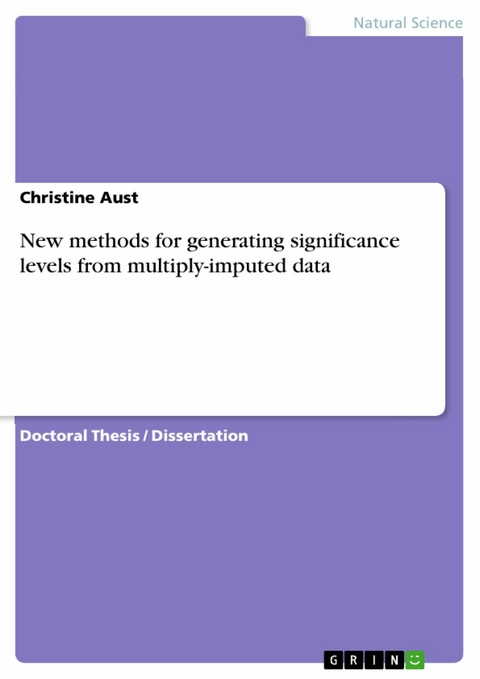
New methods for generating significance levels from multiply-imputed data (eBook)

eBook Download: PDF
2018 | 1. Auflage
103 Seiten
GRIN Verlag
978-3-668-67419-6 (ISBN)
Lese- und Medienproben

New methods for generating significance levels from multiply-imputed data -  Christine Aust
Systemvoraussetzungen
36,99 inkl. MwSt
(CHF 36,10)
Der eBook-Verkauf erfolgt durch die Lehmanns Media GmbH (Berlin) zum Preis in Euro inkl. MwSt.
  • Download sofort lieferbar
  • Zahlungsarten anzeigen
Doctoral Thesis / Dissertation from the year 2010 in the subject Mathematics - Statistics, grade: summa cum laude, University of Bamberg (Sozial- und Wirtschaftswissenschaften), language: English, abstract: Missing data are an ubiquitous problem in statistical analyses that has become an important research field in applied statistics. A highly useful technique to handle missing values in many settings is multiple imputation, that was first proposed by Rubin (1977, 1978) and extended in Rubin (1987). Due to the ongoing improvement in computer power in the last 10 years, multiple imputation has become a well known and often used tool in statistical analyses. However, there still exists a problem in generally obtaining significance levels from multiply-imputed data, because the application of multiple imputation requires normally distributed or t-distributed complete-data estimators. Today there are basically three methods that extend the suggestions given in Rubin (1987). First, Li, Raghunathan, and Rubin (1991) proposed a procedure, where significance levels are created by computing a modified Wald-test statistic that is then referred to an F-distribution. This procedure is essentially calibrated and the loss of power due to a finite number of imputations is quite modest in cases likely to occur in practice. But this procedure requires access to the completed-data estimates and their variance-covariance matrices, that may not be available in practice with standard software. Second, Meng and Rubin (1992) proposed a complete-data two-stage-likelihood-ratio-test-based procedure that in large samples is equivalent to the previous one. This procedure requires access to the code for the calculation of the log-likelihood-ratio statistics. Common statistical software does not provide access to the code in their standard analyses routines. Third, Li, Meng, Raghunathan, and Rubin (1991) developed an improved version of a method in Rubin (1987) that only requires the chi-square-statistics from a usual complete-data Wald-test. This method is only approximately calibrated and has a substantial loss of power compared to the previous two. To sum, there exist several procedures to generate significance levels in general from multiply-imputed data, but none of them has satisfactory applicability due to the facts mentioned above. Since many statistical analyses are based on hypothesis tests, especially on the Wald-test in regression analyses, it is very important to find a method that retains the advantages and overcomes the disadvantages of the existing procedures. Developing such a method was the aim of the present thesis.
Erscheint lt. Verlag 3.4.2018
Verlagsort München
Sprache englisch
Themenwelt Mathematik / Informatik Mathematik Statistik
Mathematik / Informatik Mathematik Wahrscheinlichkeit / Kombinatorik
Schlagworte missing data • multiple imputation • multiply-imputed data • p-value • significance levels • Statistical Methods • Statistics
ISBN-10 3-668-67419-1 / 3668674191
ISBN-13 978-3-668-67419-6 / 9783668674196
Informationen gemäß Produktsicherheitsverordnung (GPSR)
Haben Sie eine Frage zum Produkt?
PDFPDF (Ohne DRM)

Digital Rights Management: ohne DRM
Dieses eBook enthält kein DRM oder Kopier­schutz. Eine Weiter­gabe an Dritte ist jedoch rechtlich nicht zulässig, weil Sie beim Kauf nur die Rechte an der persön­lichen Nutzung erwerben.

Dateiformat: PDF (Portable Document Format)
Mit einem festen Seiten­layout eignet sich die PDF besonders für Fach­bücher mit Spalten, Tabellen und Abbild­ungen. Eine PDF kann auf fast allen Geräten ange­zeigt werden, ist aber für kleine Displays (Smart­phone, eReader) nur einge­schränkt geeignet.

Systemvoraussetzungen:
PC/Mac: Mit einem PC oder Mac können Sie dieses eBook lesen. Sie benötigen dafür einen PDF-Viewer - z.B. den Adobe Reader oder Adobe Digital Editions.
eReader: Dieses eBook kann mit (fast) allen eBook-Readern gelesen werden. Mit dem amazon-Kindle ist es aber nicht kompatibel.
Smartphone/Tablet: Egal ob Apple oder Android, dieses eBook können Sie lesen. Sie benötigen dafür einen PDF-Viewer - z.B. die kostenlose Adobe Digital Editions-App.

Buying eBooks from abroad
For tax law reasons we can sell eBooks just within Germany and Switzerland. Regrettably we cannot fulfill eBook-orders from other countries.

Mehr entdecken
aus dem Bereich