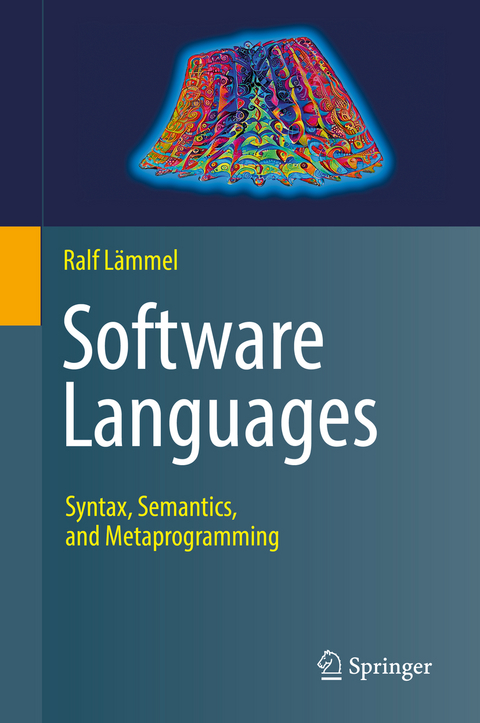
Software Languages
Springer International Publishing (Verlag)
978-3-319-90798-7 (ISBN)
By doing this, the book collects and organizes scattered knowledge from software language engineering, focusing on application areas such as software analysis (software reverse engineering), software transformation (software re-engineering), software composition (modularity), and domain-specific languages. It is designed as a textbook for independent study as well as for bachelor's (advanced level) or master's university courses in Computer Science. An additional website provides complementary material, for example, lecture slides and videos.
This book is a valuable resource for anyone wanting to understand the fundamental concepts and important engineering principles underlying software languages, allowing them to acquire much of the operational intelligence needed for dealing with software languages in software development practice. This is an important skill set for software engineers, as languages are increasingly permeating software development.
Ralf Lämmel is Software Engineer at Facebook since 2018 and Professor of Computer Science (currently on leave of absence) at the University of Koblenz-Landau in Germany since 2007. In the past, he had held positions at the University of l'Aquila, Microsoft, the Free University of Amsterdam, CWI (Dutch Center for Mathematics and Computer Science), and the University of Rostock, Germany. His research and teaching interests include software language engineering, software reverse engineering, software re-engineering, mining software repositories, functional programming, grammar-based and model-based techniques, and, more recently, megamodeling. He is one of the founding fathers of the international summer school series on Generative and Transformational Techniques on Software Engineering (GTTSE) and the international conference on Software Language Engineering (SLE).
1 The Notion of a Software Language.- 2 A Story of a Domain-Specific Language.- 3 Foundations of Tree- and Graph-Based Abstract Syntax.- 4 Representation of Object Programs in Metaprograms.- 5 A Suite of Metaprogramming Scenarios.- 6 Foundations of Textual Concrete Syntax.- 7 Implementation of Textual Concrete Syntax.- 8 A Primer on Operational Semantics.- 9 A Primer on Type Systems.- 10 An Excursion into the Lambda Calculus.- 11 An Ode to Compositionality.- 12 A Suite of Metaprogramming Techniques.
Selected by Choice magazine as an Outstanding Academic Title for 2019
"The book's 12 chapters cover a wealth of information by adopting a formal point of view that supplies the rigor needed for such an extensive treatment while offering plenty of self-learning opportunities through exercises and additional references. ... This book is also useful as the first step in a more in-depth exploration of specific topics, such as metaprogramming, as it provides the references needed for a comprehensive literature review. ... Summing Up: Highly recommended. Advanced undergraduates through faculty and professionals." (L. Benedicenti, Choice, Vol. 56 (9), May, 2019)
| Erscheinungsdatum | 08.06.2018 |
|---|---|
| Zusatzinfo | XXX, 424 p. 49 illus., 32 illus. in color. |
| Verlagsort | Cham |
| Sprache | englisch |
| Maße | 155 x 235 mm |
| Gewicht | 842 g |
| Themenwelt | Mathematik / Informatik ► Informatik ► Software Entwicklung |
| Schlagworte | context specific languages • domain-specific languages • Formal Language Definitions • model-based software engineering • Software Composition • software creation and management • system description languages |
| ISBN-10 | 3-319-90798-0 / 3319907980 |
| ISBN-13 | 978-3-319-90798-7 / 9783319907987 |
| Zustand | Neuware |
| Informationen gemäß Produktsicherheitsverordnung (GPSR) | |
| Haben Sie eine Frage zum Produkt? |
aus dem Bereich