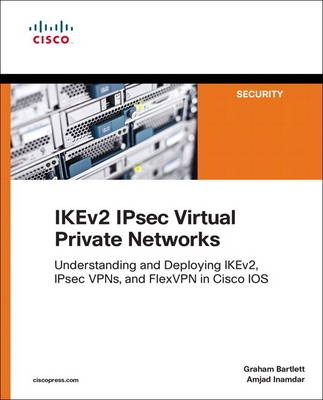
Create and manage highly-secure Ipsec VPNs with IKEv2 and Cisco FlexVPN The IKEv2 protocol significantly improves VPN security, and Cisco's FlexVPN offers a unified paradigm and command line interface for taking full advantage of it. Simple and modular, FlexVPN relies extensively on tunnel interfaces while maximizing compatibility with legacy VPNs. Now, two Cisco network security experts offer a complete, easy-tounderstand, and practical introduction to IKEv2, modern IPsec VPNs, and FlexVPN. The authors explain each key concept, and then guide you through all facets of FlexVPN planning, deployment, migration, configuration, administration, troubleshooting, and optimization. You'll discover how IKEv2 improves on IKEv1, master key IKEv2 features, and learn how to apply them with Cisco FlexVPN. IKEv2 IPsec Virtual Private Networks offers practical design examples for many common scenarios, addressing IPv4 and IPv6, servers, clients, NAT, pre-shared keys, resiliency, overhead, and more. If you're a network engineer, architect, security specialist, or VPN administrator, you'll find all the knowledge you need to protect your organization with IKEv2 and FlexVPN. Understand IKEv2 improvements: anti-DDoS cookies, configuration payloads, acknowledged responses, and more Implement modern secure VPNs with Cisco IOS and IOS-XE Plan and deploy IKEv2 in diverse real-world environments Configure IKEv2 proposals, policies, profiles, keyrings, and authorization Use advanced IKEv2 features, including SGT transportation and IKEv2 fragmentation Understand FlexVPN, its tunnel interface types, and IOS AAA infrastructure Implement FlexVPN Server with EAP authentication, pre-shared keys, and digital signatures Deploy, configure, and customize FlexVPN clients Configure, manage, and troubleshoot the FlexVPN Load Balancer Improve FlexVPN resiliency with dynamic tunnel source, backup peers, and backup tunnels Monitor IPsec VPNs with AAA, SNMP, and Syslog Troubleshoot connectivity, tunnel creation, authentication, authorization, data encapsulation, data encryption, and overlay routing Calculate IPsec overhead and fragmentation Plan your IKEv2 migration: hardware, VPN technologies, routing, restrictions, capacity, PKI, authentication, availability, and more
 EPUB (Adobe DRM)
Kopierschutz: Adobe-DRM
Adobe-DRM ist ein Kopierschutz, der das eBook vor Mißbrauch schützen soll. Dabei wird das eBook bereits beim Download auf Ihre persönliche Adobe-ID autorisiert. Lesen können Sie das eBook dann nur auf den Geräten, welche ebenfalls auf Ihre Adobe-ID registriert sind.
Details zum Adobe-DRM
Dateiformat: EPUB (Electronic Publication)
EPUB ist ein offener Standard für eBooks und eignet sich besonders zur Darstellung von Belletristik und Sachbüchern. Der Fließtext wird dynamisch an die Display- und Schriftgröße angepasst. Auch für mobile Lesegeräte ist EPUB daher gut geeignet.
Systemvoraussetzungen:
PC/Mac: Mit einem PC oder Mac können Sie dieses eBook lesen. Sie benötigen eine Adobe-ID und die Software Adobe Digital Editions (kostenlos). Von der Benutzung der OverDrive Media Console raten wir Ihnen ab. Erfahrungsgemäß treten hier gehäuft Probleme mit dem Adobe DRM auf.
eReader: Dieses eBook kann mit (fast) allen eBook-Readern gelesen werden. Mit dem amazon-Kindle ist es aber nicht kompatibel.
Smartphone/Tablet: Egal ob Apple oder Android, dieses eBook können Sie lesen. Sie benötigen eine Adobe-ID sowie eine kostenlose App.
Geräteliste und zusätzliche Hinweise
Buying eBooks from abroad
For tax law reasons we can sell eBooks just within Germany and Switzerland. Regrettably we cannot fulfill eBook-orders from other countries.