


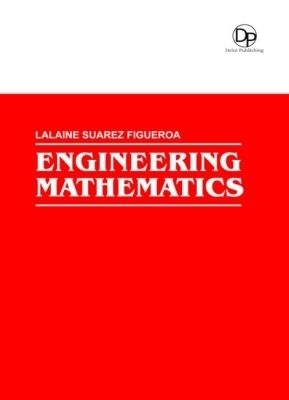
Engineering Mathematics
Seiten
2016
Delve Publishing (Verlag)
978-1-68095-687-0 (ISBN)
Delve Publishing (Verlag)
978-1-68095-687-0 (ISBN)
- Titel nicht im Sortiment
- Artikel merken
Provides an introduction to engineering mathematics. Engineering mathematics is the art of applying mathematics to complex real-world problems. It combines mathematical theory, practical engineering and scientific computing to address today's technological challenges. It is a creative and exciting discipline, spanning traditional boundaries.
Engineering Mathematics is the art of applying mathematics to complex real-world problems. It combines mathematical theory, practical engineering and scientific computing to address today’s technological challenges. It is a creative and exciting discipline, spanning traditional boundaries. Engineering mathematicians can be found in an extraordinarily wide range of careers, from designing next generation Formula One cars to working at the cutting edge of robotics, from running their own business creating new autonomous vehicles to developing innovative indices for leading global financial institutions. Mathematics or particularly applied mathematics is widely used in every engineering fields. In the various engineering fields, different forms of math may be applied to achieve a specific solution. For instance, linear algebra is widely applied in electrical engineering to design electrical circuits. Boolean algebra is the basis of digital logic design, a key component of building computers. In civil and mechanical engineering, geometry is used to design structures and ensure that they perform in a safe and meaningful way. When designing a bridge, civil engineers may use differential equations to calculate the approximate size of the supporting piers needed. They may also use complex mathematical modeling to predict the lifespan of the structure to be constructed. Industrial engineers use calculus to find the rate at which certain variables will change in a given operation. Industrial engineering routinely entails making approximations and safe estimations to ensure that all processes are properly controlled. One or more forms of mathematics are used in these approximations and estimations.
Engineering Mathematics is the art of applying mathematics to complex real-world problems. It combines mathematical theory, practical engineering and scientific computing to address today’s technological challenges. It is a creative and exciting discipline, spanning traditional boundaries. Engineering mathematicians can be found in an extraordinarily wide range of careers, from designing next generation Formula One cars to working at the cutting edge of robotics, from running their own business creating new autonomous vehicles to developing innovative indices for leading global financial institutions. Mathematics or particularly applied mathematics is widely used in every engineering fields. In the various engineering fields, different forms of math may be applied to achieve a specific solution. For instance, linear algebra is widely applied in electrical engineering to design electrical circuits. Boolean algebra is the basis of digital logic design, a key component of building computers. In civil and mechanical engineering, geometry is used to design structures and ensure that they perform in a safe and meaningful way. When designing a bridge, civil engineers may use differential equations to calculate the approximate size of the supporting piers needed. They may also use complex mathematical modeling to predict the lifespan of the structure to be constructed. Industrial engineers use calculus to find the rate at which certain variables will change in a given operation. Industrial engineering routinely entails making approximations and safe estimations to ensure that all processes are properly controlled. One or more forms of mathematics are used in these approximations and estimations.
Lalaine Suarez Figueroa gained her Bachelor's Degree in Instrumentation and Control Engineering from Rizal Technological University in 2007. She had gained her Certification from Philippine Instrumentation and Control Society in 2008. She is currently working as a Designer in a multinational engineering and construction firm which had an office based in the Philippines.
| Erscheinungsdatum | 16.03.2018 |
|---|---|
| Sprache | englisch |
| Maße | 152 x 229 mm |
| Gewicht | 760 g |
| Themenwelt | Mathematik / Informatik ► Mathematik ► Angewandte Mathematik |
| ISBN-10 | 1-68095-687-6 / 1680956876 |
| ISBN-13 | 978-1-68095-687-0 / 9781680956870 |
| Zustand | Neuware |
| Informationen gemäß Produktsicherheitsverordnung (GPSR) | |
| Haben Sie eine Frage zum Produkt? |
Mehr entdecken
aus dem Bereich
aus dem Bereich
Buch | Softcover (2025)
Springer Vieweg (Verlag)
CHF 62,95
Buch | Softcover (2025)
Springer Fachmedien Wiesbaden (Verlag)
CHF 69,95
Buch | Softcover (2024)
Springer Vieweg (Verlag)
CHF 53,15


