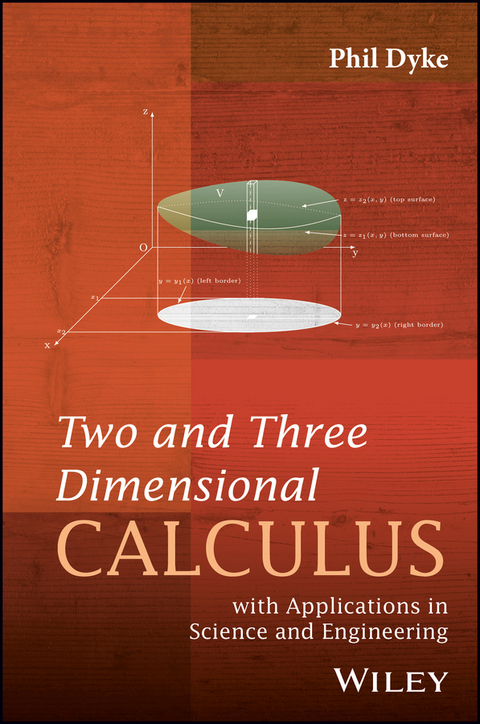
Two and Three Dimensional Calculus (eBook)
400 Seiten
Wiley (Verlag)
978-1-119-22179-1 (ISBN)
Covers multivariable calculus, starting from the basics and leading up to the three theorems of Green, Gauss, and Stokes, but always with an eye on practical applications.
Written for a wide spectrum of undergraduate students by an experienced author, this book provides a very practical approach to advanced calculus-starting from the basics and leading up to the theorems of Green, Gauss, and Stokes. It explains, clearly and concisely, partial differentiation, multiple integration, vectors and vector calculus, and provides end-of-chapter exercises along with their solutions to aid the readers' understanding.
Written in an approachable style and filled with numerous illustrative examples throughout, Two and Three Dimensional Calculus: with Applications in Science and Engineering assumes no prior knowledge of partial differentiation or vectors and explains difficult concepts with easy to follow examples. Rather than concentrating on mathematical structures, the book describes the development of techniques through their use in science and engineering so that students acquire skills that enable them to be used in a wide variety of practical situations. It also has enough rigor to enable those who wish to investigate the more mathematical generalizations found in most mathematics degrees to do so.
- Assumes no prior knowledge of partial differentiation, multiple integration or vectors
- Includes easy-to-follow examples throughout to help explain difficult concepts
- Features end-of-chapter exercises with solutions to exercises in the book.
Two and Three Dimensional Calculus: with Applications in Science and Engineering is an ideal textbook for undergraduate students of engineering and applied sciences as well as those needing to use these methods for real problems in industry and commerce.
Phil Dyke teaches mathematics to undergraduates, and marine physics to postgraduates at the School of Computing, Electronics and Mathematics, University of Plymouth, UK. He is also the author of ten other textbooks.
Phil Dyke teaches mathematics to undergraduates, and marine physics to postgraduates at the School of Computing, Electronics and Mathematics, University of Plymouth, UK. He is also the author of ten other textbooks.
Cover 1
Title Page 5
Copyright 6
Contents 9
Preface 13
Chapter 1 Revision of One?Dimensional Calculus 15
1.1 Limits and Convergence 15
1.2 Differentiation 17
1.2.1 Rules for Differentiation 19
1.2.2 Mean Value Theorem 21
1.2.3 Taylor's Series 22
1.2.4 Maxima and Minima 26
1.2.5 Numerical Differentiation 27
1.3 Integration 30
Chapter 2 Partial Differentiation 39
2.1 Introduction 39
2.2 Differentials 43
2.2.1 Small Errors 44
2.3 Total Derivative 47
2.4 Chain Rule 50
2.4.1 Leibniz Rule 53
2.4.2 Chain Rule in n Dimensions 55
2.4.3 Implicit Functions 56
2.5 Jacobian 57
2.6 Higher Derivatives 60
2.6.1 Higher Differentials 63
2.7 Taylor's Theorem 64
2.8 Conjugate Functions 66
2.9 Case Study: Thermodynamics 68
Chapter 3 Maxima and Minima 75
3.1 Introduction 75
3.2 Maxima, Minima and Saddle Points 77
3.3 Lagrange Multipliers 88
3.3.1 Generalisations 91
3.4 Optimisation 95
3.4.1 Hill Climbing Techniques 95
Chapter 4 Vector Algebra 103
4.1 Introduction 103
4.2 Vector Addition 104
4.3 Components 106
4.4 Scalar Product 108
4.5 Vector Product 111
4.5.1 Scalar Triple Product 116
4.5.2 Vector Triple Product 119
Chapter 5 Vector Differentiation 123
5.1 Introduction 123
5.2 Differential Geometry 125
5.2.1 Space Curves 126
5.2.2 Surfaces 134
5.3 Mechanics 143
Chapter 6 Gradient, Divergence, and Curl 153
6.1 Introduction 153
6.2 Gradient 153
6.3 Divergence 157
6.4 Curl 159
6.5 Vector Identities 160
6.6 Conjugate Functions 165
Chapter 7 Curvilinear Co?ordinates 171
7.1 Introduction 171
7.2 Curved Axes and Scale Factors 171
7.3 Curvilinear Gradient, Divergence, and Curl 175
7.3.1 Gradient 175
7.3.2 Divergence 177
7.3.3 Curl 179
7.4 Further Results and Tensors 180
7.4.1 Tensor Notation 180
7.4.2 Covariance and Contravariance 182
Chapter 8 Path Integrals 187
8.1 Introduction 187
8.2 Integration Along a Curve 187
8.3 Practical Applications 195
Chapter 9 Multiple Integrals 205
9.1 Introduction 205
9.2 The Double Integral 205
9.2.1 Rotation and Translation 213
9.2.2 Change of Order of Integration 215
9.2.3 Plane Polar Co?ordinates 217
9.2.4 Applications of Double Integration 222
9.3 Triple Integration 227
9.3.1 Cylindrical and Spherical Polar Co?ordinates 233
9.3.2 Applications of Triple Integration 241
Chapter 10 Surface Integrals 255
10.1 Introduction 255
10.2 Green's Theorem in the Plane 256
10.3 Integration over a Curved Surface 260
10.4 Applications of Surface Integration 267
Chapter 11 Integral Theorems 273
11.1 Introduction 273
11.2 Stokes' Theorem 274
11.3 Gauss' Divergence Theorem 282
11.3.1 Green's Second Identity 289
11.4 Co?ordinate?Free Definitions 291
11.5 Applications of Integral Theorems 293
11.5.1 Electromagnetic Theory 293
11.5.1.1 Maxwell's Equations 293
11.5.2 Fluid Mechanics 297
11.5.3 Elasticity Theory 301
11.5.4 Heat Transfer 311
Exercises 312
Chapter 12 Solutions and Answers to Exercises 315
12.1 Chapter 1 315
12.2 Chapter 2 322
12.3 Chapter 3 326
12.4 Chapter 4 335
12.5 Chapter 5 341
12.6 Chapter 6 351
12.7 Chapter 7 354
12.8 Chapter 8 358
12.9 Chapter 9 362
12.10 Chapter 10 377
9.11 Chapter 11 383
References 389
Index 391
EULA 397
| Erscheint lt. Verlag | 2.3.2018 |
|---|---|
| Sprache | englisch |
| Themenwelt | Mathematik / Informatik ► Mathematik ► Analysis |
| Mathematik / Informatik ► Mathematik ► Angewandte Mathematik | |
| Schlagworte | Advanced Calculus • Analysis • Analysis f. mehrere Variable • Angewandte Mathematik • Applied mathematics • Applied Mathematics in Engineering • Applied Mathmatics in Engineering • Basic calculus • Calculus • calculus and computing • calculus applications • Calculus for engineering • calculus for physics • calculus textbook • calculus theorems • fundamental theorem of calculus • GAUSS • Green • guide to calculus • Mathematics • Mathematik • Mathematik in den Ingenieurwissenschaften • Mehrdimensionale Analysis • Multivariate Calculus • Stokes • teaching calculus • understanding calculus |
| ISBN-10 | 1-119-22179-X / 111922179X |
| ISBN-13 | 978-1-119-22179-1 / 9781119221791 |
| Informationen gemäß Produktsicherheitsverordnung (GPSR) | |
| Haben Sie eine Frage zum Produkt? |
 PDF (Adobe DRM)
Kopierschutz: Adobe-DRM
Adobe-DRM ist ein Kopierschutz, der das eBook vor Mißbrauch schützen soll. Dabei wird das eBook bereits beim Download auf Ihre persönliche Adobe-ID autorisiert. Lesen können Sie das eBook dann nur auf den Geräten, welche ebenfalls auf Ihre Adobe-ID registriert sind.
Details zum Adobe-DRM
Dateiformat: PDF (Portable Document Format)
Mit einem festen Seitenlayout eignet sich die PDF besonders für Fachbücher mit Spalten, Tabellen und Abbildungen. Eine PDF kann auf fast allen Geräten angezeigt werden, ist aber für kleine Displays (Smartphone, eReader) nur eingeschränkt geeignet.
Systemvoraussetzungen:
PC/Mac: Mit einem PC oder Mac können Sie dieses eBook lesen. Sie benötigen eine
eReader: Dieses eBook kann mit (fast) allen eBook-Readern gelesen werden. Mit dem amazon-Kindle ist es aber nicht kompatibel.
Smartphone/Tablet: Egal ob Apple oder Android, dieses eBook können Sie lesen. Sie benötigen eine
Geräteliste und zusätzliche Hinweise
Buying eBooks from abroad
For tax law reasons we can sell eBooks just within Germany and Switzerland. Regrettably we cannot fulfill eBook-orders from other countries.
aus dem Bereich