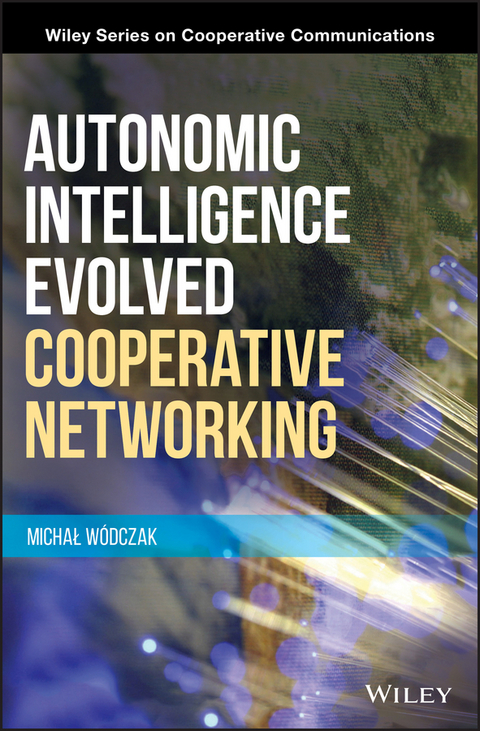
Autonomic Intelligence Evolved Cooperative Networking (eBook)
288 Seiten
John Wiley & Sons (Verlag)
978-1-119-21599-8 (ISBN)
DR. MICHAL WODCZAK holds a PhD in Telecommunications from Poznan University of Technology, obtained under the umbrella of European Union Sixth Framework Programme, as well as an Executive MBA from Aalto University School of Business, distinguished by the Triple Crown of AACSB, AMBA, and EQUIS accreditations. In this respect, advancing a double industrial and academic expertise of a complementary nature, he is known, among others, to have run standardisation activities as Vice Chairman and Rapporteur of ETSI ISG AFI, as well as serving as Editorial Board Member of IEEE CTN, respectively.
About the Author ix
Preface xi
Acknowledgements xiii
Acronyms xv
Notation xxiii
1 Introduction 1
2 Autonomically Driven Cooperative Design 7
2.1 Introduction 7
2.2 Biologically Inspired Autonomics 8
2.2.1 Rationale and Vision 8
2.2.2 Nomenclatural Perspectives 12
2.2.3 Towards Self-Management 17
2.3 Emergent Autonomic Networking 21
2.3.1 Generic Autonomic Network Architecture 21
2.3.2 Decision-Making Entities 25
2.3.3 Abstraction Levels and Control Loops 30
2.4 Synergetic Cooperative Approach 34
2.4.1 Vertical Technological Pillars 34
2.4.2 Horizontal Architectural Extensions 38
2.4.3 Incremental Conceptual Outline 42
2.5 Conclusion 47
References 48
3 Protocol Level Spatio-Temporal Processing 51
3.1 Introduction 51
3.2 Multiple-InputMultiple-Output Channel 52
3.2.1 Diversity-Rooted Origins 52
3.2.2 Radio Channel Virtualisation 56
3.2.3 Capacity,Modelling, and Gains 60
3.3 Space-Time Coding Techniques 64
3.3.1 Orthogonal Block-Coded Designs 64
3.3.2 Derivation of Decoding Metrics 68
3.3.3 Trellis-Coded Approach 71
3.4 Protocol Level Overlay Logic 76
3.4.1 Autonomic Cooperative Node 76
3.4.2 Cooperative Transmission Decision Element 80
3.4.3 Architectural Integration Aspects 83
3.5 Conclusion 88
References 89
4 Function Level Relaying Techniques 93
4.1 Introduction 93
4.2 Conventional and Cooperative Relaying 94
4.2.1 Classification of Relaying Protocols 94
4.2.2 Collaborative and Supportive Protocols 98
4.2.3 Virtual Antenna Arrays 103
4.3 Fixed Relay Deployment Concepts 106
4.3.1 Grid-Based Manhattan Scenario 106
4.3.2 Noncooperative Approach Limitations 110
4.3.3 Cooperation-Enabled Indoor Scenario 111
4.4 Function Level Overlay Logic 119
4.4.1 Roots of Autonomic Cooperative Behaviour 119
4.4.2 Cooperative Re-Routing Decision Element 123
4.4.3 Architectural Integration Aspects 127
4.5 Conclusion 131
References 132
5 Node Level Routing Mechanisms 137
5.1 Introduction 137
5.2 Optimised Link State Routing Protocol 138
5.2.1 Functional and Structural Characteristics 138
5.2.2 Multi-Point Relay Station Selection Heuristics 142
5.2.3 Information Storage Repositories 146
5.3 Routing Information Enhanced Cooperation 150
5.3.1 Justification and Algorithmic Outline 150
5.3.2 Evolved Messaging Structure 154
5.3.3 Address Auto-Configuration and Duplication 158
5.4 Node Level Overlay Logic 162
5.4.1 Autonomic Cooperative Networking Protocol 162
5.4.2 Cooperation Management Decision Element 166
5.4.3 Architectural Integration Aspects 170
5.5 Conclusion 175
References 176
6 Network Level SystemOrchestration 179
6.1 Introduction 179
6.2 Standardisation Driven Design 180
6.2.1 Research and Investment Perspective 180
6.2.2 Staged Instantiation of Reference Model 183
6.2.3 Cross-Specification Extensions 187
6.3 Cooperative Emergency Networking 192
6.3.1 Emergency System Requirements 192
6.3.2 Autonomic Control Incorporation 197
6.3.3 Cooperative Enhancement Justification 201
6.4 Network Level Overlay Logic 203
6.4.1 Autonomic Cooperative Networking Architectural Model 203
6.4.2 Cooperation Orchestration Decision Element 209
6.4.3 Architectural Integration Aspects 213
6.5 Conclusion 217
References 218
7 Conclusion 223
A Appendix 227
Index 253
| Erscheint lt. Verlag | 28.2.2018 |
|---|---|
| Reihe/Serie | Wiley Series on Cooperative Communications | Wiley Series on Cooperative Communications |
| Sprache | englisch |
| Themenwelt | Mathematik / Informatik ► Informatik ► Netzwerke |
| Technik ► Elektrotechnik / Energietechnik | |
| Technik ► Nachrichtentechnik | |
| Schlagworte | Communication Technology - Networks • Computer Science • Drahtlose Kommunikation • Electrical & Electronics Engineering • Elektrotechnik u. Elektronik • Informatik • Kommunikationsnetz • Kommunikationsnetze • Mobile & Wireless Communications • Networking • Netzwerk • Netzwerke |
| ISBN-10 | 1-119-21599-4 / 1119215994 |
| ISBN-13 | 978-1-119-21599-8 / 9781119215998 |
| Informationen gemäß Produktsicherheitsverordnung (GPSR) | |
| Haben Sie eine Frage zum Produkt? |
 EPUB (Adobe DRM)
Kopierschutz: Adobe-DRM
Adobe-DRM ist ein Kopierschutz, der das eBook vor Mißbrauch schützen soll. Dabei wird das eBook bereits beim Download auf Ihre persönliche Adobe-ID autorisiert. Lesen können Sie das eBook dann nur auf den Geräten, welche ebenfalls auf Ihre Adobe-ID registriert sind.
Details zum Adobe-DRM
Dateiformat: EPUB (Electronic Publication)
EPUB ist ein offener Standard für eBooks und eignet sich besonders zur Darstellung von Belletristik und Sachbüchern. Der Fließtext wird dynamisch an die Display- und Schriftgröße angepasst. Auch für mobile Lesegeräte ist EPUB daher gut geeignet.
Systemvoraussetzungen:
PC/Mac: Mit einem PC oder Mac können Sie dieses eBook lesen. Sie benötigen eine
eReader: Dieses eBook kann mit (fast) allen eBook-Readern gelesen werden. Mit dem amazon-Kindle ist es aber nicht kompatibel.
Smartphone/Tablet: Egal ob Apple oder Android, dieses eBook können Sie lesen. Sie benötigen eine
Geräteliste und zusätzliche Hinweise
Buying eBooks from abroad
For tax law reasons we can sell eBooks just within Germany and Switzerland. Regrettably we cannot fulfill eBook-orders from other countries.
aus dem Bereich