Applied Engineering Analysis (eBook)
John Wiley & Sons (Verlag)
978-1-119-07119-8 (ISBN)
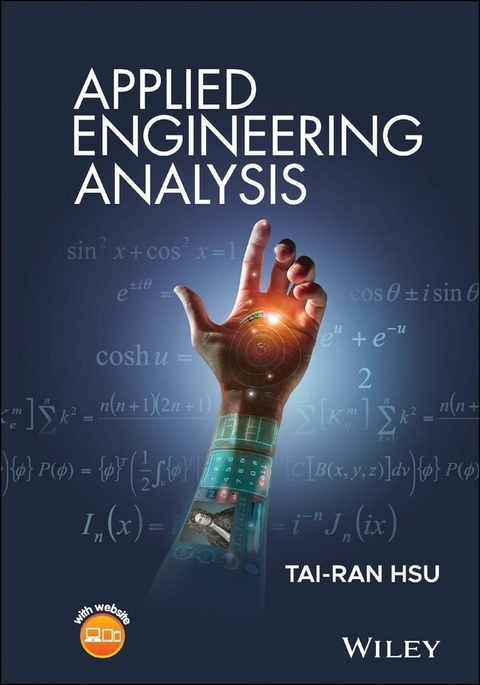
Applied Engineering Analysis
Tai-Ran Hsu, San Jose State University, USA
A resource book applying mathematics to solve engineering problems
Applied Engineering Analysis is a concise textbookwhich demonstrates how toapply mathematics to solve engineering problems. It begins with an overview of engineering analysis and an introduction to mathematical modeling, followed by vector calculus, matrices and linear algebra, and applications of first and second order differential equations. Fourier series and Laplace transform are also covered, along with partial differential equations, numerical solutions to nonlinear and differential equations and an introduction to finite element analysis. The book also covers statistics with applications to design and statistical process controls.
Drawing on the author's extensive industry and teaching experience, spanning 40 years, the book takes a pedagogical approach and includes examples, case studies and end of chapter problems. It is also accompanied by a website hosting a solutions manual and PowerPoint slides for instructors.
Key features:
|
Applied Engineering Analysis is a resource book for engineering students and professionals to learn how to apply the mathematics experience and skills that they have already acquired to their engineering profession for innovation, problem solving, and decision making.
TAI-RAN HSU, San Jose State University, USA
TAI-RAN HSU is currently a Professor of Mechanical Engineering at San Jose State University (SJSU), San Jose, California, USA. He joined the SJSU as the Chair of the department in 1990 and served two terms until 1998, and also from 2012 to 2015. He served in a similar capacity at the University of Manitoba, Winnipeg, Canada before joining SJSU. Prior to his academic career, he worked as a design engineer with heat exchangers, steam power plant equipment, large steam turbines, and nuclear reactor fuel systems for major industries in Canada and U.S.A. He has published six books and edited another two on a wide ranging topics on finite element method in thermomechanics, microelectronics packaging, CAD, and MEMS and microsystems design and packaging. Additionally, he published over one hundred technical papers in archive journals and conference proceedings.
TAI-RAN HSU, San Jose State University, USA TAI-RAN HSU is currently a Professor of Mechanical Engineering at San Jose State University (SJSU), San Jose, California, USA. He joined the SJSU as the Chair of the department in 1990 and served two terms until 1998, and also from 2012 to 2015. He served in a similar capacity at the University of Manitoba, Winnipeg, Canada before joining SJSU. Prior to his academic career, he worked as a design engineer with heat exchangers, steam power plant equipment, large steam turbines, and nuclear reactor fuel systems for major industries in Canada and U.S.A. He has published six books and edited another two on a wide ranging topics on finite element method in thermomechanics, microelectronics packaging, CAD, and MEMS and microsystems design and packaging. Additionally, he published over one hundred technical papers in archive journals and conference proceedings.
Preface
This book is designed to be a textbook for a one-semester course in engineering analysis for both junior and senior undergraduate classes or entry-level graduate programs. It is also designed for practicing engineers who are in need of analytical tools to solve technical problems in their line of duties. Unlike many textbooks adopted for class teaching of engineering analysis, this book introduces fewer additional mathematical topics beyond the courses on calculus and differential equations, but has heavy engineering content. Another unique feature of this book is its strong focus on using mathematics as a tool to solve engineering problems. Theories are presented in the book to show students their connection with practical issues in problem-solving. Overall, this book should be treated as an engineering, not advanced engineering mathematics textbook.
Mathematics and physics are two principal pillars of engineering education of all disciplines. Indeed, courses in mathematics and physics dominate the curricula of lower division engineering education in both the Freshman and Sophomore years in most engineering programs worldwide. Many engineering schools offer a course on engineering analysis that follows classes on precalculus, calculus, and differential equations. Engineering analysis is also offered at the entry level of graduate studies in many universities in the world.
The widespread acceptance of engineering analysis as a core curriculum by many educators is attributed to their conviction that students need to synergistically integrate all of the mathematical subjects that they learned earlier and apply them in solving engineering problems. However, the pedagogy of engineering analysis and its outcome has rarely been discussed in open forums. Many universities offer a course on engineering analysis as a terminal mathematics course with additional advanced mathematics subjects. Consequently, all textbook vendors with whom I have had contact in the last 30 years have consistently published books on advanced engineering mathematics, as textbooks for my course on engineering analysis. Upon close inspection, almost all have little direct relevance to the engineering profession. Additionally, all of these books are close to, or exceed, 1000 printed pages, with overwhelming coverage of detailed and elegant mathematical treatments to mostly mathematical problems. I have also observed that in all of the advanced engineering mathematics books such as those cited in the bibliography of this book, less than 10 percent of the pages have applications to engineering problems. Consequently, a textbook that is designed to teach students to solve engineering problems using mathematics as a tool is truly needed in classes on engineering analysis or those with similar objectives.
Many science and engineering educators are of the opinion that most engineering problems in the real world are of a physical nature. The disconnect in teaching mathematics and physics, as it occurs in lower division engineering education, has resulted in the inability of students to use mathematics as a tool to solve such engineering problems. Many students in my engineering analysis classes are skillful in manipulating mathematics in their assigned problems, including performing integrations and solving differential equations either using classical solution techniques learned previously, or using modern tools such as electronic calculators and computers. However, they are not capable of deriving appropriate equations for solving particular genuine engineering problems. Even more, students cannot apply integrations to determine simple design engineering properties such as areas, volumes, and centroids of solids of given geometry. The situation has worsened in recent years with rapid advances in information technology, which offer students ready access to turnkey software packages such as finite-element and finite-difference codes. This results in obtaining the solutions of engineering problems, in which insight, knowledge, and experience are sacrificed for numbers with seven-decimal point accuracy and fancy graphics. Unfortunately, most of these student users do not know what these numbers and graphs mean as solutions to the problems. These readily available commercial computer codes have actually further prevented engineering students from understanding fundamental engineering principles, worsening an already serious dissociation occurring early in mathematics and physics education.
An encouraging sign in recent years, however, has been the emergence of a consensus among visionary educators that students should relate their mathematics to the engineering subjects they will encounter in their upper division classes, and develop them as tools to solve real-world problems. It was with this conviction that I was motivated to write this book.
The present book intends to develop the analytical capability of students in engineering education. I am convinced that upper division students are not short of exposure to mathematics; what is lacking is the opportunity that they get to use what they learned in solving engineering problems. Consequently, no advanced mathematical subjects need to be added to this book. Rather, I have placed strong emphasis on how students will learn to apply the mathematics that they learned in previous years to solve engineering problems. Another aspect of this book is to include sufficient materials to fit the 3 hours per week in a 15-week timeframe that most engineering schools provide for this course. The topics to be covered were carefully chosen to ensure proper balance between breadth and depth, with lower division mathematics and physics courses as prerequisites.
There are 12 chapters in this book. Chapter 1 offers an overview of engineering analysis, in which students will learn the need for a linkage between physics and mathematics in solving engineering problems. Chapter 2 provides students with basic concepts of mathematical modeling of physical problems. Mathematical modeling often requires setting up functions and variables that represent physical quantities in practical situations. It may involve all forms of mathematical expressions ranging from algebraic equations to integrations and differential equations. Students are expected to apply their skills to determine physical quantities such as areas, volumes, centroids of plane subjects, moments of inertia, and so on as required in many engineering analyses. Special functions and curve-fitting techniques that can model specific engineering effects and phenomena are also presented. Chapter 3 refreshes the topics on vectors and vector calculus, which are viable tools in dealing with complicated engineering problems of different disciplines. Application of vector calculus, in particular, to rigid body dynamics is illustrated. Chapter 4 relates to the application of linear algebra and matrices in the formulation of modern-day analytical tools, and the solution techniques for very large numbers of simultaneous equations such as in the finite-element analysis. Chapter 5 deals with Fourier series, which are used to represent many periodic phenomena in engineering practices. Chapter 6 relates to Laplace transformation for functions that represent physical phenomena covering half of the infinite space or time domain, such as in the case of indeterminate beams subjected to distributed loads in various sections of the spans, or with discrete concentrated forces. Chapters 7 and 8 deal with the derivation, not just solution techniques, of first- and second-order ordinary differential equations with applications in fluid dynamics and heat transfer by conduction and convection in solids interfaced with fluids with applications in heating, cooling, and refrigeration of small solids. Chapter 8 presents the principles and mathematical modeling of free and forced vibrations, as well as resonant and near-resonant vibrations of solids with elastic restraints. Chapter 9 deals with the solutions of partial differential equations, in which equations for heat conduction and mechanical vibrations in solid structures are introduced. This chapter also offers solution methods such as the separation of variables technique and integral transform methods involving Laplace and Fourier transforms with numerical illustrations. Chapter 10 offers numerical solution methods for solving nonlinear and transcendental equations and differential equations and integrals, with examples that will facilitate learning of these techniques. Special descriptions of the overviews of popular Mathematica and MatLAB software are included in this chapter with a special article on the use of MatLAB in one of the appendices of the book. Chapter 11 introduces the principle and mathematical formulation of the finite-element method, which intends to make readers intelligent users of this versatile and powerful numerical technique for obtaining the solutions to many engineering and scientific problems with complicated geometry, loading, and boundary conditions. The book ends with a special chapter on statistics for engineering analysis as Chapter 12, in which the readers will learn the common terminologies in the science of statistics with physical meanings. This chapter will usher the readers to the common practice of statistical process control (SPC) currently adopted by industries involved in mass production. This chapter also includes probabilistic design methods for structures and mechanical systems that would not be otherwise handled using traditional deterministic techniques.
I have taught engineering analysis to senior undergraduate and entry-level graduate students in two major universities in the U.S. and...
| Erscheint lt. Verlag | 27.2.2018 |
|---|---|
| Sprache | englisch |
| Themenwelt | Mathematik / Informatik ► Mathematik ► Angewandte Mathematik |
| Technik ► Maschinenbau | |
| Schlagworte | Applied Mathematics in Engineering • Applied Mathmatics in Engineering • Differential Equations • Engineering Analysis • Engineering statistics • Festkörpermechanik • Fourier series • Laplace transform and applications • linear algebra • Maschinenbau • Mathematical Modeling • Mathematics • Mathematik • Mathematik in den Ingenieurwissenschaften • mechanical engineering • numerical solutions • Partial differential equations • solid mechanics • Statistics • Statistik • Statistik in den Ingenieurwissenschaften • Vector calculus |
| ISBN-10 | 1-119-07119-4 / 1119071194 |
| ISBN-13 | 978-1-119-07119-8 / 9781119071198 |
| Informationen gemäß Produktsicherheitsverordnung (GPSR) | |
| Haben Sie eine Frage zum Produkt? |
 EPUB (Adobe DRM)
Kopierschutz: Adobe-DRM
Adobe-DRM ist ein Kopierschutz, der das eBook vor Mißbrauch schützen soll. Dabei wird das eBook bereits beim Download auf Ihre persönliche Adobe-ID autorisiert. Lesen können Sie das eBook dann nur auf den Geräten, welche ebenfalls auf Ihre Adobe-ID registriert sind.
Details zum Adobe-DRM
Dateiformat: EPUB (Electronic Publication)
EPUB ist ein offener Standard für eBooks und eignet sich besonders zur Darstellung von Belletristik und Sachbüchern. Der Fließtext wird dynamisch an die Display- und Schriftgröße angepasst. Auch für mobile Lesegeräte ist EPUB daher gut geeignet.
Systemvoraussetzungen:
PC/Mac: Mit einem PC oder Mac können Sie dieses eBook lesen. Sie benötigen eine
eReader: Dieses eBook kann mit (fast) allen eBook-Readern gelesen werden. Mit dem amazon-Kindle ist es aber nicht kompatibel.
Smartphone/Tablet: Egal ob Apple oder Android, dieses eBook können Sie lesen. Sie benötigen eine
Geräteliste und zusätzliche Hinweise
Buying eBooks from abroad
For tax law reasons we can sell eBooks just within Germany and Switzerland. Regrettably we cannot fulfill eBook-orders from other countries.
aus dem Bereich