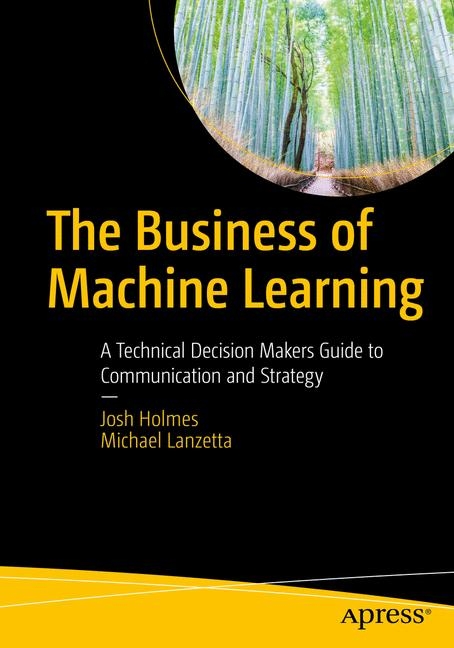
The Business of Machine Learning
Apress (Verlag)
978-1-4842-3542-3 (ISBN)
- Keine Verlagsinformationen verfügbar
- Artikel merken
You will learn how to analyze, communicate, and launch a viable program that, when done correctly, will positively transform your business. The authors engage you to experience the business of machine learning through actual conversations that open with an exchange between a data scientist and and his counterpart in business, the technical decision maker. You will learn where to go when the conversation leads to an impasse and work step-by-step to methodically resolve the challenges. After reading this book, you will come away with the confidence to tackle a machine learning strategy customized for your team or business objectives. Revel in the vast capabilities of machine learning tools at your disposal and reach that "a ha" moment when you discover the profound and enduring impact machine learning can have on your business.
What You'll Learn
Understand the vast potential of machine learning, and how and when to apply different ML techniques
Devise strategies to improve efficiency and accuracy in your business
Get to know your customers and their specific needs through interpreting highly accurate and complex data
Communicate more effectively with teams of architects and data scientists as they develop and deploy complex machine learning solutions
Contrast the life cycle of a machine learning project to a software development project
Master terms such as “convolutional neural network,” “nonparametric regression,” and “multi-class decision jungle”
Who This Book is For
Any technical business decision maker who has to implement a machine learning strategy or converse with data scientists. A basic level of technical understanding is helpful, but does not have to be specific to programming languages or operating systems.
This book is open access under a CC BY license.
Josh Holmes is CTO of the Commercial Software Engineering Americas team at Microsoft. Prior to joining Microsoft, Josh consulted for a variety of clients ranging from large Fortune 500 firms to startups. Josh speaks and presents globally on the topics of IoT and machine learning. A tireless and passionate advocate for the tech community, Josh has founded and/or run numerous organizations, including the Great Lakes Area .NET Users Group and the Ann Arbor Computer Society. He was also on the forming committee for CodeMash. You can contact Josh through his blog. Mike Lanzetta designs and implements machine learning solutions for Fortune 500 companies at Microsoft. He has been doing software development for more than 20 years, working at four-person startups to Amazon. His experience runs the gamut from electronic circuit design, travel optimization, and drug discovery to demand forecasting at Amazon and machine learning at Microsoft. Mike regularly presents and chairs at conferences nationally and internationally. He has an M.Sc. in CSE from UW and a B.Sc. in CE from UCSC. He is often found blogging or tweeting on the topic of machine learning.
Chapter 1: What is ML: Why the hype right now. (30 pages)
a) Conversation with a Machine Learning Expert
b) Where’s ML being used today?
i) Spam checking, spell check and grammar
ii) Siri, search engines, music selection (Spotify…)
c) Short history of Machine learning dating back to the 1950s
d) What is AI and what’s its relationship to ML
e) Why Machine Learning is Hot Right now
i) Storage is more accessible than ever
ii) Access to compute, especially GPUS, is higher than ever
iii) New algorithms are being created every day
iv) New tooling making things more accessible
f) How is Machine Learning done?
i) What’s inside a model?
ii) What’s a feature?
g) How do data scientists think about feature extraction?
i) This requires domain expertise so a data scientist in the financial space, for example, wouldn't necessarily be effective in machine translation tasks or obstacle avoidance.
h) What are some of the new tools that will help folks access machine learning
Chapter 2: What is DL, how does it differ, why now? (20 pages)
a) Conversation involving Deep Learning
b) Deep learning is a branch of machine learning.
i) Machines do their own feature extraction
ii) Deep learning has turned intractable problems to tractable
c) What’s made this possible at this point?
i) Compute, especially GPUs, are more accessible than ever
ii) New Math: Back propagation and Gradient Descent
d) Constructing a deep network
i) Training a model
ii) Using activation functions
iii) batch normalization.
iv) What is dropout?
v) Choosing an optimization function: SGD and Beyond
vi) Evaluating a model
vii) What is a SoftMax?
Chapter 3: Things that kind of look like AI and solve amazing problems but really aren't... (20 pages)
a) Conversation between a programmer and an ML expert on choosing the right tool for the job
b) Why are these things not actually Machine Learning?
i) Who programmed the rules?
ii) Deterministic verses Probabilistic results
c) Ways to solve problems that look like machine learning
i) Expert systems – rule based systems including state machines
(1) When to use an expert system
(2) Pitfalls and drawbacks of an expert system
ii) Convex optimization – set of techniques for deterministically finding the optimal resourcing
(1) When to use convex optimization
(2) Pitfalls and drawbacks to convex optimization
iii) Time-series Forecasting - using past data to predict the future, taking into account seasonal effects and short/long-term trends
(1) When to use time-series forecasting
(2) Pitfalls and drawbacks to using time-series forecasting
iv) Dynamic programming - cleverly breaking problems down, solving the easier smaller ones, and storing their solutions
(1) When to use dynamic programming
(2) Pitfalls and drawbacks of dynamic programming
Chapter 4: What sort of problems can you /should you solve with ML? DL? (20 pages)
a) Conversation with data scientist around selecting ML tools
b) What’s ML really good at?
i) Discussion of problems where ML has helped
c) What’s ML not good at?
i) A walk through a few problems where ML doesn't do very well
ii) Not enough data
iii) Curse of dimensionality
d) Recognizing a machine learning problem
i) Filtering out problems that can be solved by methods in Chapter 3
ii) Phrasing your problem as an ML problem
e) When is an ML problem actually a Deep Learning problem? How to know when this answer has changed (things are moving fast!)
Chapter 5: ML: Dealing with Data (featurization) (20 pages)
a) Conversation with a data scientist about featurization of data.
b) How do determine what data you need to collect
c) How to store this data
i) Data store
ii) Formats
d) How a data scientist works with data
i) Data cleaning
ii) Labeling
iii) Featurization
e) Potential pitfalls
i) Feature skew and Heteroskedasticity
ii) Label skew
iii) Interdependence of features
iv) Outlier detection
v) Data sparsity
vi) Missing values
Chapter 6: ML Under Supervision: Regression and Classification (20 pages)
a) The primary two methods of solving problems with classic machine learning
i) Classification turns features into a single decision such as a yes or no or into different buckets. E.G. Will it rain tomorrow?
ii) Regression turns features into numeric values. E.G. What’s the temperature likely to be tomorrow?
Chapter 7: Unsupervised and Semi-supervised ML (20 pages)
a) Conversation with a data scientist about what a computer can do without any direction
b) What unsupervised learning can do
i) Working with unlabeled data
ii) Clustering and finding patterns in data
iii) Anomaly Detection
iv) How to recognize an unsupervised learning problem
c) How semi-supervised learning can help augment supervised learning
i) Combines labeled and unlabeled data
d) Moving from unsupervised to supervised
i) Creating labels from the clusters
Chapter 8: Deep Learning: On Images (CNNs) (20 pages)
a) Conversation with a data scientist about image processing
b) Short history of image recognition
i) How featurization of an image has traditionally been done
c) How the introduction of deep learning has accelerated the field
d) How does Deep Learning work with Images
i) Creating image features
ii) What is a convolution
iii) what is a convolutional neural network(CNN)
iv) what do width, stride and padding mean to a CNN?
Chapter 9: Deep Learning: On Text and Sound (RNNs) (20 pages)
a) Conversation with a data scientist about text and sound processing
b) Processing sequential data is far different than processing an image
i) Sequencing matters
ii) Looking at sequencing
(1) Letters
(2) Words
(3) Phoneme
c) Recurrent Neural Networks
i) Semantic mapping through of sequential data
ii) Vanishing and exploding gradient problems
iii) LSTMs and GRUs
iv) Attention-based methods
d) How can this be used?
i) Learn to caption images
ii) Speak like a celebrity
iii) Find information from long documents that would otherwise remain hidden with more traditional ML methods.
Chapter 10: Deep Learning: Self-Xing Y's, or Deep Reinforcement Learning (20 pages)
a) Conversation with a data scientist about reinforcement learning
b) Reinforcement Learning
i) Short history of reinforcement learning
(1) old technique being given dramatic new life with Deep Learning.
c) Basics of Q-Learning
i) Defining intelligent Q-functions
d) High profile uses
i) defeat the best Go player in the world,
ii) drive cars
iii) fly planes on its own.
Chapter 11: The ML Process: Data Provenance, Model Versioning, Deployment, etc. (30 pages)
a) Conversation with a data scientist on the life cycle of a machine learning project.
b) Traditional Software Lifecycle verses Machine Learning Software Lifecycle
i) Accounting for the data
(1) Where the data is coming from
(2) How it’s changed over the time
ii) Versioning the model itself
c) Tracking quality of the model over time
i) Accuracy over time
d) Deployment of the model
i) Where does the model live?
(1) Server
(2) On a device
(3) Hybrid
ii) Hierarchical models
(1) Stacked degrees of precision
iii) Model compression/quantization
(1) Various techniques for doing this
(a) Normalization of values
(b) Giving up degrees of precision
e) Updating the model
i) Retraining
ii) Redeployment
Chapter 12: Advanced Topics: (20 pages)
a
b) VAEs (Variational Auto Encoders), GANs (Generative Adversarial Networks), Cyclegans?
c) Featurizers, x2vec
d) Ensembling and voting ensembles – multiple models who are ensembled (voting on the regression discussion in chapter 7)
e) Collaborative Filtering and Recommenders
| Erscheinungsdatum | 03.11.2020 |
|---|---|
| Zusatzinfo | XX, 230 p. |
| Verlagsort | Berkley |
| Sprache | englisch |
| Maße | 155 x 235 mm |
| Themenwelt | Mathematik / Informatik ► Informatik ► Programmiersprachen / -werkzeuge |
| Mathematik / Informatik ► Informatik ► Software Entwicklung | |
| Informatik ► Theorie / Studium ► Künstliche Intelligenz / Robotik | |
| Schlagworte | AI • AI in the Cloud • Azure Machine Learning • Beginning Machine Learning • Deep learning • Do I have to learn math to understand machine lear • Do I have to learn math to understand machine learning? • Getting started with Machine Learning • Josh Holmes • machine learning • Michael Lanzetta • ML • open access • What's k-means |
| ISBN-10 | 1-4842-3542-8 / 1484235428 |
| ISBN-13 | 978-1-4842-3542-3 / 9781484235423 |
| Zustand | Neuware |
| Informationen gemäß Produktsicherheitsverordnung (GPSR) | |
| Haben Sie eine Frage zum Produkt? |
aus dem Bereich