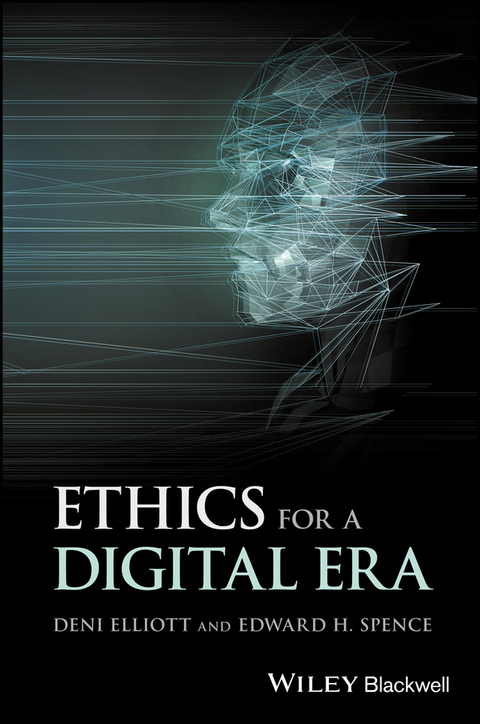
Ethics for a Digital Era (eBook)
John Wiley & Sons (Verlag)
978-1-118-96889-5 (ISBN)
'Elliott and Spence have produced a tight, teachable, and timely primer on media ethics for users and creators of information in the digital age. Pitched at just the right depth of detail to provide a big picture contextualization of changing media practices grounded in concerns for democracy and the public good, the book explores and reflects the implications of the convergence of the Fourth and Fifth Estates with an open-access, hyper-linked architecture which invites self-reflective practice on the part of its users'
Philip Gordon, Utah Valley University
2019 PROSE Award Finalist in the Media & Cultural Studies category!
The rapid and ongoing evolution of digital technologies has transformed the waythe world communicates and digests information. Fueled by a 24-hour news cycleand post-truth politics, media consumption and the technologies that drive ithave become more influential in shaping public opinion, and it has become more imperative than ever to examine their social and ethical consequences. Ethics for a Digital Era provides a penetrating analysis of the ethical issues that have emerged as the digital revolution progresses, including journalistic practices that impact on the truth, reliability, and trustworthiness of communicating information. The volume explores new methods and models for ethical inquiry in a digital world, and maps out guidelines for web-based news producers and users to conceptualize ethical issuesand analyze ethically questionable acts.
In each of three thematic sections, Deni Elliott and Edward H. Spence reflect upon shifts in media ethics as contemporary mass communication combines traditional analog practices with new forms like blogs, vlogs, podcasts, and social media posts, and evolves into an interactive medium with users who both produce and consume the news. Later chapters apply a process of normative decision-making to some of the most important issues which arise in these interactions, and encourage users to bridge their own thinking between the virtual and physical worlds of information and its communication.
Timely and thought-provoking, Ethics for a Digital Era is an invaluable resource for undergraduate and graduate students in media and mass communication, applied ethics, and journalism, as well as general readers interested in the ethical impact of their media consumption.
DENI ELLIOTT, EdD holds the Poynter Jamison Chair in Media Ethics and Press Policy and is Department Chair and full professor in the Department of Journalism and Digital Communication at the University of South Florida, St. Petersburg.
EDWARD H. SPENCE teaches and conducts research in the philosophy and ethics of information technologies and communication at Charles Sturt University. He is a Research Fellow at the 4TU Centre of Excellence for Ethics and Technology in The Hague, and Research Associate at the University of Sydney, Australia.
"e;Elliott and Spence have produced a tight, teachable, and timely primer on media ethics for users and creators of information in the digital age. Pitched at just the right depth of detail to provide a big picture contextualization of changing media practices grounded in concerns for democracy and the public good, the book explores and reflects the implications of the convergence of the Fourth and Fifth Estates with an open-access, hyper-linked architecture which invites self-reflective practice on the part of its users Philip Gordon, Utah Valley University2019 PROSE Award Finalist in the Media & Cultural Studies category!The rapid and ongoing evolution of digital technologies has transformed the waythe world communicates and digests information. Fueled by a 24-hour news cycleand post-truth politics, media consumption and the technologies that drive ithave become more influential in shaping public opinion, and it has become more imperative than ever to examine their social and ethical consequences. Ethics for a Digital Era provides a penetrating analysis of the ethical issues that have emerged as the digital revolution progresses, including journalistic practices that impact on the truth, reliability, and trustworthiness of communicating information. The volume explores new methods and models for ethical inquiry in a digital world, and maps out guidelines for web-based news producers and users to conceptualize ethical issuesand analyze ethically questionable acts. In each of three thematic sections, Deni Elliott and Edward H. Spence reflect upon shifts in media ethics as contemporary mass communication combines traditional analog practices with new forms like blogs, vlogs, podcasts, and social media posts, and evolves into an interactive medium with users who both produce and consume the news. Later chapters apply a process of normative decision-making to some of the most important issues which arise in these interactions, and encourage users to bridge their own thinking between the virtual and physical worlds of information and its communication. Timely and thought-provoking, Ethics for a Digital Era is an invaluable resource for undergraduate and graduate students in media and mass communication, applied ethics, and journalism, as well as general readers interested in the ethical impact of their media consumption.
DENI ELLIOTT, EdD holds the Poynter Jamison Chair in Media Ethics and Press Policy and is Department Chair and full professor in the Department of Journalism and Digital Communication at the University of South Florida, St. Petersburg. EDWARD H. SPENCE teaches and conducts research in the philosophy and ethics of information technologies and communication at Charles Sturt University. He is a Research Fellow at the 4TU Centre of Excellence for Ethics and Technology in The Hague, and Research Associate at the University of Sydney, Australia.
Acknowledgments viii
Introduction 1
Part I: From Analog to Digital News 11
1 A New Paradigm for News 13
2 Legacy News Organizations Move from Analog to Digital 37
3 Intellectual Property and Information Sharing 64
4 Citizen Responsibility in the Digital Era 76
Part II: Thinking Through Ethical Issues in Digital Journalism 89
5 DOIT, A Process for Normative Analysis 91
6 Issues in Convergent Journalism 104
7 Privacy and Disclosure 116
8 Deception in Sourcing and Presentation 136
9 Media Corruption 154
Part III: Using the Virtual World to Create a Better Physical World 171
10 Beyond Ethics: Communicating Wisely 173
Epilogue: Digital Diversity and Democracy 190
Index 197
| Erscheint lt. Verlag | 26.1.2018 |
|---|---|
| Reihe/Serie | Blackwell Public Philosophy Series | Blackwell Public Philosophy Series |
| Sprache | englisch |
| Themenwelt | Geisteswissenschaften ► Philosophie ► Allgemeines / Lexika |
| Geisteswissenschaften ► Philosophie ► Ethik | |
| Mathematik / Informatik ► Informatik | |
| Naturwissenschaften | |
| Sozialwissenschaften ► Kommunikation / Medien ► Medienwissenschaft | |
| Sozialwissenschaften ► Politik / Verwaltung | |
| Sozialwissenschaften ► Soziologie | |
| Schlagworte | Angewandte Ethik • Applied Ethics • Communication & Media Studies • communications • digital journalism • Digital Media • digital media ethics • digital media reporting • ethical analysis • ethical guidelines for web-based news producers • ethical reporting • ethics • ethics and the news • Ethik • Journalism • journalism ethics • journalistic integrity</p> • Kommunikation u. Medienforschung • <p>ethical journalism • mass communications • media • media consumption • media delivery • Media Ethics • Media Law & Ethics • Media morality • Medienrecht, Medienethik • modern media • morality in journalism • New Media • Philosophie • Philosophy • professional journalism • Reporting • web-based mass communication • web-based news |
| ISBN-10 | 1-118-96889-1 / 1118968891 |
| ISBN-13 | 978-1-118-96889-5 / 9781118968895 |
| Informationen gemäß Produktsicherheitsverordnung (GPSR) | |
| Haben Sie eine Frage zum Produkt? |
 PDF (Adobe DRM)
Kopierschutz: Adobe-DRM
Adobe-DRM ist ein Kopierschutz, der das eBook vor Mißbrauch schützen soll. Dabei wird das eBook bereits beim Download auf Ihre persönliche Adobe-ID autorisiert. Lesen können Sie das eBook dann nur auf den Geräten, welche ebenfalls auf Ihre Adobe-ID registriert sind.
Details zum Adobe-DRM
Dateiformat: PDF (Portable Document Format)
Mit einem festen Seitenlayout eignet sich die PDF besonders für Fachbücher mit Spalten, Tabellen und Abbildungen. Eine PDF kann auf fast allen Geräten angezeigt werden, ist aber für kleine Displays (Smartphone, eReader) nur eingeschränkt geeignet.
Systemvoraussetzungen:
PC/Mac: Mit einem PC oder Mac können Sie dieses eBook lesen. Sie benötigen eine
eReader: Dieses eBook kann mit (fast) allen eBook-Readern gelesen werden. Mit dem amazon-Kindle ist es aber nicht kompatibel.
Smartphone/Tablet: Egal ob Apple oder Android, dieses eBook können Sie lesen. Sie benötigen eine
Geräteliste und zusätzliche Hinweise
Buying eBooks from abroad
For tax law reasons we can sell eBooks just within Germany and Switzerland. Regrettably we cannot fulfill eBook-orders from other countries.
aus dem Bereich