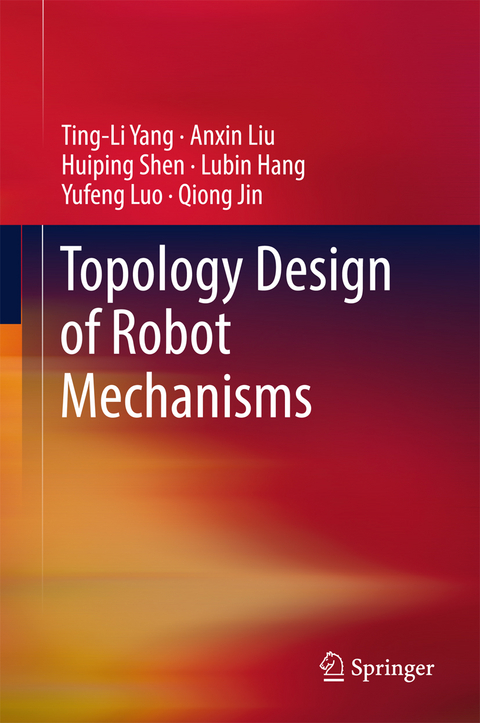
Topology Design of Robot Mechanisms (eBook)
XIX, 236 Seiten
Springer Singapore (Verlag)
978-981-10-5532-4 (ISBN)
This book focuses on the topology theory of mechanisms developed by the authors and provides a systematic method for the topology design of parallel mechanisms (PMs).
The main original theoretical contributions of this book include:
(1) Three basic concepts
(a) The 'geometrical constraint type', kinematic pair and connection of links are three structural elements. As such, the symbolic expression of these mechanisms' structures is an invariance.
(b) The position and orientation characteristic (POC) set describes the POC of relative motion between any two links and is an invariance.
(c) In turn, the simple open chain (SOC) unit is used to develop four basic equations of mechanism topology (see Chapters 4 to 6).
(2) Mechanism composition principle
The book proposes a mechanism composition principle based on the SOC unit and establishes a systematic theory for the unified modeling of the topology, kinematics, and dynamics of mechanisms (see Chapter 7).
(3) Four basic equations
(a) A POC equation of serial mechanisms and its 10 operation rules (see Chapter 4).
(b) A POC equation of PMs and its 14 operation rules (see Chapter 5).(c) The general DOF formulas
(see Chapter 6).
(d) The coupling degree formula for the Assur kinematic chain (see Chapter 7).
(4) One systematic method for the topology design of parallel mechanisms (see Chapters 8-10)
Drawing on these three basic concepts and four basic equations, the book puts forward a systematic method for the topology design of PMs, one that is fundamentally different from existing methods. Its main characteristics are as follows:
(a) The design process includes two stages: the first is structure synthesis, which allows many structure types to be obtained; the second involves the performance analysis, classification and optimization of structure types.
(b) The design operation is independent of the motion position and selection of fixed coordinate system.As such, the proposed method is essentially geometrical. This ensures that full-cycle DOF and the generality of geometric conditions of mechanism existence apply.
(c) Each individual design step follows an explicit formula or the guidelines for design criteria, making the operation simple, feasible and reproducible. In addition, the topology design of the SCARA PM is studied in detail, providing an example to illustrate the proposed method (see Chapter 10).
This book focuses on the topology theory of mechanisms developed by the authors and provides a systematic method for the topology design of robot mechanisms.The main original theoretical contributions of this book include:A. Three basic concepts* The "e;geometrical constraint type of axes"e; is introduced as the third element of the topological structure of a mechanism. When it is combined with the other two elements, the kinematic pair and the connection of links, the symbolic expression of the topological structure is independent of the motion positions (except for the singularity positions) and the fixed coordinate system (Chapter 2).* The position and orientation characteristic (POC) set is used to describe the POC of the relative motion between any two links. The POC set, derived from the unit vector set of the velocity of a link, is only depend on the topological structure of a mechanism. Therefore, it is also independent of the motion positions and the fixed coordinate system (Chapter 3).* The single open chain (SOC) unit is the base unit of the topological structure used to develop the four basic equations of the mechanism topology (Chapters 2, 4-6).B. The mechanism composition principle based on the SOC unitsThis book proposes a mechanism composition principle, based on the SOC units, to establish a systematic theory for the unified modeling of the topology, kinematics, and dynamics of mechanisms based on the SOC units (Chapter 7).C. Four basic equations* The POC equation of serial mechanisms with 10 symbolic operation rules (Chapter 4).* The POC equation of parallel mechanisms with 14 symbolic operation rules (Chapter 5).* The general DOF formula for spatial mechanisms (Chapter 6).* The coupling degree formula for the Assur kinematic chain (Chapter 7).D. One systematic method for the topology design of robot mechanisms (Chapters 8-10)Based on the three basic concepts and the four basic equations addressed above, this book puts forward a systematic method for the topology design of parallel mechanisms, which is fundamentally different from all existing methods. Its main characteristics are as follows:* The design process includes two stages: the first is structure synthesis, which derives many structure types; the second involves the performance analysis, classification and optimization of structure types derived from the first stage.* The design operation is independent of the motion positions and the fixed coordinate system. Therefore, the proposed method is essentially a geometrical method, which ensures the full-cycle DOF and the generality of geometric conditions of mechanism existence. * Each individual design step follows an explicit formula or the guidelines for design criteria, making the operation simple, feasible and reproducible. In addition, the topology design of the SCARA PMs is studied in detail to demonstrate the proposed method (Chapter 10).
Introduction.- Topological structure of mechanisms and mathematical representation.- Position and orientation characteristic of mechanisms and mathematical representation.- Topological structure equations of mechanisms.- General DOF formula of mechanisms.- Composition principle and topological structure characteristics of mechanisms.- General method for topological structure synthesis of mechanisms.- Topological structure design of 3-DOF parallel mechanisms.- Topological structure design of 4-DOF parallel mechanisms.- Topological structure design of 5-DOF parallel mechanisms.- Topological structure design of 6-DOF parallel mechanisms.- Conclusion.
| Erscheint lt. Verlag | 2.1.2018 |
|---|---|
| Zusatzinfo | XIX, 236 p. 73 illus. |
| Verlagsort | Singapore |
| Sprache | englisch |
| Themenwelt | Informatik ► Theorie / Studium ► Künstliche Intelligenz / Robotik |
| Technik ► Maschinenbau | |
| Schlagworte | mechanism composition principle • position and orientation characteristic • robot mechanism • single-open-chain • topological structure synthesis |
| ISBN-10 | 981-10-5532-7 / 9811055327 |
| ISBN-13 | 978-981-10-5532-4 / 9789811055324 |
| Informationen gemäß Produktsicherheitsverordnung (GPSR) | |
| Haben Sie eine Frage zum Produkt? |
 PDF (Wasserzeichen)
DRM: Digitales Wasserzeichen
Dieses eBook enthält ein digitales Wasserzeichen und ist damit für Sie personalisiert. Bei einer missbräuchlichen Weitergabe des eBooks an Dritte ist eine Rückverfolgung an die Quelle möglich.
Dateiformat: PDF (Portable Document Format)
Mit einem festen Seitenlayout eignet sich die PDF besonders für Fachbücher mit Spalten, Tabellen und Abbildungen. Eine PDF kann auf fast allen Geräten angezeigt werden, ist aber für kleine Displays (Smartphone, eReader) nur eingeschränkt geeignet.
Systemvoraussetzungen:
PC/Mac: Mit einem PC oder Mac können Sie dieses eBook lesen. Sie benötigen dafür einen PDF-Viewer - z.B. den Adobe Reader oder Adobe Digital Editions.
eReader: Dieses eBook kann mit (fast) allen eBook-Readern gelesen werden. Mit dem amazon-Kindle ist es aber nicht kompatibel.
Smartphone/Tablet: Egal ob Apple oder Android, dieses eBook können Sie lesen. Sie benötigen dafür einen PDF-Viewer - z.B. die kostenlose Adobe Digital Editions-App.
Buying eBooks from abroad
For tax law reasons we can sell eBooks just within Germany and Switzerland. Regrettably we cannot fulfill eBook-orders from other countries.
aus dem Bereich