


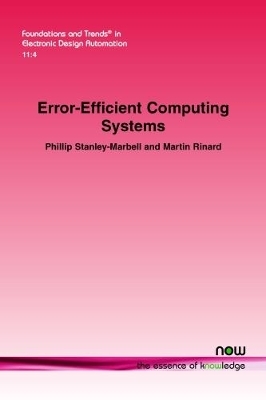
Error-Efficient Computing Systems
Seiten
2017
now publishers Inc (Verlag)
9781680833584 (ISBN)
now publishers Inc (Verlag)
9781680833584 (ISBN)
- Titel ist leider vergriffen;
keine Neuauflage - Artikel merken
Error-Efficient Computing Systems explores techniques to make computing systems faster or more energy-efficient by allowing them to make controlled errors. It is intended for anyone interested in a holistic summary of the theory, practice, and history of making computing systems more efficient by trading errors for improved efficiency.
Error-Efficient Computing Systems explores the theory and practice of techniques to make computing systems faster or more energy-efficient by allowing them to make controlled errors. In the same way that systems which only use as much energy as necessary are referred to as being energy-efficient, the class of systems addressed by this survey can be thought of as being error-efficient: they only prevent as many errors as they need to. The definition of what constitutes an error varies across the parts of a system and which errors are acceptable depends on the application at hand. In computing systems, making errors, when behaving correctly would be too expensive, can conserve resources. The resource conserved may be time: By making some errors, systems may be faster. The resource may also be energy: A system may use less power from its batteries or from the electrical grid by only avoiding certain errors while tolerating benign errors that are associated with reduced power consumption. The resource in question may be an even more abstract quantity such as consistency of ordering of the outputs of the system in question. Error-Efficient Computing Systems is an ideal reference for anyone interested in a holistic summary of the theory, practice, and history of how to make computing systems more efficient by trading errors for improved efficiency.
Error-Efficient Computing Systems explores the theory and practice of techniques to make computing systems faster or more energy-efficient by allowing them to make controlled errors. In the same way that systems which only use as much energy as necessary are referred to as being energy-efficient, the class of systems addressed by this survey can be thought of as being error-efficient: they only prevent as many errors as they need to. The definition of what constitutes an error varies across the parts of a system and which errors are acceptable depends on the application at hand. In computing systems, making errors, when behaving correctly would be too expensive, can conserve resources. The resource conserved may be time: By making some errors, systems may be faster. The resource may also be energy: A system may use less power from its batteries or from the electrical grid by only avoiding certain errors while tolerating benign errors that are associated with reduced power consumption. The resource in question may be an even more abstract quantity such as consistency of ordering of the outputs of the system in question. Error-Efficient Computing Systems is an ideal reference for anyone interested in a holistic summary of the theory, practice, and history of how to make computing systems more efficient by trading errors for improved efficiency.
1: Introduction 2: Types of Errors and Randomization 3: Computation, Energy, and Noise 4: Tolerating Errors in Outputs 5: Tolerating Errors in Inputs 6: Conclusion. References.
| Erscheinungsdatum | 03.01.2018 |
|---|---|
| Reihe/Serie | Foundations and Trends in Electronic Design Automation |
| Verlagsort | Hanover |
| Sprache | englisch |
| Themenwelt | Mathematik / Informatik ► Informatik ► Theorie / Studium |
| ISBN-13 | 9781680833584 / 9781680833584 |
| Zustand | Neuware |
| Informationen gemäß Produktsicherheitsverordnung (GPSR) | |
| Haben Sie eine Frage zum Produkt? |
Mehr entdecken
aus dem Bereich

aus dem Bereich
was jeder über Informatik wissen sollte
Buch | Softcover (2024)
Springer Vieweg (Verlag)
CHF 53,15
Grundlagen – Anwendungen – Perspektiven
Buch | Softcover (2022)
Springer Vieweg (Verlag)
CHF 53,15
Teil 2 der gestreckten Abschlussprüfung Fachinformatiker/-in …
Buch | Softcover (2025)
Europa-Lehrmittel (Verlag)
CHF 37,90


