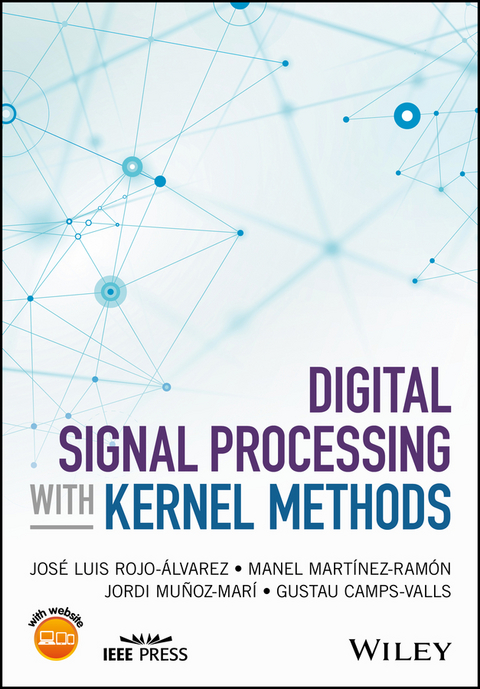
Digital Signal Processing with Kernel Methods (eBook)
John Wiley & Sons (Verlag)
978-1-118-70583-4 (ISBN)
A realistic and comprehensive review of joint approaches to machine learning and signal processing algorithms, with application to communications, multimedia, and biomedical engineering systems
Digital Signal Processing with Kernel Methods reviews the milestones in the mixing of classical digital signal processing models and advanced kernel machines statistical learning tools. It explains the fundamental concepts from both fields of machine learning and signal processing so that readers can quickly get up to speed in order to begin developing the concepts and application software in their own research.
Digital Signal Processing with Kernel Methods provides a comprehensive overview of kernel methods in signal processing, without restriction to any application field. It also offers example applications and detailed benchmarking experiments with real and synthetic datasets throughout. Readers can find further worked examples with Matlab source code on a website developed by the authors.
- Presents the necessary basic ideas from both digital signal processing and machine learning concepts
- Reviews the state-of-the-art in SVM algorithms for classification and detection problems in the context of signal processing
- Surveys advances in kernel signal processing beyond SVM algorithms to present other highly relevant kernel methods for digital signal processing
An excellent book for signal processing researchers and practitioners, Digital Signal Processing with Kernel Methods will also appeal to those involved in machine learning and pattern recognition.
JOSÉ LUIS ROJO-ÁLVAREZ, PhD, is a Professor in the Department of Signal Theory and Communications at the University Rey Juan Carlos, Fuenlabrada (Madrid) and Center for Computational Simulation, Universidad Politécnica de Madrid, Spain.
MANEL MARTÍNEZ-RAMÓN, PhD, is a Professor in the Department of Electrical and Computer Engineering at the University of New Mexico, Albuquerque, USA.
JORDI MUÑOZ-MARÍ, PhD, is an Associate Professor in the Department of Electronics Engineering at the Universitat de València, Spain.
GUSTAU CAMPS-VALLS, PhD, is an Associate Professor in the Department of Electronics Engineering at the Universitat de València, Spain.
A realistic and comprehensive review of joint approaches to machine learning and signal processing algorithms, with application to communications, multimedia, and biomedical engineering systems Digital Signal Processing with Kernel Methods reviews the milestones in the mixing of classical digital signal processing models and advanced kernel machines statistical learning tools. It explains the fundamental concepts from both fields of machine learning and signal processing so that readers can quickly get up to speed in order to begin developing the concepts and application software in their own research. Digital Signal Processing with Kernel Methods provides a comprehensive overview of kernel methods in signal processing, without restriction to any application field. It also offers example applications and detailed benchmarking experiments with real and synthetic datasets throughout. Readers can find further worked examples with Matlab source code on a website developed by the authors: http://github.com/DSPKM Presents the necessary basic ideas from both digital signal processing and machine learning concepts Reviews the state-of-the-art in SVM algorithms for classification and detection problems in the context of signal processing Surveys advances in kernel signal processing beyond SVM algorithms to present other highly relevant kernel methods for digital signal processing An excellent book for signal processing researchers and practitioners, Digital Signal Processing with Kernel Methods will also appeal to those involved in machine learning and pattern recognition.
JOSÉ LUIS ROJO-ÁLVAREZ, PhD, is a Professor in the Department of Signal Theory and Communications at the University Rey Juan Carlos, Fuenlabrada (Madrid) and Center for Computational Simulation, Universidad Politécnica de Madrid, Spain. MANEL MARTÍNEZ-RAMÓN, PhD, is a Professor in the Department of Electrical and Computer Engineering at the University of New Mexico, Albuquerque, USA. JORDI MUÑOZ-MARÍ, PhD, is an Associate Professor in the Department of Electronics Engineering at the Universitat de València, Spain. GUSTAU CAMPS-VALLS, PhD, is an Associate Professor in the Department of Electronics Engineering at the Universitat de València, Spain.
About the Authors
José Luis Rojo‐Álvarez received the Telecommunication Engineering degree in 1996 from University of Vigo, Spain, and a PhD in Telecommunication Engineering in 2000 from the Polytechnic University of Madrid, Spain. Since 2016, he has been a full Professor in the Department of Signal Theory and Communications, University Rey Juan Carlos, Madrid, Spain. He has published more than 90 papers in indexed journals and more than 150 international conference communications. He has participated in more than 60 projects (with public and private fundings), and directed more than 10 of them, including several actions in the National Plan for Research and Fundamental Science. He was a senior researcher at the Prometeo program in Ecuador (Army University, 2013 to 2015) and research advisor at the Telecommunication Ministry. In 2016 he received the Rey Juan Carlos University Prize for Talented Researcher.
His main current research interests include statistical learning theory, digital signal processing, and complex system modeling, with applications to cardiac signals and image processing. Specifically, he is committed to the development of new electrocardiographic imaging systems, long‐term cardiac monitoring intelligent systems, and big data for electronic recording and hospital information analysis at large scales.
Manel Martínez‐Ramón received an MsD in Telecommunications Engineering from Universitat Politécnica de Catalunya in 1996, and a PhD in Communications Technologies from Universidad Carlos III de Madrid (Spain) in 1999. In 2004 he spent a 20‐month postdoctoral period at the MIND Research Network (New Mexico, USA). He was an Associate Professor at Universidad Carlos III de Madrid until 2013. There, he held various positions from Associate Dean of the School of Engineering to Associate Vice‐Chancellor for Infrastructures. He has taught more than 30 different undergraduate and graduate classes in different universities.
Since August 2013 he has been a full professor with the Department of Electrical and Computer Engineering at the University of New Mexico, where he was permanently appointed Prince of Asturias Endowed Chair of the University of New Mexico, later renamed to King Felipe VI Endowed Chair, which is sponsored by the Household of the King of Spain. He is head of the machine learning track of this department and he is the Associate Director of the Center of Emerging Energy Technologies of this university. He is currently a principal investigator of several projects funded by the National Science Foundation and other agencies.
He has co‐authored more than 40 journal papers and about 60 conference papers, and several books and book chapters. His research interests are in applications of machine learning to cyberphysical systems, including first‐responders systems, smart grids, and cognitive radio.
Jordi Muñoz‐Marí was born in Valéncia, Spain, in 1970, and received a BSc degree in Physics (1993), a BSc degree in Electronics Engineering (1996), and a PhD degree in Electronics Engineering (2003) from the Universitat de Valéncia. He is currently an associate professor in the Electronics Engineering Department at the Universitat de Valéncia, where he teaches electronic circuits, digital signal processing, and data science. He is a research member of the Image and Signal Processing (ISP) group. His research activity is tied to the study and development of machine‐learning algorithms for signal and image processing.
Gustau Camps‐Valls received BSc degrees in Physics (1996) and in Electronics Engineering (1998) and a PhD degree in Physics (2002), all from the Universitat de Valéncia. He is currently an Associate Professor (hab. Full Professor) in the Department of Electronics Engineering. He is a research coordinator in the Image and Signal Processing (ISP) group. He is interested in the development of machine‐learning algorithms for geoscience and remote‐sensing data analysis. He is an author of 130 journal papers, more than 150 conference papers, 20 international book chapters, and editor of the books Kernel Methods in Bioengineering, Signal and Image Processing (IGI, 2007), Kernel Methods for Remote Sensing Data Analysis" (John Wiley & Sons, 2009), and Remote Sensing Image Processing (MC, 2011). He holds a Hirsch's index h = 47, entered the ISI list of Highly Cited Researchers in 2011, and Thomson Reuters ScienceWatch identified one of his papers on kernel‐based analysis of hyperspectral images as a Fast Moving Front research. In 2015, he obtained the prestigious European Research Council (ERC) consolidator grant on Statistical Learning for Earth Observation Data Analysis. Since 2007 he has been a member of the Data Fusion Technical Committee of the IEEE GRSS, and since 2009 of the Machine Learning for Signal Processing Technical Committee of the IEEE SPS. He is a member of the MTG‐IRS Science Team (MIST) of EUMETSAT. He is Associate Editor of the IEEE Transactions on Signal Processing, IEEE Signal Processing Letters, IEEE Geoscience and Remote Sensing Letters, and invited guest editor for IEEE Journal of Selected Topics in Signal Processing (2012) and IEEE Geoscience and Remote Sensing Magazine (2015).
Valero Laparra Pérez‐Muelas received a BSc degree in Telecommunications Engineering (2005), a BSc degree in Electronics Engineering (2007), a BSc degree in Mathematics (2010), and a PhD degree in Computer Science and Mathematics (2011). Currently, he has a postdoctoral position in the Image Processing Laboratory (IPL) and an Assistant Professor position in the Department of Electronics Engineering at the Universitat de Valéncia.
Luca Martino obtained his PhD in Statistical Signal Processing from Universidad Carlos III de Madrid, Spain, in 2011. He has been an Assistant Professor in the Department of Signal Theory and Communications at Universidad Carlos III de Madrid since then. In August 2013 he joined the Department of Mathematics and Statistics at the University of Helsinki. In March 2015, he joined the Universidade de Sao Paulo (USP). Currently, he is a postdoctoral researcher at the Universitat de Valéncia. His research interests include Bayesian inference, Monte Carlo methods, and nonparametric regression techniques.
Sergio Muñoz‐Romero earned his PhD in Machine Learning at Universidad Carlos III de Madrid, where he also received the Telecommunication Engineering degree. He has led pioneering projects where machine‐learning knowledge was successfully used to solve real big‐data problems. Currently, he is a researcher at Universidad Rey Juan Carlos. Since 2015, he has worked at Persei vivarium as Head of Data Science and Big Data. His present research interests are centered around machine‐learning algorithms and statistical learning theory, mainly in dimensionality reduction and feature selection methods, and their applications to bioengineering and big data.
Adrián Pérez‐Suay obtained his BSc degree in Mathematics (2007), a Master's degree in Advanced Computing and Intelligent Systems (2010), and a PhD degree in Computational Mathematics and Computer Science (2015) about distance metric learning, all from the Universitat de Valéncia. He is currently a postdoctoral researcher at the Image Processing Laboratory (IPL) working on feature extraction and classification problems in remote‐sensing data analysis, and has worked as assistant professor in the Department of Mathematics at the Universitat de Valéncia.
Margarita Sanromán‐Junquera received the Technical Telecommunication Engineering degree from Universidad Carlos III de Madrid, Spain, in 2007, the Telecommunication Engineering degree from Universidad Rey Juan Carlos, Spain, in 2009, an MSc in Biomedical Engineering and Telemedicine from the Universidad Politécnica de Madrid, Spain, in 2010, and a PhD in Multimedia and Communication from Universidad Rey Juan Carlos and Universidad Carlos III de Madrid, in 2014. She is currently an Assistant Professor in the Department of Signal Theory and Communications, Telematics, and Computing at Universidad Rey Juan Carlos. Her research interests include statistical learning theory, digital processing of images and signals, and their applications to bioengineering.
Cristina Soguero‐Ruiz received the Telecommunication Engineering degree and a BSc degree in Business Administration and Management in 2011, and an MSc degree in Biomedical Engineering from the University Rey Juan Carlos, Madrid, Spain, in 2012. She obtained her PhD degree in Machine Learning with Applications in Healthcare in 2015 in the Joint Doctoral Program in Multimedia and Communications in conjunction with University Rey Juan Carlos and University Carlos III. She was supported by FPU Spanish Research and Teaching Fellowship (granted in 2012, third place in TEC area). She won the Orange Foundation Best PhD Thesis Award by the Spanish Official College of Telecommunication Engineering.
Steven Van‐Vaerenbergh received his MSc degree in Electrical Engineering from Ghent University, Belgium, in 2003, and a PhD degree from the University of Cantabria, Santander, Spain, in 2010. He was a visiting researcher with the Computational Neuroengineering Laboratory, University of Florida, Gainesville, in 2008. Currently, he is a postdoctoral associate with the Department of Telecommunication Engineering, University of Cantabria, Spain, where he is the principal...
| Erscheint lt. Verlag | 27.12.2017 |
|---|---|
| Reihe/Serie | IEEE Press |
| Wiley - IEEE | Wiley - IEEE |
| Sprache | englisch |
| Themenwelt | Mathematik / Informatik ► Informatik ► Netzwerke |
| Technik ► Elektrotechnik / Energietechnik | |
| Technik ► Nachrichtentechnik | |
| Schlagworte | advanced kernel machines • brain imaging • cardiac signal processing • circuits and linear systems • Complex system modelling • Computer Hardware • Computer Science • Digital Communications • digital electronic systems • digital signal processing • digital signal processing models • digital signal processing with kernel methods • Electrical & Electronics Engineering • Elektrotechnik u. Elektronik • Hardware • Image Processing • Informatik • introduction to programmable logical devices • kernel signal processing • machine learning • microprocessor electronic systems • Mustererkennung • Pattern Analysis • Signal Processing • Signal processing algorithms • signal processing for biomedical engineering systems • Signal Processing for Communications • signal processing for multimedia • Signal Processing in Communications • Signalverarbeitung • Statistical Learning • statistical learning theory • statistical learning tools • SVM algorithms |
| ISBN-10 | 1-118-70583-1 / 1118705831 |
| ISBN-13 | 978-1-118-70583-4 / 9781118705834 |
| Informationen gemäß Produktsicherheitsverordnung (GPSR) | |
| Haben Sie eine Frage zum Produkt? |
 EPUB (Adobe DRM)
Kopierschutz: Adobe-DRM
Adobe-DRM ist ein Kopierschutz, der das eBook vor Mißbrauch schützen soll. Dabei wird das eBook bereits beim Download auf Ihre persönliche Adobe-ID autorisiert. Lesen können Sie das eBook dann nur auf den Geräten, welche ebenfalls auf Ihre Adobe-ID registriert sind.
Details zum Adobe-DRM
Dateiformat: EPUB (Electronic Publication)
EPUB ist ein offener Standard für eBooks und eignet sich besonders zur Darstellung von Belletristik und Sachbüchern. Der Fließtext wird dynamisch an die Display- und Schriftgröße angepasst. Auch für mobile Lesegeräte ist EPUB daher gut geeignet.
Systemvoraussetzungen:
PC/Mac: Mit einem PC oder Mac können Sie dieses eBook lesen. Sie benötigen eine
eReader: Dieses eBook kann mit (fast) allen eBook-Readern gelesen werden. Mit dem amazon-Kindle ist es aber nicht kompatibel.
Smartphone/Tablet: Egal ob Apple oder Android, dieses eBook können Sie lesen. Sie benötigen eine
Geräteliste und zusätzliche Hinweise
Buying eBooks from abroad
For tax law reasons we can sell eBooks just within Germany and Switzerland. Regrettably we cannot fulfill eBook-orders from other countries.
aus dem Bereich