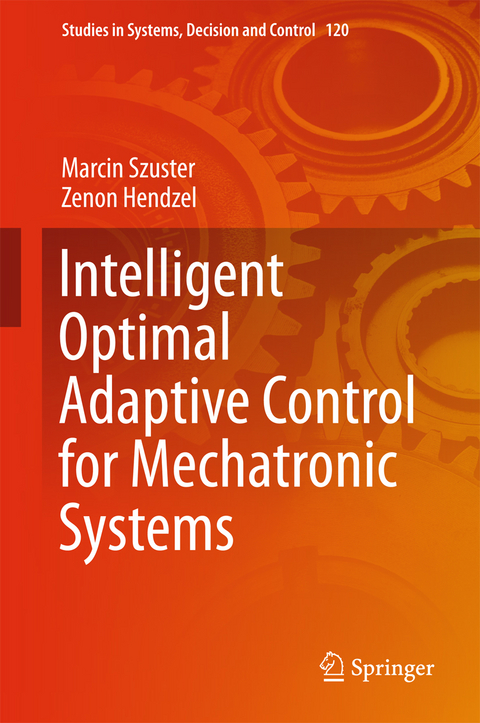
Intelligent Optimal Adaptive Control for Mechatronic Systems (eBook)
XI, 382 Seiten
Springer International Publishing (Verlag)
978-3-319-68826-8 (ISBN)
Contents 7
1 Introduction 12
1.1 Artificial Intelligence and Neural Networks 15
1.2 Learning with a Critic 16
1.3 Scope of Study 17
References 20
2 Object of Research 22
2.1 Two-Wheeled Mobile Robot 22
2.1.1 Description of the Kinematics of a Mobile Robot 23
2.1.2 Description of the Dynamics of a Mobile Robot 32
2.2 Robotic Manipulator 42
2.2.1 Description of the Kinematics of a Robotic Manipulator 43
2.2.2 Description of the Dynamics of a Robotic Manipulator 52
References 60
3 Intelligent Control of Mechatronic Systems 62
3.1 Methods for Control of Nonlinear Systems 62
3.2 Neural Control 65
3.2.1 Random Vector Functional Link Neural Network 67
3.2.2 Neural Network with Gaussian-Type Activation Functions 68
References 69
4 Optimal Control Methods for Mechatronic Systems 71
4.1 Bellman's Dynamic Programming 71
4.2 Linear-Quadratic Regulator 75
4.3 Pontryagin's Maximum Principle 81
4.4 Summary 90
References 93
5 Learning Methods for Intelligent Systems 94
5.1 Supervised Learning 94
5.1.1 Steepest Descent Algorithm 95
5.1.2 Variable Metric Algorithm 96
5.1.3 Levenberg--Marquardt Algorithm 97
5.1.4 Conjugate Gradient Method 98
5.2 Learning with a Critic 99
5.2.1 Q-Learning Algorithm 101
5.3 Learning Without a Teacher 102
5.3.1 Winner-Take-All Networks 102
5.3.2 Winner-Take-Most Networks 103
References 104
6 Adaptive Dynamic Programming - Discrete Version 105
6.1 Neural Dynamic Programming 105
6.2 Model-Based Learning Methods 109
6.2.1 Heuristic Dynamic Programming 110
6.2.2 Dual-Heuristic Dynamic Programming 114
6.2.3 Global Dual-Heuristic Dynamic Programming 125
6.3 Model-Free Learning Methods 128
6.3.1 Action-Dependent Heuristic Dynamic Programming 128
References 131
7 Control of Mechatronic Systems 135
7.1 Tracking Control of a WMR and a RM with a PD Controller 137
7.1.1 Synthesis of PD-Type Control 138
7.1.2 Simulation Tests 138
7.1.3 Conclusions 148
7.2 Adaptive Tracking Control of a WMR 148
7.2.1 Synthesis of an Adaptive Control Algorithm 149
7.2.2 Simulation Tests 152
7.2.3 Conclusions 156
7.3 Neural Tracking Control of a WMR 156
7.3.1 Synthesis of a Neural Control Algorithm 156
7.3.2 Simulation Tests 160
7.3.3 Conclusions 164
7.4 Heuristic Dynamic Programming in Tracking Control of a WMR 164
7.4.1 Synthesis of HDP-Type Control 165
7.4.2 Simulation Tests 171
7.4.3 Conclusions 182
7.5 Dual-Heuristic Dynamic Programming in Tracking Control of a WMR and a RM 183
7.5.1 Synthesis of DHP-Type Control 183
7.5.2 Simulation Tests 190
7.5.3 Conclusions 203
7.6 Globalised Dual-Heuristic Dynamic Programming in Tracking Control of a WMR and a RM 203
7.6.1 Synthesis of GDHP-Type Control 204
7.6.2 Simulation Tests 210
7.6.3 Conclusions 222
7.7 Action Dependent Heuristic Dynamic Programming in Tracking Control of a WMR 222
7.7.1 Synthesis of ADHDP-type Control 223
7.7.2 Simulation Tests 226
7.7.3 Conclusions 231
7.8 Behavioural Control of WMR's Motion 232
7.8.1 Behavioural Control Synthesis 236
7.8.2 Simulation Tests 242
7.8.3 Conclusions 249
7.9 Summary 250
7.9.1 Selection of Value of the Future Reward Discount Factor ? 256
References 257
8 Reinforcement Learning in the Control of Nonlinear Continuous Systems 262
8.1 Classical Reinforcement Learning 263
8.1.1 Control Synthesis, Stability of a System, Reinforcement Learning Algorithm 263
8.1.2 Simulation Tests 268
8.1.3 Conclusions 273
8.2 Approximation of Classical Reinforcement Learning 273
8.2.1 Control System Synthesis, Stability of the System, Reinforcement Learning Algorithm 274
8.2.2 Simulation Tests 276
8.2.3 Conclusions 277
8.3 Reinforcement Learning in the Actor-Critic Structure 278
8.3.1 Synthesis of Control System, System Stability, Reinforcement Learning Algorithm 279
8.3.2 Simulation Tests 284
8.3.3 Conclusions 287
8.4 Reinforcement Learning of Actor-Critic Type in the Optimal Adaptive Control 287
8.4.1 Control Synthesis, Stability of a System, Reinforcement Learning Algorithm 287
8.4.2 Simulation Tests 291
8.4.3 Conclusions 293
8.5 Implementation of Critic's Adaptive Structure in Optimal Control 294
8.5.1 Control Synthesis, Critic's Learning Algorithm, Stability of a System 294
8.5.2 Simulation Tests 299
8.5.3 Conclusions 302
References 303
9 Two-Person Zero-Sum Differential Games and Hinfty Control 305
9.1 Hinfty control 305
9.2 A Two-Person Zero-Sum Differential Game 307
9.3 Application of a Two-Person Zero-Sum Differential Game in Control of the Drive Unit of a WMR 308
9.3.1 Simulation Tests 309
9.3.2 Conclusions 314
9.4 Application of a Neural Network in the Two-Person Zero-Sum Differential Game in WMR Control 314
9.4.1 Simulation Tests 318
9.4.2 Conclusions 321
References 322
10 Experimental Verification of Control Algorithms 323
10.1 Description of Laboratory Stands 323
10.1.1 WMR Motion Control Stand 323
10.1.2 RM Motion Control Stand 325
10.2 Analysis of the PD Control 327
10.2.1 Analysis of the WMR Motion Control 327
10.2.2 Analysis of the RM Motion Control 332
10.2.3 Conclusions 334
10.3 Analysis of the Adaptive Control 335
10.3.1 Analysis of the WMR Motion Control 335
10.3.2 Conclusions 339
10.4 Analysis of the Neural Control 339
10.4.1 Analysis of the WMR Motion Control 339
10.4.2 Conclusions 343
10.5 Analysis of the HDP Control 343
10.5.1 Analysis of the WMR Motion Control 343
10.5.2 Conclusions 352
10.6 Analysis of the DHP Control 353
10.6.1 Analysis of the WMR Motion Control 353
10.6.2 Analysis of the RM Motion Control 358
10.6.3 Conclusions 363
10.7 Analysis of the GDHP Control 363
10.7.1 Analysis of the WMR Motion Control 364
10.7.2 Conclusions 368
10.8 Analysis of the ADHDP Control 368
10.8.1 Analysis of the WMR Motion Control 368
10.8.2 Conclusions 372
10.9 Analysis of Behavioral Control 372
10.9.1 Analysis of the WMR Motion Control 374
10.9.2 Conclusions 378
10.10 Summary 379
References 385
11 Summary 386
| Erscheint lt. Verlag | 28.12.2017 |
|---|---|
| Reihe/Serie | Studies in Systems, Decision and Control | Studies in Systems, Decision and Control |
| Zusatzinfo | XI, 382 p. 224 illus., 119 illus. in color. |
| Verlagsort | Cham |
| Sprache | englisch |
| Themenwelt | Informatik ► Theorie / Studium ► Künstliche Intelligenz / Robotik |
| Technik ► Bauwesen | |
| Technik ► Maschinenbau | |
| Schlagworte | Bellman’s Dynamic Programming • DHP Method • GDHP Controller • Heuristic Dynamic Programming • Learning Without a Model • Neural Tracking Control • Nonlinear Systems • robotic manipulators • Supervised and Unsupervised Learning • Two-wheeled Mobile Robots |
| ISBN-10 | 3-319-68826-X / 331968826X |
| ISBN-13 | 978-3-319-68826-8 / 9783319688268 |
| Informationen gemäß Produktsicherheitsverordnung (GPSR) | |
| Haben Sie eine Frage zum Produkt? |
 PDF (Wasserzeichen)
DRM: Digitales Wasserzeichen
Dieses eBook enthält ein digitales Wasserzeichen und ist damit für Sie personalisiert. Bei einer missbräuchlichen Weitergabe des eBooks an Dritte ist eine Rückverfolgung an die Quelle möglich.
Dateiformat: PDF (Portable Document Format)
Mit einem festen Seitenlayout eignet sich die PDF besonders für Fachbücher mit Spalten, Tabellen und Abbildungen. Eine PDF kann auf fast allen Geräten angezeigt werden, ist aber für kleine Displays (Smartphone, eReader) nur eingeschränkt geeignet.
Systemvoraussetzungen:
PC/Mac: Mit einem PC oder Mac können Sie dieses eBook lesen. Sie benötigen dafür einen PDF-Viewer - z.B. den Adobe Reader oder Adobe Digital Editions.
eReader: Dieses eBook kann mit (fast) allen eBook-Readern gelesen werden. Mit dem amazon-Kindle ist es aber nicht kompatibel.
Smartphone/Tablet: Egal ob Apple oder Android, dieses eBook können Sie lesen. Sie benötigen dafür einen PDF-Viewer - z.B. die kostenlose Adobe Digital Editions-App.
Buying eBooks from abroad
For tax law reasons we can sell eBooks just within Germany and Switzerland. Regrettably we cannot fulfill eBook-orders from other countries.
aus dem Bereich