


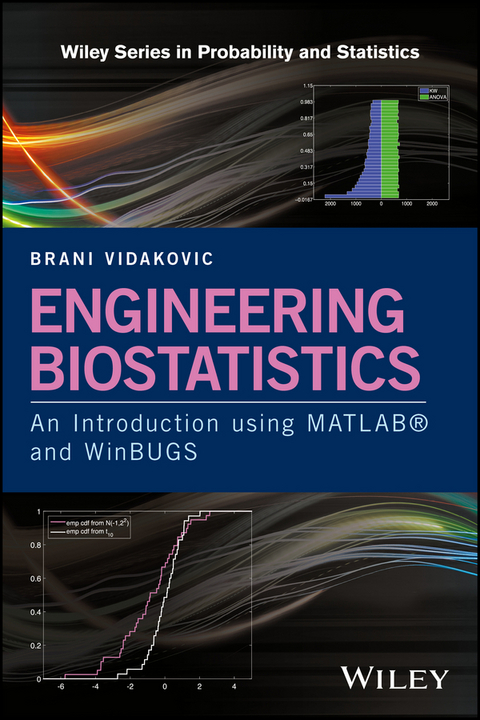
Engineering Biostatistics (eBook)
John Wiley & Sons (Verlag)
978-1-119-16898-0 (ISBN)
Provides a one-stop resource for engineers learning biostatistics using MATLAB® and WinBUGS
Through its scope and depth of coverage, this book addresses the needs of the vibrant and rapidly growing bio-oriented engineering fields while implementing software packages that are familiar to engineers. The book is heavily oriented to computation and hands-on approaches so readers understand each step of the programming. Another dimension of this book is in parallel coverage of both Bayesian and frequentist approaches to statistical inference. It avoids taking sides on the classical vs. Bayesian paradigms, and many examples in this book are solved using both methods. The results are then compared and commented upon. Readers have the choice of MATLAB® for classical data analysis and WinBUGS/OpenBUGS for Bayesian data analysis. Every chapter starts with a box highlighting what is covered in that chapter and ends with exercises, a list of software scripts, datasets, and references.
Engineering Biostatistics: An Introduction using MATLAB® and WinBUGS also includes:
- parallel coverage of classical and Bayesian approaches, where appropriate
- substantial coverage of Bayesian approaches to statistical inference
- material that has been classroom-tested in an introductory statistics course in bioengineering over several years
- exercises at the end of each chapter and an accompanying website with full solutions and hints to some exercises, as well as additional materials and examples
Engineering Biostatistics: An Introduction using MATLAB® and WinBUGS can serve as a textbook for introductory-to-intermediate applied statistics courses, as well as a useful reference for engineers interested in biostatistical approaches.
BRANI VIDAKOVIC, PhD, is a Professor in the School of Industrial and Systems Engineering (ISyE) at Georgia Institute of Technology and Department of Biomedical Engineering at Georgia Institute of Technology/Emory University. Dr. Vidakovic is a Fellow of the American Statistical Association, Elected Member of the International Statistical Institute, an Editor-in-Chief of Encyclopedia of Statistical Sciences, Second Edition, and former and current Associate Editor of several leading journals in the field of statistics.
Provides a one-stop resource for engineers learning biostatistics using MATLAB and WinBUGS Through its scope and depth of coverage, this book addresses the needs of the vibrant and rapidly growing bio-oriented engineering fields while implementing software packages that are familiar to engineers. The book is heavily oriented to computation and hands-on approaches so readers understand each step of the programming. Another dimension of this book is in parallel coverage of both Bayesian and frequentist approaches to statistical inference. It avoids taking sides on the classical vs. Bayesian paradigms, and many examples in this book are solved using both methods. The results are then compared and commented upon. Readers have the choice of MATLAB for classical data analysis and WinBUGS/OpenBUGS for Bayesian data analysis. Every chapter starts with a box highlighting what is covered in that chapter and ends with exercises, a list of software scripts, datasets, and references. Engineering Biostatistics: An Introduction using MATLAB and WinBUGS also includes: parallel coverage of classical and Bayesian approaches, where appropriate substantial coverage of Bayesian approaches to statistical inference material that has been classroom-tested in an introductory statistics course in bioengineering over several years exercises at the end of each chapter and an accompanying website with full solutions and hints to some exercises, as well as additional materials and examples Engineering Biostatistics: An Introduction using MATLAB and WinBUGS can serve as a textbook for introductory-to-intermediate applied statistics courses, as well as a useful reference for engineers interested in biostatistical approaches.
BRANI VIDAKOVIC, PhD, is a Professor in the School of Industrial and Systems Engineering (ISyE) at Georgia Institute of Technology and Department of Biomedical Engineering at Georgia Institute of Technology/Emory University. Dr. Vidakovic is a Fellow of the American Statistical Association, Elected Member of the International Statistical Institute, an Editor-in-Chief of Encyclopedia of Statistical Sciences, Second Edition, and former and current Associate Editor of several leading journals in the field of statistics.
Chapter 1
Introduction
Many people were at first surprised at my using the new words “Statistics” and “Statistical,” as it was supposed that some term in our own language might have expressed the same meaning. But in the course of a very extensive tour through the northern parts of Europe, which I happened to take in 1786, I found that in Germany they were engaged in a species of political inquiry to which they had given the name of “Statistics”…. I resolved on adopting it, and I hope that it is now completely naturalised and incorporated with our language.
– Sinclair, 1791; Vol XX
WHAT IS COVERED IN THIS CHAPTER
- What is the subject of statistics?
- Population, sample, data
- Appetizer examples
The problems confronting health professionals today often involve fundamental aspects of device and system analysis, and their design and application. As such they are of extreme importance to engineers and scientists.
Due to many aspects of engineering and scientific practice involving nondeterministic outcomes, understanding and knowledge of statistics is important to any engineer and scientist. Statistics is a guide to the unknown. It is a science that deals with designing experimental protocols; collecting, summarizing, and presenting data; and, most important, making inferences and aiding decisions in the presence of variability and uncertainty. For example, R. A. Fisher's 1943 elucidation of the human blood-group system Rhesus in terms of the three linked loci C, D, and E, as described in Fisher (1947) or Edwards (2007), is a brilliant example of building a coherent structure of new knowledge guided by a statistical analysis of available experimental data.
The uncertainty that statistical science addresses derives mainly from two sources: (1) from observing only a part of an existing, fixed, but large population or (2) from having a process that results in nondeterministic outcomes. At least a part of the process needs to be either a black box or inherently stochastic, so the outcomes cannot be predicted with certainty.
A population is a statistical universe. It is defined as a collection of existing attributes of some natural phenomenon or a collection of potential attributes when a process is involved. In the case of a process, the underlying population is called hypothetical, for obvious reasons. Thus, populations can be either finite or infinite. A subset of a population selected by some relevant criteria is called a subpopulation.
Often we think about a population as an assembly of people, animals, items, events, times, etc., in which the attribute of interest is measurable. For example, the population of all US citizens older than 21 is an example of a population for which many attributes can be assessed. Attributes might be a history of heart disease, weight, political affiliation, level of blood sugar, etc.
A sample is an observed part of a population. Selection of a sample is a rich methodology in itself, but, unless otherwise specified, it is assumed that the sample is selected at random. The randomness ensures that the sample is representative of its population.
The sampling process depends on the nature of the problem and the population. For example, a sample may be obtained via a retrospective study (usually existing historical outcomes over some period of time), an observational study (an observer monitors the process or population in real time), a sample survey (a researcher administers a questionnaire to measure the characteristics and/or attitudes of subjects), or a designed study (a researcher makes deliberate changes in controllable variables to induce a cause/effect relationship), to name just a few.
Example 1.1. Ohm's Law Measurements. A student constructed a simple electric circuit in which the resistance R and voltage E were controllable. The output of interest is current I, and according to Ohm's law it is
This is a mechanistic, theoretical model. In a finite number of measurements under an identical R, E setting, the measured current varies. The population here is hypothetical – an infinite collection of all potentially obtainable measurements of its attribute, current I. The observed sample is finite. In the presence of sample variability, one establishes an empirical (statistical) model for currents from the population as either (statistical) model for currents from the population as either
On the basis of a sample, one may first select the model and then proceed with the inference about the nature of the discrepancy, ɛ.
Example 1.2. Cell Counts. In a quantitative engineering physiology laboratory, a team of four students was asked to make a LabVIEW© program to automatically count MC3T3-E1 cells in a hemocytometer (Fig. 1.1). This automatic count was to be compared with the manual count collected through an inverted bright field microscope. The manual count is considered the gold standard.
Fig. 1.1 Cells on a hemocytometer plate.
The experiment consisted of placing 10 μL of cell solutions at two levels of cell confluency: 20% and 70%. There were n1 =12 pairs of measurements (automatic and manual counts) at 20% and n2 = 10 pairs at 70%, as in the table below.
| 20% confluency |
| Automated | 34 | 44 | 40 | 62 | 53 | 51 | 30 | 33 | 38 | 51 | 26 | 48 |
| Manual | 30 | 43 | 34 | 53 | 49 | 39 | 37 | 42 | 30 | 50 | 35 | 54 |
| 70% confluency |
| Automated | 72 | 82 | 100 | 94 | 83 | 94 | 73 | 87 | 107 | 102 |
| Manual | 76 | 51 | 92 | 77 | 74 | 81 | 72 | 87 | 100 | 104 |
The students wish to answer the following questions:
- Are the automated and manual counts significantly different for a fixed confluency level? What are the confidence intervals for the population differences if normality of the measurements is assumed?
- If the difference between automated and manual counts constitutes an error, are the errors comparable for the two confluency levels?
We will revisit this example later in the book (Exercise 10.20) and see that for the 20% confluency level there is no significant difference between the automated and manual counts, whereas for the 70% level the difference is significant. We will also see that the errors for the two confluency levels significantly differ. The statistical design for comparison of errors is called a difference in differences (DiD) and is quite common in biomedical data analysis.
Example 1.3. Rana Pipiens. Students in a quantitative engineering physiology laboratory were asked to expose the gastrocnemius muscle of the northern leopard frog (Rana pipiens, and stimulate the sciatic nerve to observe contractions in the skeletal muscle. Students were interested in modeling the length–tension relationship. The force used was the active force, calculated by subtracting the measured passive force (no stimulation) from the total force (with stimulation).
The active force represents the dependent variable. The length of the muscle begins at 35 mm and stretches in increments of 0.5 mm, until a maximum length of 42.5 mm is achieved. The velocity at which the muscle was stretched was held constant at 0.5 mm/s.
| Reading | Change in Length (in %) | Passive force | Total... |
| Erscheint lt. Verlag | 7.12.2017 |
|---|---|
| Reihe/Serie | Wiley Series in Probability and Statistics |
| Wiley Series in Probability and Statistics | Wiley Series in Probability and Statistics |
| Sprache | englisch |
| Themenwelt | Mathematik / Informatik ► Informatik ► Datenbanken |
| Mathematik / Informatik ► Informatik ► Software Entwicklung | |
| Mathematik / Informatik ► Mathematik ► Angewandte Mathematik | |
| Mathematik / Informatik ► Mathematik ► Statistik | |
| Mathematik / Informatik ► Mathematik ► Wahrscheinlichkeit / Kombinatorik | |
| Schlagworte | Applied Statistics • Bayesian and frequentist approaches • biomedical engineering • Biomedizintechnik • bio-oriented engineering fields • Biostatistics • Biostatistik • classical vs. Bayesian paradigms • Computational Bioengineering • Engineering statistics • MATLAB • Rechnergestütztes Bioengineering • Statistical Inference • Statistics • Statistik • Statistik in den Ingenieurwissenschaften • WinBUGS |
| ISBN-10 | 1-119-16898-8 / 1119168988 |
| ISBN-13 | 978-1-119-16898-0 / 9781119168980 |
| Informationen gemäß Produktsicherheitsverordnung (GPSR) | |
| Haben Sie eine Frage zum Produkt? |
 EPUB (Adobe DRM)
Kopierschutz: Adobe-DRM
Adobe-DRM ist ein Kopierschutz, der das eBook vor Mißbrauch schützen soll. Dabei wird das eBook bereits beim Download auf Ihre persönliche Adobe-ID autorisiert. Lesen können Sie das eBook dann nur auf den Geräten, welche ebenfalls auf Ihre Adobe-ID registriert sind.
Details zum Adobe-DRM
Dateiformat: EPUB (Electronic Publication)
EPUB ist ein offener Standard für eBooks und eignet sich besonders zur Darstellung von Belletristik und Sachbüchern. Der Fließtext wird dynamisch an die Display- und Schriftgröße angepasst. Auch für mobile Lesegeräte ist EPUB daher gut geeignet.
Systemvoraussetzungen:
PC/Mac: Mit einem PC oder Mac können Sie dieses eBook lesen. Sie benötigen eine
eReader: Dieses eBook kann mit (fast) allen eBook-Readern gelesen werden. Mit dem amazon-Kindle ist es aber nicht kompatibel.
Smartphone/Tablet: Egal ob Apple oder Android, dieses eBook können Sie lesen. Sie benötigen eine
Geräteliste und zusätzliche Hinweise
Buying eBooks from abroad
For tax law reasons we can sell eBooks just within Germany and Switzerland. Regrettably we cannot fulfill eBook-orders from other countries.
aus dem Bereich


