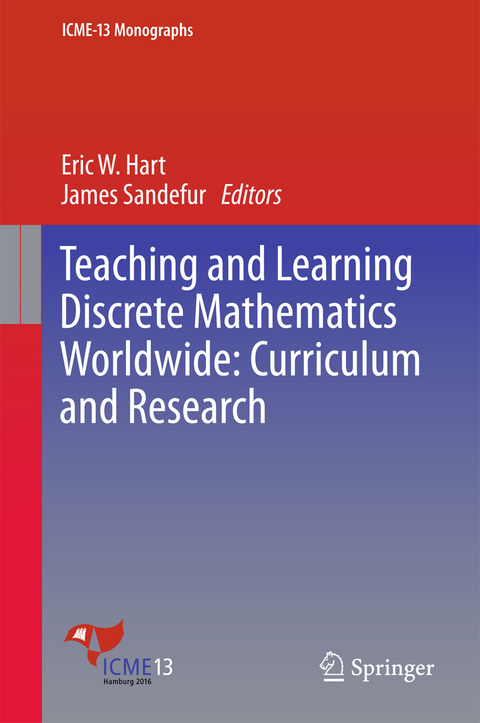
Teaching and Learning Discrete Mathematics Worldwide: Curriculum and Research (eBook)
XII, 276 Seiten
Springer International Publishing (Verlag)
978-3-319-70308-4 (ISBN)
This book discusses examples of discrete mathematics in school curricula, including in the areas of graph theory, recursion and discrete dynamical systems, combinatorics, logic, game theory, and the mathematics of fairness. In addition, it describes current discrete mathematics curriculum initiatives in several countries, and presents ongoing research, especially in the areas of combinatorial reasoning and the affective dimension of learning discrete mathematics.
Discrete mathematics is the math of our time.' So declared the immediate past president of the National Council of Teachers of Mathematics, John Dossey, in 1991. Nearly 30 years later that statement is still true, although the news has not yet fully reached school mathematics curricula. Nevertheless, much valuable work has been done, and continues to be done. This volume reports on some of that work. It provides a glimpse of the state of the art in learning and teaching discrete mathematics around the world, and it makes the case once again that discrete mathematics is indeed mathematics for our time, even more so today in our digital age, and it should be included in the core curricula of all countries for all students.
Part I: The Landscape of Discrete Mathematics in the School Curriculum Discrete Mathematics is Essential Mathematics in a 21st Century School Curriculum (and introduction to this volume) Eric W. Hart and W. Gary Martin The Absence of Discrete Mathematics from Primary and Secondary Education in the United States … and Why that is Counterproductive Joseph G. Rosenstein Discrete Mathematics in Lower School Grades? Situation and Possibilities in Italy Aaron Gaio and Benedetto Di Paola Discrete Mathematics and the Affective Dimension of Mathematical Learning and Engagement Gerald A. Goldin Part II: Combinatorics and Combinatorial Reasoning Combinatorial Reasoning to Solve Problems Tom Coenen, Frits Hof, and Nellie Verhoef Children’s Combinatorial Counting Strategies and their Relationship to Mathematical Counting Principles Karina Höveler Reinforcing Mathematical Concepts and Developing Mathematical Practices through Combinatorial Activity Elise Lockwood and Zack Reed Complex Mathematics Education in the 21st Century: Improving Combinatorial Thinking based on Tamás Varga's Heritage and Recent Research Results Ödön Vancsó, Eliza Beregszászi, Hana Burian, György Emese, Eleonóra Stettner, and Judit Szitányi Part III: Recursion and Recursive Thinking Discrete Dynamical Systems: A Pathway for Students to Become Enchanted with Mathematics Robert L. Devaney How Recursion Supports Algebraic Understanding James Sandefur, Kay Somers, and Rosalie Dance Part IV: Networks and Graphs Food Webs, Competition Graphs, and a 60-year-old Unsolved Problem Margaret (Midge) Cozzens and Pratik Koirala Graph Theory in Primary, Middle and High School Daniela Ferrarello and Maria Flavia Mammana Part V: Fair Decision-Making and Game Theory Fairness Sol Garfunkel Mathematical Research in the Classroom via Combinatorial Games Ximena Colipan Machines designed to play Nim games (1940-1970): A possible (re)use in the modern French mathematics curriculum? Lisa Rougetet Part VI: Logic and Proof Mathematics and Logic: Their Relationship in the Teaching of Mathematics Vladimir I. Igoshin
| Erscheint lt. Verlag | 9.12.2017 |
|---|---|
| Reihe/Serie | ICME-13 Monographs | ICME-13 Monographs |
| Zusatzinfo | XII, 276 p. 84 illus. |
| Verlagsort | Cham |
| Sprache | englisch |
| Themenwelt | Mathematik / Informatik ► Mathematik |
| Sozialwissenschaften ► Pädagogik ► Schulpädagogik / Grundschule | |
| Schlagworte | Affect in mathematics education • combinatorial reasoning • discrete dynamical systems • graph theory • Learning and Instruction • logic in mathematics education • mathematical education • mathematics of fairness • Recursion |
| ISBN-10 | 3-319-70308-0 / 3319703080 |
| ISBN-13 | 978-3-319-70308-4 / 9783319703084 |
| Informationen gemäß Produktsicherheitsverordnung (GPSR) | |
| Haben Sie eine Frage zum Produkt? |
 PDF (Wasserzeichen)
DRM: Digitales Wasserzeichen
Dieses eBook enthält ein digitales Wasserzeichen und ist damit für Sie personalisiert. Bei einer missbräuchlichen Weitergabe des eBooks an Dritte ist eine Rückverfolgung an die Quelle möglich.
Dateiformat: PDF (Portable Document Format)
Mit einem festen Seitenlayout eignet sich die PDF besonders für Fachbücher mit Spalten, Tabellen und Abbildungen. Eine PDF kann auf fast allen Geräten angezeigt werden, ist aber für kleine Displays (Smartphone, eReader) nur eingeschränkt geeignet.
Systemvoraussetzungen:
PC/Mac: Mit einem PC oder Mac können Sie dieses eBook lesen. Sie benötigen dafür einen PDF-Viewer - z.B. den Adobe Reader oder Adobe Digital Editions.
eReader: Dieses eBook kann mit (fast) allen eBook-Readern gelesen werden. Mit dem amazon-Kindle ist es aber nicht kompatibel.
Smartphone/Tablet: Egal ob Apple oder Android, dieses eBook können Sie lesen. Sie benötigen dafür einen PDF-Viewer - z.B. die kostenlose Adobe Digital Editions-App.
Buying eBooks from abroad
For tax law reasons we can sell eBooks just within Germany and Switzerland. Regrettably we cannot fulfill eBook-orders from other countries.
aus dem Bereich