


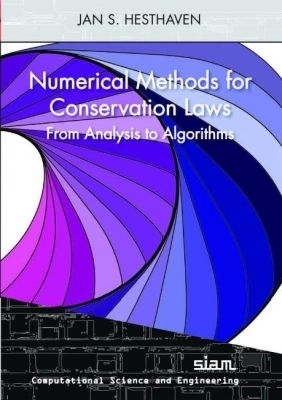
Numerical Methods for Conservation Laws
From Analysis to Algorithm
Seiten
2018
Society for Industrial & Applied Mathematics,U.S. (Verlag)
978-1-61197-509-3 (ISBN)
Society for Industrial & Applied Mathematics,U.S. (Verlag)
978-1-61197-509-3 (ISBN)
- Titel z.Zt. nicht lieferbar
- Versandkostenfrei
- Auch auf Rechnung
- Artikel merken
Offers the first comprehensive introduction to modern computational methods and their analysis for hyperbolic conservation laws, building on intense research activities for more than four decades of development; discusses classic results on monotone and finite difference/finite volume schemes; and addresses modern concepts of TVD and entropy stability.
Conservation laws are the mathematical expression of the principles of conservation and provide effective and accurate predictive models of our physical world. Although intense research activity during the last decades has led to substantial advances in the development of powerful computational methods for conservation laws, their solution remains a challenge and many questions are left open; thus it is an active and fruitful area of research.
Numerical Methods for Conservation Laws: From Analysis to Algorithms:
offers the first comprehensive introduction to modern computational methods and their analysis for hyperbolic conservation laws, building on intense research activities for more than four decades of development;
discusses classic results on monotone and finite difference/finite volume schemes, but emphasizes the successful development of high-order accurate methods for hyperbolic conservation laws;
addresses modern concepts of TVD and entropy stability, strongly stable Runge-Kutta schemes, and limiter-based methods before discussing essentially nonoscillatory schemes, discontinuous Galerkin methods, and spectral methods;
explores algorithmic aspects of these methods, emphasizing one- and two-dimensional problems and the development and analysis of an extensive range of methods;
includes MATLAB software with which all main methods and computational results in the book can be reproduced; and
demonstrates the performance of many methods on a set of benchmark problems to allow direct comparisons.
Code and other supplemental material are available online at www.siam.org/books/cs18.
Conservation laws are the mathematical expression of the principles of conservation and provide effective and accurate predictive models of our physical world. Although intense research activity during the last decades has led to substantial advances in the development of powerful computational methods for conservation laws, their solution remains a challenge and many questions are left open; thus it is an active and fruitful area of research.
Numerical Methods for Conservation Laws: From Analysis to Algorithms:
offers the first comprehensive introduction to modern computational methods and their analysis for hyperbolic conservation laws, building on intense research activities for more than four decades of development;
discusses classic results on monotone and finite difference/finite volume schemes, but emphasizes the successful development of high-order accurate methods for hyperbolic conservation laws;
addresses modern concepts of TVD and entropy stability, strongly stable Runge-Kutta schemes, and limiter-based methods before discussing essentially nonoscillatory schemes, discontinuous Galerkin methods, and spectral methods;
explores algorithmic aspects of these methods, emphasizing one- and two-dimensional problems and the development and analysis of an extensive range of methods;
includes MATLAB software with which all main methods and computational results in the book can be reproduced; and
demonstrates the performance of many methods on a set of benchmark problems to allow direct comparisons.
Code and other supplemental material are available online at www.siam.org/books/cs18.
Jan S. Hesthaven is Dean of Basic Sciences, Professor of Mathematics, and holds the Chair of Computational Mathematics and Simulation Science at Ecole Polytechnique Fédérale de Lausanne (EPFL) in Switzerland. Prior to joining EPFL in 2013, he was Professor of Applied Mathematics at Brown University. He has worked for more than two decades on the development, analysis, and application of modern computational methods for linear and nonlinear wave problems, with an emphasis on high-order accurate methods. He is an Alfred P. Sloan Fellow (2001), an NSF Career award winner (2002), and a SIAM Fellow (2014).
| Erscheinungsdatum | 08.01.2018 |
|---|---|
| Reihe/Serie | Computational Science and Engineering |
| Verlagsort | New York |
| Sprache | englisch |
| Maße | 152 x 229 mm |
| Gewicht | 1260 g |
| Themenwelt | Mathematik / Informatik ► Informatik ► Theorie / Studium |
| Mathematik / Informatik ► Mathematik ► Angewandte Mathematik | |
| ISBN-10 | 1-61197-509-3 / 1611975093 |
| ISBN-13 | 978-1-61197-509-3 / 9781611975093 |
| Zustand | Neuware |
| Informationen gemäß Produktsicherheitsverordnung (GPSR) | |
| Haben Sie eine Frage zum Produkt? |
Mehr entdecken
aus dem Bereich

aus dem Bereich
was jeder über Informatik wissen sollte
Buch | Softcover (2024)
Springer Vieweg (Verlag)
CHF 53,15
Teil 2 der gestreckten Abschlussprüfung Fachinformatiker/-in …
Buch | Softcover (2025)
Europa-Lehrmittel (Verlag)
CHF 37,90
Wenn Computer mit plus und mal an ihre Grenzen stoßen
Buch | Softcover (2025)
Springer (Verlag)
CHF 32,15


