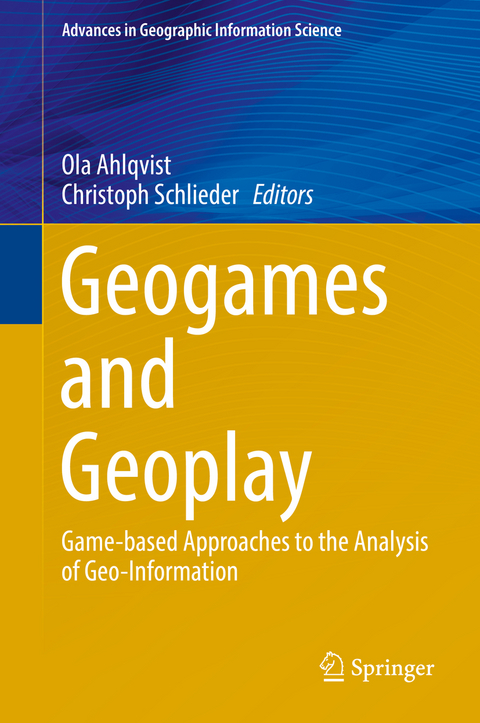
Geogames and Geoplay (eBook)
X, 238 Seiten
Springer International Publishing (Verlag)
978-3-319-22774-0 (ISBN)
Of interest to anyone interested in creating and using Geogames, this volume serves as a channel for sharing early experiences, discussing technological challenges and solutions, and outlines a future research agenda.
Games and play are part of human life, and in many game activities, place, space and geography plays a central role in determining the rules and interactions that are characteristic of each game. Recent developments and widespread access to mobile information, communication, and geospatial technologies have spurred a flurry of developments, including many variations of gaming activities that are situated in, or otherwise connected to the real world.
Dr. Ola Ahlqvist worked professionally with local and regional environmental planning in Finland and Sweden in the early 1990's. After completing a PhD in Geography at Stockholm University in 2001 followed by post-doctoral training at Penn State University he joined The Ohio State University Department of Geography in 2005. His research interests revolve around three broad areas: 1) semantic uncertainty and formal ontology in analysis of land cover change, landscape history, and visualization. 2) how online maps, social media, and games form a nexus for spatial collaboration, social-environmental simulation, and decision making. 3) the scholarship of teaching and learning in GIS and Service-Learning.
Christoph Schlieder is Chair of Applied Computer Science at the University of Bamberg, Germany and leads the research group on Computing in the Cultural Sciences. He holds a Ph.D. and a Habilitation degree in computer science, both from the University of Hamburg. Before coming to
Bamberg he worked at the University of Bremen where he headed the Artificial Intelligence research group. His research interests focus on methods from semantic information processing and their application to problems from the cultural sciences. Most of his scientific work puts an emphasis on spatial modelling. He has widely published on technical topics including qualitative and diagrammatic reasoning, preferred mental models, geo-spatial semantics, and mobile assistance systems. Since 2004 he designs and analyzes geogames and, more specifically, location-based games played outdoors on mobile devices.Dr. Ola Ahlqvist worked professionally with local and regional environmental planning in Finland and Sweden in the early 1990's. After completing a PhD in Geography at Stockholm University in 2001 followed by post-doctoral training at Penn State University he joined The Ohio State University Department of Geography in 2005. His research interests revolve around three broad areas: 1) semantic uncertainty and formal ontology in analysis of land cover change, landscape history, and visualization. 2) how online maps, social media, and games form a nexus for spatial collaboration, social-environmental simulation, and decision making. 3) the scholarship of teaching and learning in GIS and Service-Learning. Christoph Schlieder is Chair of Applied Computer Science at the University of Bamberg, Germany and leads the research group on Computing in the Cultural Sciences. He holds a Ph.D. and a Habilitation degree in computer science, both from the University of Hamburg. Before coming to Bamberg he worked at the University of Bremen where he headed the Artificial Intelligence research group. His research interests focus on methods from semantic information processing and their application to problems from the cultural sciences. Most of his scientific work puts an emphasis on spatial modelling. He has widely published on technical topics including qualitative and diagrammatic reasoning, preferred mental models, geo-spatial semantics, and mobile assistance systems. Since 2004 he designs and analyzes geogames and, more specifically, location-based games played outdoors on mobile devices.
Foreword.- Introducing Geogames and Geoplay – Characterizing an emerging research field.- Defining a Geogame genre using core concepts of games, play, and geographic information and thinking.- OriGami – A Mobile Geogame for Spatial Literacy.- Spatial Game for Negotiations and Consensus Building in Urban Planning: YouPlaceIt!.- Addressing Uneven Participation Patterns in VGI through Gamification Mechanisms.- Teaching Geogame Design: Game Relocation as a Spatial Analysis Task.- (Re-)Localization of Location-Based Games.- The Design and Play of Geogames as Place-based Education.- A cost-effective workflow for depicting landscapes in immersive virtual environments.- Structural Gamification of a University GIS Course.- Geocaching on the Moon.- Ludography.
| Erscheint lt. Verlag | 10.11.2017 |
|---|---|
| Reihe/Serie | Advances in Geographic Information Science | Advances in Geographic Information Science |
| Zusatzinfo | X, 238 p. 60 illus., 56 illus. in color. |
| Verlagsort | Cham |
| Sprache | englisch |
| Themenwelt | Mathematik / Informatik ► Mathematik |
| Naturwissenschaften ► Geowissenschaften ► Geografie / Kartografie | |
| Schlagworte | AR Games • game mechanics • Geodesign • Geogames • Geoplay • GIS Games • location-based games • Spatial Gamification • VGI |
| ISBN-10 | 3-319-22774-2 / 3319227742 |
| ISBN-13 | 978-3-319-22774-0 / 9783319227740 |
| Informationen gemäß Produktsicherheitsverordnung (GPSR) | |
| Haben Sie eine Frage zum Produkt? |
 PDF (Wasserzeichen)
DRM: Digitales Wasserzeichen
Dieses eBook enthält ein digitales Wasserzeichen und ist damit für Sie personalisiert. Bei einer missbräuchlichen Weitergabe des eBooks an Dritte ist eine Rückverfolgung an die Quelle möglich.
Dateiformat: PDF (Portable Document Format)
Mit einem festen Seitenlayout eignet sich die PDF besonders für Fachbücher mit Spalten, Tabellen und Abbildungen. Eine PDF kann auf fast allen Geräten angezeigt werden, ist aber für kleine Displays (Smartphone, eReader) nur eingeschränkt geeignet.
Systemvoraussetzungen:
PC/Mac: Mit einem PC oder Mac können Sie dieses eBook lesen. Sie benötigen dafür einen PDF-Viewer - z.B. den Adobe Reader oder Adobe Digital Editions.
eReader: Dieses eBook kann mit (fast) allen eBook-Readern gelesen werden. Mit dem amazon-Kindle ist es aber nicht kompatibel.
Smartphone/Tablet: Egal ob Apple oder Android, dieses eBook können Sie lesen. Sie benötigen dafür einen PDF-Viewer - z.B. die kostenlose Adobe Digital Editions-App.
Buying eBooks from abroad
For tax law reasons we can sell eBooks just within Germany and Switzerland. Regrettably we cannot fulfill eBook-orders from other countries.
aus dem Bereich