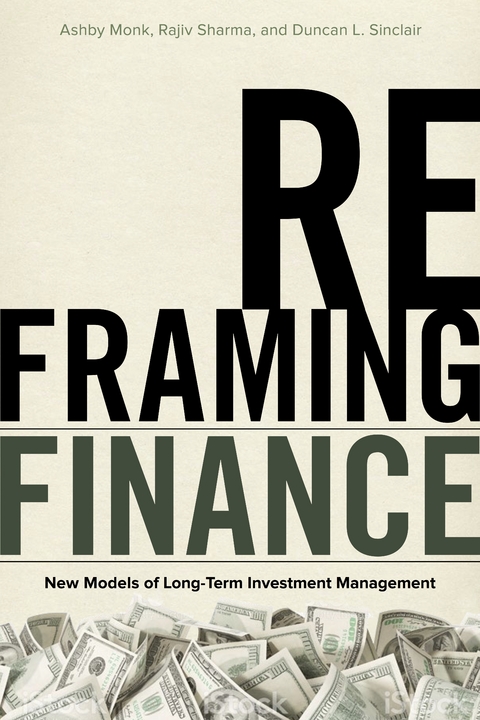
Reframing Finance (eBook)
216 Seiten
Stanford University Press (Verlag)
978-1-5036-0275-5 (ISBN)

Since the 2008 financial crisis, beneficiary organizations-like pension funds, sovereign wealth funds, endowments, and foundations-have been seeking ways to mitigate the risk of their investments and make better financial decisions. For them, Reframing Finance offers a path forward.This book argues that institutional investors would better serve their long-term goals by putting money into large-scale, future-facing projects such as infrastructure, green energy, innovation in agriculture, and real estate development. At the same time, redirecting long-term investments would close significant financial gaps that government cannot. Drawing on key contributions in economic sociology, social network theory, and economics, the book conceptualizes a collaborative model of investment that is already becoming increasingly common: Large investors contribute more directly to private market assets, while financial intermediaries seek to foster co-investment partnerships, better aligning incentives for all. A combination of rich case studies and rigorous theory enables asset owners to move toward more efficient, private-market investing, while also laying groundwork for research at the frontier of finance.
Ashby Monk is Executive and Research Director of Stanford University's Global Projects Center. Rajiv Sharma is Research Program Manager at Stanford's Global Projects Center and Visiting Research Associate at Oxford University's Smith School of Enterprise and the Environment. Duncan L. Sinclair is Vice Chair at Deloitte.
Contents and Abstracts1A Collaborative Model for Long-Term Investing chapter abstractThis chapter introduces the key themes that will be looked at in this book. In particular, it looks at the problem of long-term investing, illustrating why institutional investors are not acting in a long-term manner and the repercussions that this has for wider society. It provides a clear distinction between asset owner investors who have monopolies over their capital source and financial intermediaries, who are essentially acting on the former's behalf but have come under much scrutiny for their shorter-term, opportunistic, and at times unethical behavior. The collaborative model of long-term investing and re-intermediation thesis is introduced as an innovative way for institutional investors to overcome some of the challenges of short-termism. The chapter outlines how social network theory and economic sociology are used to validate the collaborative model. This paves the way for detailed explanations and case study examples starting in Chapter 2.2Building an Institutional Investor's Collaborative Network and Social Capital chapter abstractDrawing on social capital theory, this chapter provides the key theoretical validation for why it is crucial for institutional investors to build their social capital. It argues that one of the key value propositions of financial intermediaries is the network that they are able to tap into when facilitating the investment management process, whether it be for sourcing opportunities, attracting investor capital, or acquiring proprietary knowledge. This argument is backed up by the literature, specifically when one understands in detail the structural, relational, and cognitive dimensions of social capital. The chapter provides practical guidance on how institutional investors can overcome some of their own long-term investment challenges by building an effective and efficient network. After providing key considerations for network-building, the chapter analyzes some of the major membership and roundtable initiatives that have been created to help institutional investors collaborate and achieve their long-term investment objectives.3Re-intermediating Investment Management chapter abstractChapter 3 focuses on the re-intermediating aspect of the collaborative model, explaining the idea that institutional investors need to re-engage with their asset managers in order to obtain greater alignment of interests. The chapter recognizes that asset managers can provide value to their investor clients under the right terms and conditions and seeks to understand what such a governance arrangement looks like. It draws inspiration from the sociology–informed relational contracting method, which emphasizes trust, mutual dependency, and cooperation over the long term as key norms of the contractual engagement. Relational contracting is thus proposed as an ideological form of governance between investors and investment managers, which is practically translated into more discrete mandates, greater responsibility for investors, greater transparency, and robust incentive structures. The chapter provides theoretical evidence for the importance of relational contacts and practical guidance for achieving them.4New Vehicles to Drive the Collaborative Model chapter abstractChapter 4 presents actual case study examples of the vehicles that have been set up and represent the collaborative model. Whereas earlier chapters provided the theoretical explanation and validation for the collaborative model, Chapter 4 provides detailed explanations of eight investor-led co-investment platforms, joint ventures, and platform companies. The vehicles illustrated represent innovative ways for institutional investors to pool capital together to invest around the world into long-term assets such as infrastructure, agriculture, and real estate. The case studies are designed to outline how they came about and what the challenges were in their setup. The chapter is supplemented with a database that identifies over a hundred collaborative investment vehicles that have been set up mostly in the last few years. This chapter will help provide key lessons on strategy, governance, and structural issues as more of these vehicles are setup in the future.5The Future of Long-Term Institutional Investment chapter abstractThe concluding chapter emphasizes the need for institutional investors to rely on their own network economies as well as the agglomeration economies that they have access to through financial intermediaries. Social capital managers can be instrumental in helping institutional investors take advantage of these networks. Responding to the current trend toward peer collaboration and dis-intermediation, the chapter emphasizes the need for existing intermediaries to change their business models to keep pace. The number of new intermediaries that can help facilitate the flow of capital more efficiently into long-term assets are predicted to increase. The chapter highlights the importance of the government's role and the value of teaming up with true long-term partners for the sake of long-term assets like infrastructure,. This is the essence of the collaborative model, which helps investors achieve their own commercial objectives as well as broader economic objectives for society.
| Erscheint lt. Verlag | 8.8.2017 |
|---|---|
| Zusatzinfo | 29 figures, 2 tables |
| Sprache | englisch |
| Themenwelt | Mathematik / Informatik ► Mathematik ► Finanz- / Wirtschaftsmathematik |
| Recht / Steuern ► Wirtschaftsrecht | |
| Wirtschaft ► Betriebswirtschaft / Management ► Finanzierung | |
| Wirtschaft ► Betriebswirtschaft / Management ► Planung / Organisation | |
| Schlagworte | co-investment • Collaborative model • Financial Intermediaries • Infrastructure Investment • Joint Ventures • long-term investment • platform companies • real assets. • re-intermediation • Relational Contracts |
| ISBN-10 | 1-5036-0275-3 / 1503602753 |
| ISBN-13 | 978-1-5036-0275-5 / 9781503602755 |
| Informationen gemäß Produktsicherheitsverordnung (GPSR) | |
| Haben Sie eine Frage zum Produkt? |
 EPUB (Adobe DRM)
Kopierschutz: Adobe-DRM
Adobe-DRM ist ein Kopierschutz, der das eBook vor Mißbrauch schützen soll. Dabei wird das eBook bereits beim Download auf Ihre persönliche Adobe-ID autorisiert. Lesen können Sie das eBook dann nur auf den Geräten, welche ebenfalls auf Ihre Adobe-ID registriert sind.
Details zum Adobe-DRM
Dateiformat: EPUB (Electronic Publication)
EPUB ist ein offener Standard für eBooks und eignet sich besonders zur Darstellung von Belletristik und Sachbüchern. Der Fließtext wird dynamisch an die Display- und Schriftgröße angepasst. Auch für mobile Lesegeräte ist EPUB daher gut geeignet.
Systemvoraussetzungen:
PC/Mac: Mit einem PC oder Mac können Sie dieses eBook lesen. Sie benötigen eine
eReader: Dieses eBook kann mit (fast) allen eBook-Readern gelesen werden. Mit dem amazon-Kindle ist es aber nicht kompatibel.
Smartphone/Tablet: Egal ob Apple oder Android, dieses eBook können Sie lesen. Sie benötigen eine
Geräteliste und zusätzliche Hinweise
Buying eBooks from abroad
For tax law reasons we can sell eBooks just within Germany and Switzerland. Regrettably we cannot fulfill eBook-orders from other countries.
aus dem Bereich