


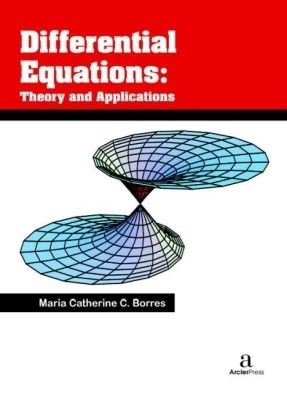
Differential Equations
Theory and Applications
Seiten
2016
Arcler Education Inc (Verlag)
978-1-68094-589-8 (ISBN)
Arcler Education Inc (Verlag)
978-1-68094-589-8 (ISBN)
- Titel z.Zt. nicht lieferbar
- Versandkostenfrei
- Auch auf Rechnung
- Artikel merken
A differential equation is a mathematical equation that relates some function with its derivatives. In applications, the functions usually represent physical quantities, the derivatives represent their rates of change, and the equation defines a relationship between the two. Because such relations are extremely common, differential equations play a prominent role in many disciplines.
A differential equation is a mathematical equation that relates some function with its derivatives. In applications, the functions usually represent physical quantities, the derivatives represent their rates of change, and the equation defines a relationship between the two. Because such relations are extremely common, differential equations play a prominent role in many disciplines including engineering, physics, economics, and biology. In pure mathematics, differential equations are studied from several different perspectives, mostly concerned with their solutions—the set of functions that satisfy the equation. Only the simplest differential equations are solvable by explicit formulas; however, some properties of solutions of a given differential equation may be determined without finding their exact form. Differential equations can be divided into several types. Apart from describing the properties of the equation itself, these classes of differential equations can help inform the choice of approach to a solution. Commonly used distinctions include whether the equation is: Ordinary/Partial, Linear/Non-linear, and Homogeneous/Inhomogeneous. One of the most basic examples of differential equations is the Malthusian Law of population growth dp/dt = rp shows how the population (p) changes with respect to time. The constant r will change depending on the species. Malthus used this law to predict how a species would grow over time. More complicated differential equations can be used to model the relationship between predators and prey. For example, as predators increase then prey decrease as more get eaten. But then the predators will have less to eat and start to die out, which allows more prey to survive. The interactions between the two populations are connected by differential equations.
A differential equation is a mathematical equation that relates some function with its derivatives. In applications, the functions usually represent physical quantities, the derivatives represent their rates of change, and the equation defines a relationship between the two. Because such relations are extremely common, differential equations play a prominent role in many disciplines including engineering, physics, economics, and biology. In pure mathematics, differential equations are studied from several different perspectives, mostly concerned with their solutions—the set of functions that satisfy the equation. Only the simplest differential equations are solvable by explicit formulas; however, some properties of solutions of a given differential equation may be determined without finding their exact form. Differential equations can be divided into several types. Apart from describing the properties of the equation itself, these classes of differential equations can help inform the choice of approach to a solution. Commonly used distinctions include whether the equation is: Ordinary/Partial, Linear/Non-linear, and Homogeneous/Inhomogeneous. One of the most basic examples of differential equations is the Malthusian Law of population growth dp/dt = rp shows how the population (p) changes with respect to time. The constant r will change depending on the species. Malthus used this law to predict how a species would grow over time. More complicated differential equations can be used to model the relationship between predators and prey. For example, as predators increase then prey decrease as more get eaten. But then the predators will have less to eat and start to die out, which allows more prey to survive. The interactions between the two populations are connected by differential equations.
Catherine Borres is currently taking up Master of Arts in Education Major in Mathematics in Philippine Normal University – Manila. She is currently working as a Content Developer for Mathematics at the Affordable Private Education Center (APEC Schools).
| Erscheinungsdatum | 20.03.2018 |
|---|---|
| Sprache | englisch |
| Maße | 152 x 229 mm |
| Gewicht | 720 g |
| Themenwelt | Mathematik / Informatik ► Mathematik ► Analysis |
| ISBN-10 | 1-68094-589-0 / 1680945890 |
| ISBN-13 | 978-1-68094-589-8 / 9781680945898 |
| Zustand | Neuware |
| Informationen gemäß Produktsicherheitsverordnung (GPSR) | |
| Haben Sie eine Frage zum Produkt? |
Mehr entdecken
aus dem Bereich

aus dem Bereich
Festigkeits- und Verformungslehre, Baudynamik, Wärmeübertragung, …
Buch | Hardcover (2025)
De Gruyter Oldenbourg (Verlag)
CHF 125,90


