


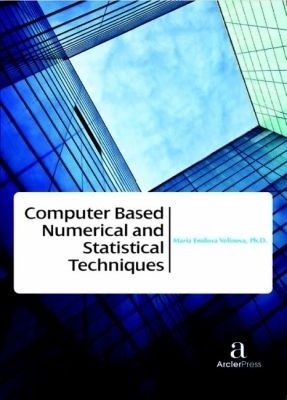
Computer Based Numerical and Statistical Techniques
Seiten
2016
Arcler Education Inc (Verlag)
978-1-68094-451-8 (ISBN)
Arcler Education Inc (Verlag)
978-1-68094-451-8 (ISBN)
- Titel z.Zt. nicht lieferbar
- Versandkostenfrei
- Auch auf Rechnung
- Artikel merken
Covers several advanced applications of numerical and statistical procedures in different fields. In particular, the book explores numerical stability analysis, numerical integration methods for differential and integral equations, numerical differentiation, time-series and images statistical analysis, and Monte Carlo methods.
Computer-based numerical and statistical techniques have the purpose to improve performance and minimize error in problem-solving application. For example, in signal processing that considers signals as stochastic processes, using their statistical properties; in climatology and climate monitoring to attempt for weather prediction and to reveal alterations in the environment; in demography where the statistical study of an entire population is performed, statistical methods can be applied to any kind of population character that varies over a time or space. For such reasons, the application of both numerical analysis and statistical sciences has become a fundamental knowledge of all the modern engineers and scientists.
The contents of this book cover several advanced applications of numerical and statistical procedures in many different fields. In particular, numerical stability analysis, numerical integration methods for differential and integral equations, numerical differentiation, time-series and images statistical analysis, and Monte Carlo methods.
In the first section of book, the search of numerical solutions of first-order linear Fuzzy differential equations, of PDEs in two different problems of fluid dynamics and heat transfer, of nonlinear Sine-Gordon equation by modified cubic B-spline collocation method, and of nonlinear models of electrical transformers is discussed. Moreover, enough space is given to the analysis of the numerical stability in weather and climate models, and of the exponential convergence of particular forms of integral equations. At last, the problems both of differentiating a noisy and nonsmooth function avoiding the noise amplification of finite-difference methods, and of the computational cost of several numerical methods applied for solving of fractional differential equations are considered.In the second and last section of the book, different examples of statistical analysis and of application of Monte Carlo (MC) methods are shown in several fields. In particular, the statistical study of time series with scaling indices, and the application of wavelet-based analysis and a sliding window-based method for extracting spatiotemporal patterns are discussed. Moreover, the statistical evaluation both of a fully automated mammographic breast density algorithm, and of the effect of nano-CMOS spatial variability on integrated circuits is also studied. Lastly, three different examples of application of MC are provided: an integrated procedure for Bayesian inference using Markov chain MC methods; MC numerical simulations to solve non-stationary random responses of nonlinear multi-degrees-of-freedom Duffing systems subjected to evolutionary random excitations; and the comparison of classical MC methods and deterministic grid-based Boltzmann equation solvers implemented in a commercial treatment planning system for radiotherapy photon beam dose calculation.
Computer-based numerical and statistical techniques have the purpose to improve performance and minimize error in problem-solving application. For example, in signal processing that considers signals as stochastic processes, using their statistical properties; in climatology and climate monitoring to attempt for weather prediction and to reveal alterations in the environment; in demography where the statistical study of an entire population is performed, statistical methods can be applied to any kind of population character that varies over a time or space. For such reasons, the application of both numerical analysis and statistical sciences has become a fundamental knowledge of all the modern engineers and scientists.
The contents of this book cover several advanced applications of numerical and statistical procedures in many different fields. In particular, numerical stability analysis, numerical integration methods for differential and integral equations, numerical differentiation, time-series and images statistical analysis, and Monte Carlo methods.
In the first section of book, the search of numerical solutions of first-order linear Fuzzy differential equations, of PDEs in two different problems of fluid dynamics and heat transfer, of nonlinear Sine-Gordon equation by modified cubic B-spline collocation method, and of nonlinear models of electrical transformers is discussed. Moreover, enough space is given to the analysis of the numerical stability in weather and climate models, and of the exponential convergence of particular forms of integral equations. At last, the problems both of differentiating a noisy and nonsmooth function avoiding the noise amplification of finite-difference methods, and of the computational cost of several numerical methods applied for solving of fractional differential equations are considered.In the second and last section of the book, different examples of statistical analysis and of application of Monte Carlo (MC) methods are shown in several fields. In particular, the statistical study of time series with scaling indices, and the application of wavelet-based analysis and a sliding window-based method for extracting spatiotemporal patterns are discussed. Moreover, the statistical evaluation both of a fully automated mammographic breast density algorithm, and of the effect of nano-CMOS spatial variability on integrated circuits is also studied. Lastly, three different examples of application of MC are provided: an integrated procedure for Bayesian inference using Markov chain MC methods; MC numerical simulations to solve non-stationary random responses of nonlinear multi-degrees-of-freedom Duffing systems subjected to evolutionary random excitations; and the comparison of classical MC methods and deterministic grid-based Boltzmann equation solvers implemented in a commercial treatment planning system for radiotherapy photon beam dose calculation.
Maria Velinova is Ph.D. holder in Quantum chemistry at the University of Sofia since April 2012. Her major research experience is in the field of Computational Chemistry, especially in statistical mechanics methods applied to different sorts of biomolecules. She is a member of the Laboratory of Quantum and Computational Chemistry at the University of Sofia.
| Erscheinungsdatum | 20.03.2018 |
|---|---|
| Sprache | englisch |
| Maße | 152 x 229 mm |
| Gewicht | 860 g |
| Themenwelt | Mathematik / Informatik ► Informatik ► Netzwerke |
| Mathematik / Informatik ► Informatik ► Theorie / Studium | |
| ISBN-10 | 1-68094-451-7 / 1680944517 |
| ISBN-13 | 978-1-68094-451-8 / 9781680944518 |
| Zustand | Neuware |
| Informationen gemäß Produktsicherheitsverordnung (GPSR) | |
| Haben Sie eine Frage zum Produkt? |
Mehr entdecken
aus dem Bereich


aus dem Bereich
das umfassende Buch zum Nachschlagen
Buch | Softcover (2025)
Markt + Technik (Verlag)
CHF 27,90
Praktische Übungen für die Vorlesungen und Praktika
Buch (2025)
Hanser (Verlag)
CHF 83,95


