


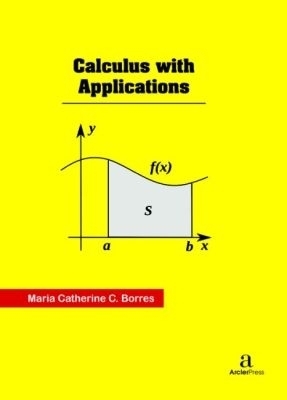
Calculus with Applications
Seiten
2016
Arcler Education Inc (Verlag)
978-1-68094-582-9 (ISBN)
Arcler Education Inc (Verlag)
978-1-68094-582-9 (ISBN)
- Titel z.Zt. nicht lieferbar
- Versandkostenfrei
- Auch auf Rechnung
- Artikel merken
Calculus is a branch of mathematics that explores variables and how they change by looking at them in infinitely small pieces called infinitesimals. Calculus, as it is practiced today, was invented in the 17th century by British scientist Isaac Newton and German scientist Gottfried Leibnitz, who independently developed the principles of calculus in the traditions of geometry and symbolic mathematics, respectively. Calculus refers to the study of how things change. It provides a framework for modeling systems in which there is change, and a way to deduce the predictions of such models. The most common practical use of calculus is when plotting graphs of certain formulae or functions. Using methods such as the first derivative and the second derivative, a graph and its dimensions can be accurately estimated. These two derivatives are used to predict how a graph may look like, the direction that it is taking on a specific point, the shape of the graph at a specific point (if concave or convex), just to name a few. In fact, you can use calculus in a lot of ways and applications. Among the disciplines that utilize calculus include physics, engineering, economics, statistics, and medicine. It is used to create mathematical models in order to arrive into an optimal solution. For example, in physics, calculus is used in a lot of its concepts. Among the physical concepts that use concepts of calculus include motion, electricity, heat, light, harmonics, acoustics, astronomy, and dynamics. In fact, even advanced physics concepts including electromagnetism and Einstein’s theory of relativity use calculus. In the field of chemistry, calculus can be used to predict functions such as reaction rates and radioactive decay. Meanwhile, in biology, it is utilized to formulate rates such as birth and death rates. In economics, calculus is used to compute marginal cost and marginal revenue, enabling economists to predict maximum profit in a specific setting. In addition, it is used to check answers for different mathematical disciplines such as statistics, analytical geometry, and algebra. Calculus can give us a generalized method of finding the slope of a curve. The slope of a line is fairly elementary, using some basic algebra it can be found. Although when we are dealing with a curve it is a different story. Calculus allows us to find out how steeply a curve will tilt at any given time. This can be very useful in any area of study. Calculus is one of the greatest inventions of modern science. There is just so much it can offer. The success of calculus has been extended over time into various other important topics in mathematics. Studying calculus gives you the fundamentals you will need in all of your future studies.
Catherine Borres is currently taking up Master of Arts in Education Major in Mathematics in Philippine Normal University – Manila. She is currently working as a Content Developer for Mathematics at the Affordable Private Education Center (APEC Schools).
| Erscheinungsdatum | 20.03.2018 |
|---|---|
| Sprache | englisch |
| Maße | 152 x 229 mm |
| Gewicht | 780 g |
| Themenwelt | Mathematik / Informatik ► Mathematik ► Analysis |
| Mathematik / Informatik ► Mathematik ► Angewandte Mathematik | |
| ISBN-10 | 1-68094-582-3 / 1680945823 |
| ISBN-13 | 978-1-68094-582-9 / 9781680945829 |
| Zustand | Neuware |
| Informationen gemäß Produktsicherheitsverordnung (GPSR) | |
| Haben Sie eine Frage zum Produkt? |
Mehr entdecken
aus dem Bereich

aus dem Bereich
Festigkeits- und Verformungslehre, Baudynamik, Wärmeübertragung, …
Buch | Hardcover (2025)
De Gruyter Oldenbourg (Verlag)
CHF 125,90


