Elementary Statistics
Pearson (Verlag)
978-0-201-85920-1 (ISBN)
- Titel erscheint in neuer Auflage
- Artikel merken
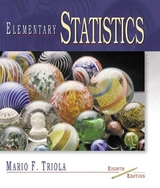
Elementary Statistics is written for students majoring in any field except mathematics. A strong mathematics background is not necessary, but students should have completed a high school or college elementary algebra course. Although underlying theory is included, this book does not stress the mathematical rigor more suitable for mathematics majors. Because the many examples and exercises cover a wide variety of different and interesting statistical applications, Elementary Statistics is appropriate for students pursuing majors in a wide variety of disciplines ranging from the social sciences of psychology and sociology to areas such as education, the allied health fields, business, economics, engineering, the humanities, the physical sciences, journalism, communications, and liberal arts.
Technological advances are reflected in the incorporation of, or reference to, several widely-used technologies. For the first time, references to the TI-83® calculator, developed by Texas Instruments especially for use in statistics and business, have been included. The latest version of MINITAB® statistical software continues to be featured in the book's exhibits and exercises. Our free, text-specific software, STATDISK®, has been completely reprogrammed for use with the new edition. A Web site has been developed to provide additional teaching resources for users of this edition. Advances in teaching are incorporated through such new features as the Cooperative Group Activities, the Decision to Data Exercises, the Cumulative Review Exercises, and a strong emphasis on using real data throughout the text and exercises. An increased emphasis on methods of data analysis is now integrated where appropriate, and an overall focus in examples and exercises on critical thinking and interpretation of results is included.
1. Introduction To Statistics.
Overview.
The Nature of Data.
Uses and Abuses of Statistics.
Design of Experiments.
Statistics with Calculators and Computers.
2. Describing, Exploring, And Comparing Data.
Overview.
Summarizing Data with Frequency Tables.
Pictures of Data.
Measures of Central Tendency.
Measures of Variation.
Measures of Position.
Exploratory Data Analysis (EDA).
3. Probability.
Overview.
Fundamentals.
Addition Rule.
Multiplication Rule.
Probabilities Through Simulations.
Counting.
4. Probability Distributions.
Overview.
Random Variables.
Binomial Experiments.
Mean, Variance, and Standard Deviation for the Binomial Distribution.
5. Normal Probability Distributions.
Overview.
The Standard Normal Distribution.
Nonstandard Normal Distributions: Finding Probabilities.
Nonstandard Normal Distributions: Finding Scores.
The Central Limit Theorem.
Normal Distribution as Approximation to Binomial Distribution.
6. Estimates And Sample Sizes.
Overview.
Estimating a Population Mean: Large Samples.
Estimating a Population Mean: Small Samples.
Estimating a Population Proportion.
Estimating a Population Variance.
7. Hypothesis Testing.
Overview.
Fundamentals of Hypothesis Testing.
Testing a Claim about a Mean: Large Samples.
Testing a Claim about a Mean: Small Samples.
Testing a Claim about Proportion.
Testing a Claim about a Standard Deviation or Variance.
8. Inferences From Two Samples.
Overview.
Inferences about Two Means: Dependent Samples.
Inferences about Two Means: Independent and Large Samples.
Comparing Two Variances
Inferences about Two Means: Independent and Small Samples.
Inferences about Two Proportions.
9. Correlation And Regression.
Overview.
Correlation.
Regression.
Variation and Prediction Intervals.
Multiple Regression.
10. Multinominal Experiments And Contingency Tables.
Overview.
Multinominal Experiments: Goodness-of-Fit.
Contingency Tables: Independence and Homogeneity.
11. Analysis Of Variance.
Overview.
One-Way ANOVA.
Two-Way ANOVA.
12. Statistical Process Control.
Overview.
Control Charts for Variation and Mean.
Control Charts for Attributes.
13. Nonparametric Statistics.
Overview.
Sign Test.
Wilcoxon Signed-Ranks Test for Two Dependent Samples.
Wilcoxon Rank-Sum Test for Two Independent Samples.
Kruskal-Wallis Test.
Rank Correlation.
Runs Test for Randomness.
14. Project And Epilogue.
A Statistics Group Project.
Which Procedure Applies.
A Perspective.
Appendix A: Tables.
Appendix B: Data Sets.
Appendix C: The Internet.
Appendix D: Glossary.
Appendix E: Bibliography.
Appendix F: Answers to Selected Exercises.
Index.
| Erscheint lt. Verlag | 9.9.1997 |
|---|---|
| Sprache | englisch |
| Maße | 206 x 240 mm |
| Gewicht | 1558 g |
| Themenwelt | Mathematik / Informatik ► Mathematik ► Statistik |
| ISBN-10 | 0-201-85920-3 / 0201859203 |
| ISBN-13 | 978-0-201-85920-1 / 9780201859201 |
| Zustand | Neuware |
| Informationen gemäß Produktsicherheitsverordnung (GPSR) | |
| Haben Sie eine Frage zum Produkt? |
aus dem Bereich