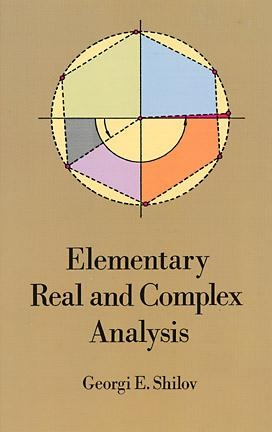
Elementary Real and Complex Analysis (eBook)
Dover Publications (Verlag)
978-0-486-13500-7 (ISBN)
In this book the renowned Russian mathematician Georgi E. Shilov brings his unique perspective to real and complex analysis, an area of perennial interest in mathematics. Although there are many books available on the topic, the present work is specially designed for undergraduates in mathematics, science and engineering. A high level of mathematical sophistication is not required.The book begins with a systematic study of real numbers, understood to be a set of objects satisfying certain definite axioms. The concepts of a mathematical structure and an isomorphism are introduced in Chapter 2, after a brief digression on set theory, and a proof of the uniqueness of the structure of real numbers is given as an illustration. Two other structures are then introduced, namely n-dimensional space and the field of complex numbers.After a detailed treatment of metric spaces in Chapter 3, a general theory of limits is developed in Chapter 4. Chapter 5 treats some theorems on continuous numerical functions on the real line, and then considers the use of functional equations to introduce the logarithm and the trigonometric functions. Chapter 6 is on infinite series, dealing not only with numerical series but also with series whose terms are vectors and functions (including power series). Chapters 7 and 8 treat differential calculus proper, with Taylor's series leading to a natural extension of real analysis into the complex domain. Chapter 9 presents the general theory of Riemann integration, together with a number of its applications. Analytic functions are covered in Chapter 10, while Chapter 11 is devoted to improper integrals, and makes full use of the technique of analytic functions.Each chapter includes a set of problems, with selected hints and answers at the end of the book. A wealth of examples and applications can be found throughout the text. Over 340 theorems are fully proved.
Preface1 Real Numbers 1.1. Set-Theoretic Preliminaries 1.2. Axioms for the Real Number System 1.3. Consequences of the Addition Axioms 1.4. Consequences of the Multiplication Axioms 1.5. Consequences of the Order Axioms 1.6. Consequences of the Least Upper Bound Axiom 1.7. The Principle of Archimedes and Its Consequences 1.8. The Principle of Nested Intervals 1.9. The Extended Real Number System Problems2 Sets 2.1. Operations on Sets 2.2. Equivalence of Sets 2.3. Countable Sets 2.4 Uncountable Sets 2.5. Mathematical Structures 2.6. n-Dimensional Space 2.7. Complex Numbers 2.8. Functions and Graphs Problems3 Metric Spaces 3.1. Definitions and Examples 3.2. Open Sets 3.3. Convergent Sequences and Homeomorphisms 3.4. Limit Points 3.5. Closed Sets 3.6. Dense Sets and Closures 3.7. Complete Metric Spaces 3.8. Completion of a Metric Space 3.9. Compactness Problems4 Limits 4.1. Basic Concepts 4.2. Some General Theorems 4.3. Limits of Numerical Functions 4.4. Upper and Lower Limits 4.5. Nondecreasing and Nonincreasing Functions 4.6. Limits of Numerical Functions 4.7. Limits of Vector Functions Problems5 Continuous Functions 5.1. Continuous Functions on a Metric Space 5.2. Continuous Numerical Functions on the Real Line 5.3. Monotonic Functions 5.4. The Logarithm 5.5. The Exponential 5.6. Trignometric Functions 5.7. Applications of Trigonometric Functions 5.8. Continuous Vector Functions of a Vecor Variable 5.9. Sequences of Functions Problems6 Series 6.1. Numerical Series 6.2. Absolute and Conditional Convergences 6.3. Operations on Series 6.4. Series of Vectors 6.5. Series of Functions 6.6. Power Series Problems7 The Derivative 7.1. Definitions and Examples 7.2. Properties of Differentiable Functions 7.3. The Differential 7.4. Mean Value Theorems 7.5. Concavity and Inflection Points 7.6. L'Hospital's Rules Problems8 Higher Derivatives 8.1. Definitions and Examples 8.2. Taylor's Formula 8.3. More on Concavity and Inflection Points 8.4. Another Version of Taylor's Formula 8.5. Taylor Series 8.6. Complex Exponentials and Trigonometric Functions 8.7. Hyperbolic Functions Problems9 The Integral 9.1. Definitions and Basic Properties 9.2. Area and Arc Length 9.3. Antiderivatives and Indefinite Integrals 9.4. Technique of Indefinite Integrals 9.5. Evaluation of Definite Integrals 9.6. More on Area 9.7. More on Arc Length 9.8. Area of a Surface of Revolution 9.9. Further Applications of Integration 9.10. Integration of Sequences of Functions 9.11. Parameter-Dependent Integrals 9.12. Line Integrals Problems10 Analytic Functions 10.1. Basic Concepts 10.2. Line Integrals of Complex Functions 10.3. Cauchy's Theorem and Its Consequences 10.4. Residues and Isolated Singular Points 10.5. Mappings and Elementary Functions Problems11 Improper Integrals 11.1. Improper Integralsof the First Kind 11.2. Convergence of Improper Integrals 11.3. Improper Integrals of the Second and Third Kinds 11.4 Evaluation of Improper Integrals by Residues 11.5 Parameter-Dependent ImproperIntegrals 11.6 The Gamma and Beta Functions ProblemsAppendix A Elementary Symbolic LogicAppendix B Measure and Integration on a Compact Metric SpaceSelected Hints and AnswersIndex
| Erscheint lt. Verlag | 31.7.2012 |
|---|---|
| Reihe/Serie | Dover Books on Mathematics |
| Sprache | englisch |
| Themenwelt | Mathematik / Informatik ► Mathematik ► Angewandte Mathematik |
| Mathematik / Informatik ► Mathematik ► Arithmetik / Zahlentheorie | |
| Schlagworte | abstract algebra • accessible introductions • advanced concepts • Algebraic • analysis class • Analytic • apostol • Applications • Applied mathematics • bartle • books on abstract algebras • books on analysis classes • books on applied mathematics • books on college maths • books on complex functions • books on differential equations • books on education majors • books on graph theories • books on markov chains • books on math courses • books on mathematical analysis • books on mathematical reasonings • books on math majors • books on measure theories • books on number theories • books on optimal controls • books on philosophical perspectives • books on pure mathematics • books on pure maths • books on theory classes • bostock • Cauchy • chartrand • Churchill • coddington • college math • combinatorial • combinatorics • Compactness • complex functions • Definitions • Differential Equations • Differentiation • education majors • Euler • Exercises • fundamentals • Genus • Graphs • graph theory • Greenberg • hamiltonian • Hardy • integrals • Integration • introductory texts • kemeny • Lemma • markov chains • math courses • Mathematical Analysis • mathematical background • mathematical proofs • mathematical reasoning • mathematical thinking • math majors • measure theory • metric • Number Theory • optimal control • Partial • Partitions • Philosophical Perspectives • Planar • primitive roots • Probability Theory • pure math • Pure Mathematics • Quadratic • Rigorous • saff • Self-study • Spaces • Springer • statements concerning • Subsets • Taylor • Theorems • Theoretical • theory applied • theory class • Topology • Trudeau • undergraduates |
| ISBN-10 | 0-486-13500-4 / 0486135004 |
| ISBN-13 | 978-0-486-13500-7 / 9780486135007 |
| Informationen gemäß Produktsicherheitsverordnung (GPSR) | |
| Haben Sie eine Frage zum Produkt? |
 EPUB (Adobe DRM)
Kopierschutz: Adobe-DRM
Adobe-DRM ist ein Kopierschutz, der das eBook vor Mißbrauch schützen soll. Dabei wird das eBook bereits beim Download auf Ihre persönliche Adobe-ID autorisiert. Lesen können Sie das eBook dann nur auf den Geräten, welche ebenfalls auf Ihre Adobe-ID registriert sind.
Details zum Adobe-DRM
Dateiformat: EPUB (Electronic Publication)
EPUB ist ein offener Standard für eBooks und eignet sich besonders zur Darstellung von Belletristik und Sachbüchern. Der Fließtext wird dynamisch an die Display- und Schriftgröße angepasst. Auch für mobile Lesegeräte ist EPUB daher gut geeignet.
Systemvoraussetzungen:
PC/Mac: Mit einem PC oder Mac können Sie dieses eBook lesen. Sie benötigen eine
eReader: Dieses eBook kann mit (fast) allen eBook-Readern gelesen werden. Mit dem amazon-Kindle ist es aber nicht kompatibel.
Smartphone/Tablet: Egal ob Apple oder Android, dieses eBook können Sie lesen. Sie benötigen eine
Geräteliste und zusätzliche Hinweise
Buying eBooks from abroad
For tax law reasons we can sell eBooks just within Germany and Switzerland. Regrettably we cannot fulfill eBook-orders from other countries.
aus dem Bereich