Calculus of Variations (eBook)
352 Seiten
Dover Publications (Verlag)
9780486141060 (ISBN)
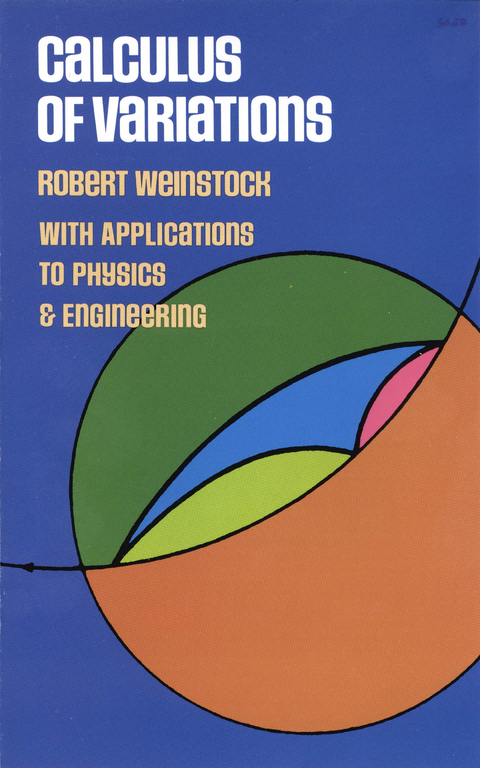
This book by Robert Weinstock was written to fill the need for a basic introduction to the calculus of variations. Simply and easily written, with an emphasis on the applications of this calculus, it has long been a standard reference of physicists, engineers, and applied mathematicians. The author begins slowly, introducing the reader to the calculus of variations, and supplying lists of essential formulae and derivations. Later chapters cover isoperimetric problems, geometrical optics, Fermat's principle, dynamics of particles, the Sturm-Liouville eigenvalue-eigenfunction problem, the theory of elasticity, quantum mechanics, and electrostatics. Each chapter ends with a series of exercises which should prove very useful in determining whether the material in that chapter has been thoroughly grasped.The clarity of exposition makes this book easily accessible to anyone who has mastered first-year calculus with some exposure to ordinary differential equations. Physicists and engineers who find variational methods evasive at times will find this book particularly helpful. "e;I regard this as a very useful book which I shall refer to frequently in the future."e; J. L. Synge, Bulletin of the American Mathematical Society.
Robert Weinstock: Mathematical Memories Robert Weinstock's Calculus of Variations, first published by McGraw-Hill in 1952 and reprinted by Dover in 1974, is one of Dover's longest-running books in mathematics. In a memoir written in the 1990s, Weinstock recalled how, after he received his PhD in physics from Stanford in 1943, he worked for a time at Harvard's Radar Research Laboratory as part of the war effort. Describing himself then as an idealistic 26-year-old, he came up with the idea that he could do more for humanity and humanity's problems as a working man than as a physicist, and so went to work for some months in 1946 as a seaman on two merchant ships. Back in the United States, Weinstock responded to a call for qualified mathematics instructors at Stanford (then, like most American colleges and universities, dealing with a major influx of new students supported by the GI Bill). He planned at the time to return to academia for only a short time. But, as it turned out, a long teaching career at Stanford, Notre Dame, and finally Oberlin ensued, concluding in 1990 after about fifty years. In the Author's Own Words:"From January into September 1946, I was a wiper (an engine-room worker who did painting, cleaning, and other maintenance) on a succession of two merchant ships. These took me twice through the Panama Canal and provided visits to all three World War Two enemy nations: Italy, Germany, and Japan. I experienced what were surely the most fascinating eight months of my life. I'm convinced, in retrospect, that I was in 1946 the only wiper in the U.S.Merchant Marine with a PhD in physics." — Robert Weinstock
PrefaceChapter 1. IntroductionChapter 2. Background Preliminaries 1. Piecewise continuity, piecewise differentiability 2. Partial and total differentiation 3. Differentiation of an integral 4. Integration by parts 5. Euler's theorem on homogeneous functions 6. Method of undetermined lagrange multipliers 7. The line integral 8. Determinants 9. Formula for surface area 10. Taylor's theorem for functions of several variables 11. The surface integral 12. Gradient, laplacian 13. Green's theorem (two dimensions) 14. Green's theorem (three dimensions)Chapter 3. Introductory Problems 1. A basic lemma 2. Statement and formulation of several problems 3. The Euler-Lagrange equation 4. First integrals of the Euler-Lagrange equation. A degenerate case 5. Geodesics 6. The brachistochrone 7. Minimum surface of revolution 8. Several dependent variables 9. Parametric representation 10. Undetermined end points 11. Brachistochrone from a given curve to a fixed pointChapter 4. Isoperimetric Problems 1. The simple isoperimetric problem 2. Direct extensions 3. Problem of the maximum enclosed area 4. Shape of a hanging rope. 5. Restrictions imposed through finite or differential equationsChapter 5. Geometrical Optics: Fermat's Principle 1. Law of refraction (Snell's law) 2. Fermat's principle and the calculus of variationsChapter 6. Dynamics of Particles 1. Potential and kinetic energies. 2. Generalized coordinates 3. Hamilton's principle. Lagrange equations of motion 3. Generalized momenta. Hamilton equations of motion. 4. Canonical transformations 5. The Hamilton-Jacobi differential equation 6. Principle of least action 7. The extended Hamilton's principleChapter 7. Two Independent Variables: The Vibrating String 1. Extremization of a double integral 2. The vibrating string 3. Eigenvalue-eigenfunction problem for the vibrating string 4. Eigenfunction expansion of arbitrary functions. Minimum characterization of the eigenvalue-eigenfunction problem 5. General solution of the vibrating-string equation 6. Approximation of the vibrating-string eigenvalues and eigenfunctions (Ritz method) 7. Remarks on the distinction between imposed and free end-point conditionsChapter 8. The Sturm-Liouville Eigenvalue-Eigenfunction Problem 1. Isoperimetric problem leading to a Sturm-Liouville system 2. Transformation of a Sturm-Liouville system 3. Two singular cases: Laguerre polynomials, Bessel functionsChapter 9. Several Independent Variables: The Vibrating Membrane 1. Extremization of a multiple integral 2. Change of independent variables. Transformation of the laplacian 3. The vibrating membrane 4. Eigenvalue-eigenfunction problem for the membrane 5. Membrane with boundary held elastically. The free membrane 6. Orthogonality of the eigenfunctions. Expansion of arbitrary functions 7. General solution of the membrane equation 8. The rectangular membrane of uniform density 9. The minimum characterization of the membrane eigenvalues 10. Consequences of the minimum characterization of the membrane eigenvalues 11. The maximum-minimum characterization of the membrane eigenvalues 12. The asymptotic distribution of the membrane eigenvalues 13. Approximation of the membrane eigenvaluesChapter 10. Theory of Elasticity 1. Stress and strain 2. General equations of motion and equilibrium 3. General aspects of the approach to certain dynamical problems 4. Bending of a cylindrical bar by couples 5. Transverse vibrations of a bar 6. The eigenvalue-eigenfunction problem for the vibrating bar 7. Bending of a rectangular plate by couples 8. Transverse vibrations of a thin plate 9. The eigenvalue-eigenfunction problem for the vibrating plate 10. The rectangular plate. Ritz method of approximationChapter 11. Quantum Mechanics 1. First derivation of the Schrödinger equation for a single particle 2. The wave character of a particle. Second derivation of the Schrödinger equation 3. The hydrogen atom. Physical interpretation of the Schrödinger wave functions 4. Extension to systems of particles. Minimum character of the energy eigenvalues 5. Ritz method: Ground state of the helium atom. Hartree model of the many-electron atomChapter 12. Electrostatics 1. Laplace's equation. Capacity of a condenser 2. Approximation of the capacity from below (relaxed boundary conditions) 3. Remarks on problems in two dimensions 4. The existence of minima of the Dirichlet integral Bibliography; Index
| Erscheint lt. Verlag | 26.4.2012 |
|---|---|
| Reihe/Serie | Dover Books on Mathematics |
| Sprache | englisch |
| Maße | 140 x 140 mm |
| Gewicht | 358 g |
| Themenwelt | Mathematik / Informatik ► Mathematik ► Analysis |
| ISBN-13 | 9780486141060 / 9780486141060 |
| Informationen gemäß Produktsicherheitsverordnung (GPSR) | |
| Haben Sie eine Frage zum Produkt? |
 EPUB (Adobe DRM)
Kopierschutz: Adobe-DRM
Adobe-DRM ist ein Kopierschutz, der das eBook vor Mißbrauch schützen soll. Dabei wird das eBook bereits beim Download auf Ihre persönliche Adobe-ID autorisiert. Lesen können Sie das eBook dann nur auf den Geräten, welche ebenfalls auf Ihre Adobe-ID registriert sind.
Details zum Adobe-DRM
Dateiformat: EPUB (Electronic Publication)
EPUB ist ein offener Standard für eBooks und eignet sich besonders zur Darstellung von Belletristik und Sachbüchern. Der Fließtext wird dynamisch an die Display- und Schriftgröße angepasst. Auch für mobile Lesegeräte ist EPUB daher gut geeignet.
Systemvoraussetzungen:
PC/Mac: Mit einem PC oder Mac können Sie dieses eBook lesen. Sie benötigen eine
eReader: Dieses eBook kann mit (fast) allen eBook-Readern gelesen werden. Mit dem amazon-Kindle ist es aber nicht kompatibel.
Smartphone/Tablet: Egal ob Apple oder Android, dieses eBook können Sie lesen. Sie benötigen eine
Geräteliste und zusätzliche Hinweise
Buying eBooks from abroad
For tax law reasons we can sell eBooks just within Germany and Switzerland. Regrettably we cannot fulfill eBook-orders from other countries.
aus dem Bereich