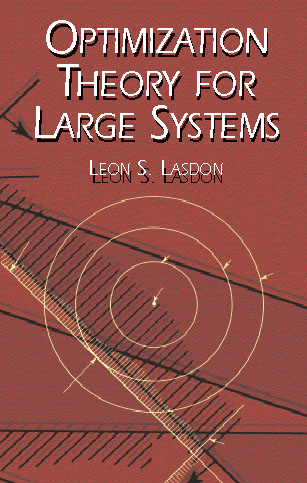
Optimization Theory for Large Systems (eBook)
560 Seiten
Dover Publications (Verlag)
978-0-486-14369-9 (ISBN)
Important text examines most significant algorithms for optimizing large systems and clarifying relations between optimization procedures. Much data appear as charts and graphs and will be highly valuable to readers in selecting a method and estimating computer time and cost in problem-solving. Initial chapter on linear and nonlinear programming presents all necessary background for subjects covered in rest of book. Second chapter illustrates how large-scale mathematical programs arise from real-world problems. Appendixes. List of Symbols.
1. Linear and Nonlinear Programming 1.1 Unconstrained Minimization 1.2 Linear Programming 1.2.1 Simplex Method 1.2.2 Revised Simplex Method 1.2.3 Duality in Linear Programming 1.2.4 Dual Simplex and Primal-Dual Algorithms 1.3 Nonlinear Programming 1.3.1 Convexity 1.3.2 Kuhn-Tucker Conditions 1.3.3 Saddle Points and Sufficiency Conditions 1.3.4 Methods of Nonlinear Programming References2. Large Mathematical Programs with Special Structure 2.1 Introduction 2.2 Activity analysis 2.3 Production and Inventory Problem 2.4 Dynamic Leontief Model 2.5 Angular and Dual-Angular Structures 2.6 Linear Programs with Many Rows or Columns 2.7 Nonlinear Programs with Coupling Variables 2.8 Mixed-Variable Programs and a Location Problem Problems, References3. The Dantzig-Wolfe Decomposition Principle 3.1 Introduction 3.2 A Theorem on Convex Combinations 3.3 Column Generation 3.4 Development of the Decomposition Principle 3.5 Example of the Decomposition Principle 3.6 Economic Interpretation of the Decomposition Principle 3.7 Lower Bound for the Minimal Cost 3.8 Application to Transportation Problems 3.9 Generalized Transportation Problems and a Forestry-Cutting Example 3.10 Optimal Allocation of Limited Resources 3.10.1 General formulation 3.10.2 Specializing the Model--Lot Sizes and Labor Allocations 3.10.3 Computational Experience 3.11 Primal-Dual Approach to the Master Program 3.11.1 Linear Fractional Programming 3.11.2 Application of the Primal-Dual Method to the Master Program 3.11.3 Example of the Primal-Dual Method 3.12 Three Algorithms for Solving the Master Program--A comparison Problems, References4. Solution of Linear Programs with Many Columns by Column-Generation Procedures 4.1 The Cutting-Stock Problem 4.2 Column-Generation and Multi-item Scheduling 4.3 Generalized Linear Programming 4.4 Grid Linearization and Nonlinear Programming 4.4.1 General Development 4.4.2 Nonlinear Version of the Dantzig-Wolfe Decomposition Principle 4.5 Design of Multiterminal Flow Networks Problems, References5. Partitioning and Relaxation Procedures in Linear Programming 5.1 Introduction 5.2 Relaxation 5.3 Problems with Coupling constraints and Coupling Variables 5.4 Rosen's Partitioning Procedure for Angular and Dual-Angular Problems 5.4.1 Development of the Algorithm 5.4.2 Computational Considerations 5.4.3 Computational Experience 5.4.4 Example of Rosen's Partitioning Method Problems, References6. Compact Inverse Methods 6.1 Introduction 6.2 Revised Simplex Method with Inverse in Product Form 6.3 Upper Bounding Methods 6.4 Generalized Upper Bounding 6.4.1 Development of the Algorithm 6.4.2 Example of the Generalized Upper Bounding Method 6.5 Extension to Angular Structures Problems, References7. Partitioning Procedures in Nonlinear Programming 7.1 Introduction 7.2 Rosen's Partitioning Algorithm for Nonlinear Programs 7.2.1 Development of the Algorithm 7.2.2 Use of Partition Programming in Refinery Optimization 7.3 Benders' Partitioning Algorithm for Mixed-Variable Programming Problems 7.3.1 Development of the Algorithm 7.3.2 Relation to the Decomposition Principle and Cutting-Plane Algorithms 7.3.3 Application to a Warehouse Location Problem 7.3.4 Numerical Example 7.3.5 Computational Experience Problems, References8. Duality and Decomposition in Mathematical Programming 8.1 Introduction 8.2 Decomposition Using a Pricing Mechanism 8.3 Saddle Points of Lagrangian Functions 8.3.1 Basic Theorems 8.3.2 Everetts Theorem 8.3.3 Application to Linear Integer Programs 8.4 Minimax Dual Problem 8.5 Differentiability of the Dual Objective Function 8.6 Computational Methods for Solving the Dual 8.7 Special Results for Convex Problems 8.8 Applications 8.8.1 Problems Involving Coupled Subsystems 8.8.2 Example--Optimal Control of Discrete-Time Dynamic Systems 8.8.3 Problems in Which the Constraint Set is Finite: Multi-item Scheduling Problems Problems, References9. Decomposition by Right-Hand-Side Allocation 9.1 Introduction 9.2 Problem Formulation 9.3 Feasible-Directions Algorithm for the Master Program 9.4 Alternative Approach to the Direction-Finding Problem 9.5 Tangential Approximation Problems, ReferencesAppendix 1. Convex Functions and Their ConjugatesAppendix 2. Subgradients and Directional Derivatives of Convex References; List of Symbols; Index
| Erscheint lt. Verlag | 17.1.2013 |
|---|---|
| Reihe/Serie | Dover Books on Mathematics |
| Sprache | englisch |
| Maße | 140 x 140 mm |
| Themenwelt | Mathematik / Informatik ► Mathematik ► Angewandte Mathematik |
| Mathematik / Informatik ► Mathematik ► Finanz- / Wirtschaftsmathematik | |
| ISBN-10 | 0-486-14369-4 / 0486143694 |
| ISBN-13 | 978-0-486-14369-9 / 9780486143699 |
| Informationen gemäß Produktsicherheitsverordnung (GPSR) | |
| Haben Sie eine Frage zum Produkt? |
 EPUB (Adobe DRM)
Kopierschutz: Adobe-DRM
Adobe-DRM ist ein Kopierschutz, der das eBook vor Mißbrauch schützen soll. Dabei wird das eBook bereits beim Download auf Ihre persönliche Adobe-ID autorisiert. Lesen können Sie das eBook dann nur auf den Geräten, welche ebenfalls auf Ihre Adobe-ID registriert sind.
Details zum Adobe-DRM
Dateiformat: EPUB (Electronic Publication)
EPUB ist ein offener Standard für eBooks und eignet sich besonders zur Darstellung von Belletristik und Sachbüchern. Der Fließtext wird dynamisch an die Display- und Schriftgröße angepasst. Auch für mobile Lesegeräte ist EPUB daher gut geeignet.
Systemvoraussetzungen:
PC/Mac: Mit einem PC oder Mac können Sie dieses eBook lesen. Sie benötigen eine
eReader: Dieses eBook kann mit (fast) allen eBook-Readern gelesen werden. Mit dem amazon-Kindle ist es aber nicht kompatibel.
Smartphone/Tablet: Egal ob Apple oder Android, dieses eBook können Sie lesen. Sie benötigen eine
Geräteliste und zusätzliche Hinweise
Buying eBooks from abroad
For tax law reasons we can sell eBooks just within Germany and Switzerland. Regrettably we cannot fulfill eBook-orders from other countries.
aus dem Bereich