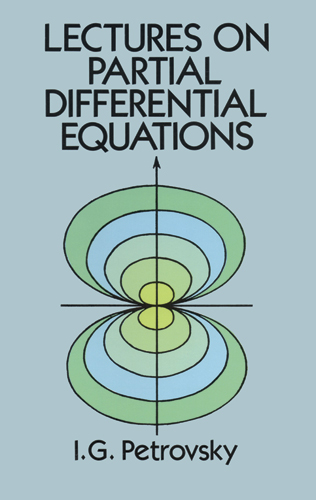
Lectures on Partial Differential Equations (eBook)
272 Seiten
Dover Publications (Verlag)
9780486155081 (ISBN)
The field of partial differential equations is an extremely important component of modern mathematics. It has great intrinsic beauty and virtually unlimited applications. This book, written for graduate-level students, grew out of a series of lectures the late Professor Petrovsky gave at Moscow State University. The first chapter uses physical problems to introduce the subjects and explains its division into hyperbolic, elliptic, and parabolic partial differential equations. Each of these three classes of equations is dealt with in one of the remaining three chapters of the book in a manner that is at once rigorous, transparent, and highly readable.Petrovsky was a leading figure in Russian mathematics responsible for many advances in the field of partial differential equations. In these masterly lectures, his commentary and discussion of various aspects of the problems under consideration will prove valuable in deepening students’ understanding and appreciation of these problems.
Foreword, by R. Courant; Translator's Note, by Abe Shenitzer; PrefaceChapter I. Introduction. Classification of equations 1. Definitions. Examples 2. The Cauchy problem. The Cauchy-Kowalewski theorem 3. The generalized Cauchy problem. Characteristics 4. Uniqueness of the solution of the Cauchy problem in the class of non-analytic functions 5. Reduction to canonical form at a point and classification of equations of the second order in one unknown function 6. Reduction to canonical form in a region of a partial differential equation of the second order in two independent variables 7. Reduction to canonical form of a system of linear partial differential equations of the first order in two independent variablesChapter II. Hyperbolic equations The Cauchy problem for non-analytic functions 8. The reasonableness of the Cauchy problem 9. The notion of generalized solutions 10. The Cauchy problem for hyperbolic systems in two independent variables 11. The Cauchy problem for the wave equation. Uniqueness of the solution 12. Formulas giving the solution of the Cauchy problem for the wave equation 13. Examination of the formulas which give the solution of the Cauchy problem 14. The Lorentz transformation 15. The mathematical foundations of the special principle of relativity 16. Survey of the fundamental facts of the theory of the Cauchy problem for general hyperbolic systems II. Vibrations of bounded bodies 17. Introduction 18. Uniqueness of the mixed initial and boundary-value problem 19. Continuous dependence of the solution on the initial data 20. The Fourier method for the equation of a vibrating string 21. The general Fourier method (introductory considerations) 22. General properties of eigenfunctions and eigenvalues 23. Justification of the Fourier method 24. Another justification of the Fourier method 25. Investigation of the vibration of a membrane 26. Supplementary information concerning eigenfunctionsChapter III. Elliptic equations 27. Introduction 28. The minimum-maximum property and its consequences 29. Solution of the Dirichlet problem for a circle 30. Theorems on the fundamental properties of harmonic functions 31. Proof of the existence of a solution of Dirichlet's problem 32. The exterior Dirichlet problem 33. The Neumann problem (the second boundary-value problem) 34. Potential theory 35. Application of potential theory to the solution of boundary-value problems 36. Approximate solution of the Dirichlet problem by the method of finite differences 37. Survey of the most important results for general elliptic equationsChapter IV. Parabolic equations 38. Conduction of heat in a bounded strip (the first boundary-value problem) 39. Conduction of heat in an infinite strip (the Cauchy problem) 40. Survey of some further investigations of equations of the parabolic type
| Erscheint lt. Verlag | 13.12.2012 |
|---|---|
| Reihe/Serie | Dover Books on Mathematics |
| Sprache | englisch |
| Maße | 140 x 140 mm |
| Gewicht | 281 g |
| Themenwelt | Mathematik / Informatik ► Mathematik |
| ISBN-13 | 9780486155081 / 9780486155081 |
| Informationen gemäß Produktsicherheitsverordnung (GPSR) | |
| Haben Sie eine Frage zum Produkt? |
 EPUB (Adobe DRM)
Kopierschutz: Adobe-DRM
Adobe-DRM ist ein Kopierschutz, der das eBook vor Mißbrauch schützen soll. Dabei wird das eBook bereits beim Download auf Ihre persönliche Adobe-ID autorisiert. Lesen können Sie das eBook dann nur auf den Geräten, welche ebenfalls auf Ihre Adobe-ID registriert sind.
Details zum Adobe-DRM
Dateiformat: EPUB (Electronic Publication)
EPUB ist ein offener Standard für eBooks und eignet sich besonders zur Darstellung von Belletristik und Sachbüchern. Der Fließtext wird dynamisch an die Display- und Schriftgröße angepasst. Auch für mobile Lesegeräte ist EPUB daher gut geeignet.
Systemvoraussetzungen:
PC/Mac: Mit einem PC oder Mac können Sie dieses eBook lesen. Sie benötigen eine
eReader: Dieses eBook kann mit (fast) allen eBook-Readern gelesen werden. Mit dem amazon-Kindle ist es aber nicht kompatibel.
Smartphone/Tablet: Egal ob Apple oder Android, dieses eBook können Sie lesen. Sie benötigen eine
Geräteliste und zusätzliche Hinweise
Buying eBooks from abroad
For tax law reasons we can sell eBooks just within Germany and Switzerland. Regrettably we cannot fulfill eBook-orders from other countries.
aus dem Bereich