


Famous Problems of Geometry and How to Solve Them (eBook)
144 Seiten
Dover Publications (Verlag)
978-0-486-13763-6 (ISBN)
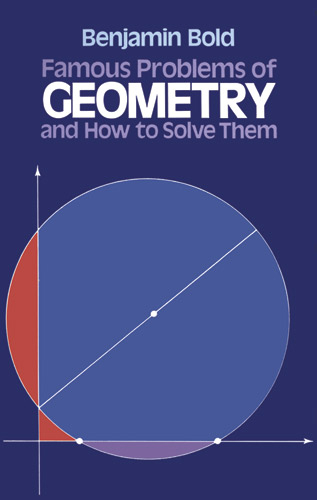
It took two millennia to prove the impossible; that is, to prove it is not possible to solve some famous Greek problems in the Greek way (using only straight edge and compasses). In the process of trying to square the circle, trisect the angle and duplicate the cube, other mathematical discoveries were made; for these seemingly trivial diversions occupied some of history's great mathematical minds. Why did Archimedes, Euclid, Newton, Fermat, Gauss, Descartes among so many devote themselves to these conundrums? This book brings readers actively into historical and modern procedures for working the problems, and into the new mathematics that had to be invented before they could be "e;solved."e;The quest for the circle in the square, the trisected angle, duplicated cube and other straight-edge-compass constructions may be conveniently divided into three periods: from the Greeks, to seventeenth-century calculus and analytic geometry, to nineteenth-century sophistication in irrational and transcendental numbers. Mathematics teacher Benjamin Bold devotes a chapter to each problem, with additional chapters on complex numbers and analytic criteria for constructability. The author guides amateur straight-edge puzzlists into these fascinating complexities with commentary and sets of problems after each chapter. Some knowledge of calculus will enable readers to follow the problems; full solutions are given at the end of the book.Students of mathematics and geometry, anyone who would like to challenge the Greeks at their own game and simultaneously delve into the development of modern mathematics, will appreciate this book. Find out how Gauss decided to make mathematics his life work upon waking one morning with a vision of a 17-sided polygon in his head; discover the crucial significance of epi = -1, "e;one of the most amazing formulas in all of mathematics."e; These famous problems, clearly explicated and diagrammed, will amaze and edify curious students and math connoisseurs.
ForewordI Achievement of the Ancient GreeksII An Analytic Criterion for ConstructibilityIII Complex NumbersIV The Delian ProblemV The Problem of Trisecting an AngleVI The Problem of Squaring the CircleVII The Problem of Constructing Regular PolygonsVIII Concluding RemarksSuggestions for Further ReadingSolutions to the Problems
| Erscheint lt. Verlag | 11.5.2012 |
|---|---|
| Reihe/Serie | Dover Books on Mathematics |
| Sprache | englisch |
| Maße | 140 x 140 mm |
| Gewicht | 159 g |
| Themenwelt | Mathematik / Informatik ► Mathematik ► Geschichte der Mathematik |
| Naturwissenschaften | |
| ISBN-10 | 0-486-13763-5 / 0486137635 |
| ISBN-13 | 978-0-486-13763-6 / 9780486137636 |
| Informationen gemäß Produktsicherheitsverordnung (GPSR) | |
| Haben Sie eine Frage zum Produkt? |
 EPUB (Adobe DRM)
Kopierschutz: Adobe-DRM
Adobe-DRM ist ein Kopierschutz, der das eBook vor Mißbrauch schützen soll. Dabei wird das eBook bereits beim Download auf Ihre persönliche Adobe-ID autorisiert. Lesen können Sie das eBook dann nur auf den Geräten, welche ebenfalls auf Ihre Adobe-ID registriert sind.
Details zum Adobe-DRM
Dateiformat: EPUB (Electronic Publication)
EPUB ist ein offener Standard für eBooks und eignet sich besonders zur Darstellung von Belletristik und Sachbüchern. Der Fließtext wird dynamisch an die Display- und Schriftgröße angepasst. Auch für mobile Lesegeräte ist EPUB daher gut geeignet.
Systemvoraussetzungen:
PC/Mac: Mit einem PC oder Mac können Sie dieses eBook lesen. Sie benötigen eine
eReader: Dieses eBook kann mit (fast) allen eBook-Readern gelesen werden. Mit dem amazon-Kindle ist es aber nicht kompatibel.
Smartphone/Tablet: Egal ob Apple oder Android, dieses eBook können Sie lesen. Sie benötigen eine
Geräteliste und zusätzliche Hinweise
Buying eBooks from abroad
For tax law reasons we can sell eBooks just within Germany and Switzerland. Regrettably we cannot fulfill eBook-orders from other countries.


