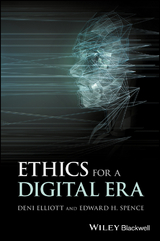
Ethics for a Digital Era (eBook)
John Wiley & Sons (Verlag)
978-1-118-96890-1 (ISBN)
DENI ELLIOTT, EdD holds the Poynter Jamison Chair in Media Ethics and Press Policy and is Department Chair and full professor in the Department of Journalism and Digital Communication at the University of South Florida, St. Petersburg.
EDWARD H. SPENCE teaches and conducts research in the philosophy and ethics of information technologies and communication at Charles Sturt University. He is a Research Fellow at the 4TU Centre of Excellence for Ethics and Technology in The Hague, and Research Associate at the University of Sydney, Australia.
"e;Elliott and Spence have produced a tight, teachable, and timely primer on media ethics for users and creators of information in the digital age. Pitched at just the right depth of detail to provide a big picture contextualization of changing media practices grounded in concerns for democracy and the public good, the book explores and reflects the implications of the convergence of the Fourth and Fifth Estates with an open-access, hyper-linked architecture which invites self-reflective practice on the part of its users Philip Gordon, Utah Valley University2019 PROSE Award Finalist in the Media & Cultural Studies category!The rapid and ongoing evolution of digital technologies has transformed the waythe world communicates and digests information. Fueled by a 24-hour news cycleand post-truth politics, media consumption and the technologies that drive ithave become more influential in shaping public opinion, and it has become more imperative than ever to examine their social and ethical consequences. Ethics for a Digital Era provides a penetrating analysis of the ethical issues that have emerged as the digital revolution progresses, including journalistic practices that impact on the truth, reliability, and trustworthiness of communicating information. The volume explores new methods and models for ethical inquiry in a digital world, and maps out guidelines for web-based news producers and users to conceptualize ethical issuesand analyze ethically questionable acts. In each of three thematic sections, Deni Elliott and Edward H. Spence reflect upon shifts in media ethics as contemporary mass communication combines traditional analog practices with new forms like blogs, vlogs, podcasts, and social media posts, and evolves into an interactive medium with users who both produce and consume the news. Later chapters apply a process of normative decision-making to some of the most important issues which arise in these interactions, and encourage users to bridge their own thinking between the virtual and physical worlds of information and its communication. Timely and thought-provoking, Ethics for a Digital Era is an invaluable resource for undergraduate and graduate students in media and mass communication, applied ethics, and journalism, as well as general readers interested in the ethical impact of their media consumption.
DENI ELLIOTT, EdD holds the Poynter Jamison Chair in Media Ethics and Press Policy and is Department Chair and full professor in the Department of Journalism and Digital Communication at the University of South Florida, St. Petersburg. EDWARD H. SPENCE teaches and conducts research in the philosophy and ethics of information technologies and communication at Charles Sturt University. He is a Research Fellow at the 4TU Centre of Excellence for Ethics and Technology in The Hague, and Research Associate at the University of Sydney, Australia.
Acknowledgments viii
Introduction 1
Part I: From Analog to Digital News 11
1 A New Paradigm for News 13
2 Legacy News Organizations Move from Analog to Digital 37
3 Intellectual Property and Information Sharing 64
4 Citizen Responsibility in the Digital Era 76
Part II: Thinking Through Ethical Issues in Digital Journalism 89
5 DOIT, A Process for Normative Analysis 91
6 Issues in Convergent Journalism 104
7 Privacy and Disclosure 116
8 Deception in Sourcing and Presentation 136
9 Media Corruption 154
Part III: Using the Virtual World to Create a Better Physical World 171
10 Beyond Ethics: Communicating Wisely 173
Epilogue: Digital Diversity and Democracy 190
Index 197
1
A New Paradigm for News
You don’t need to understand the meaning of “paradigm shift” to know that that the last half of the twentieth century witnessed a world‐wide communication revolution. The change was so profound that it changed what it means for humans to communicate with one another, interpersonally as well as in mass communication.
This chapter describes the paradigm shift—the fundamental change in information production, delivery, and consumption—that occurred in the latter half of the twentieth century. This shift has been called the digital communication revolution, the third industrial revolution, the information age, and, as we will refer to it in this book, the digital era.
The focus of this book is how the creation and consumption of news have changed through this paradigm shift. Examining the changes reveals which practices are mere conventions of this moment in the history of news and which reflect essential values that endure through changes in technology and marketing. By the end of this chapter, users should be able to explain the major ways that the paradigm shift has affected contemporary digital journalism and be able to describe the journalistic values that have transcended paradigm shifts. Users should also understand that, throughout history, mass communication in general, and journalism in particular, has experienced a series of paradigm shifts as technology has created new platforms.
A paradigm shift, according to the scientist who coined that term, Thomas Kuhn, is “a change from one way of thinking to another. It’s a revolution, a transformation, a sort of metamorphosis. It does not just happen; rather it is driven by agents of change.” Kuhn argues that scientific advancement is not a slow, orderly evolution, but rather is a “series of peaceful interludes punctuated by intellectually violent revolutions,” and in those revolutions “one conceptual world view is replaced by another” (Thomas Kuhn, quoted in Take the Leap).
The communication paradigm shift at the end of the twentieth century was as challenging to the status quo as the transportation revolution that changed the world in the first half of that century. In industrialized nations, the first half of the twentieth century saw transition from the horse‐and‐buggy to trains to planes to at least one automobile in most households. Transportation technologies created a paradigm shift, a change so dramatic that how people behaved in all areas of their lives changed. A 500‐mile trip was no longer measured in weeks but in hours. A trip across an ocean could happen in less than a day rather than taking weeks. The new rapid ability to move people and goods expanded commerce, but with the creation of new opportunities, came new problems. For example, people could get fresh foods grown anywhere, rather than consume only those that could be grown seasonally and locally. This resulted in a wider variety of foods available but also created the need to sacrifice taste and ripeness of many fruits and vegetables in favor of their transportability and created a greater carbon footprint per food item. Friends and family no longer needed to live in the same small town to see one another on a regular basis. That expanded career opportunities but separated generations and grown siblings. That limited family members’ abilities to babysit children or care for elders.
Limited‐access roads, highways, and turnpikes, designed to get people from one point to another as efficiently as possible, were constructed, changing the experience of long‐distance ground travel. No longer did drivers need to think about camping on the side of the road or where to find the infrequent roadhouses along the route of travel. Now travelers could select from a multitude of fast foods and easy‐access exit‐located hotels. Isolated, efficient travel experience triumphed over that found in roadhouse boarding, with communal dining among strangers. Airline and train routes reinforced population and commercial centers, attracting more people and manufacturing by their presence, thus stimulating greater population migration and density. The transportation revolution built upon industry and reinforced the industry‐induced change from agrarian to urban lifestyles.
In the last half of the twentieth century, computer and satellite technology created a paradigm shift in communication equal in size and significance to that created by transportation technology. Interpersonal communication that was dependent on physically mailed letters and phone calls that happened to catch a person “in” were replaced with instant verbal and visual messaging, notifying the recipient immediately on a handheld or wearable two‐way communication device. News that had been delivered to mass audiences in episodic doses at prescribed times of day changed to immediate, user‐initiated access to real‐time targeted information. Delivery by a few corporate‐owned or government‐controlled news organizations that operated within geographical borders gave way to a global flood of information providers and direct interaction between news producers and consumers and a blending of those roles, with no gatekeeping required.
In the twentieth century, those who delivered messages via mass communication were generally professionals. The core group of those who laid claim to the label “journalist” were reporters and editors who worked in print media newsrooms.
Some who worked in the production of radio or television news, including some anchors who delivered the news on camera, field reporters, and producers, considered themselves journalists and worked to uphold professional values. Others who did the same tasks weren’t so sure that they were “real” journalists and didn’t think that the professionalism expectations of print journalists applied to them. Newspaper photographers and broadcast video and audio recorders were often considered tangential to news reports and were sometimes called “reporters with their brains knocked out” by text‐superior colleagues. Running a machine that captured images or sound was considered inferior to collecting and crafting words into news packages.
Radio shows were hosted by disc jockeys who played phonograph records and read advertising messages and “rip and read” news bulletins provided by wire services, with no thought of accountability for the truth or accuracy of the messages that they read.
The notion that stories were best told through a marriage of visuals, text, and sound was still in its infancy.
From the vantage point of today’s digital era, it is hard to believe that citizens or leaders in commerce, industry, or government could function without personal computers in hand to provide immediate access to others along with real‐time notification of time, weather, and news. In the twentieth century, everyone had a favorite news source. Whether it was the New York Times, La Monde, the BBC, or the Australian Broadcasting Corporation depended on location, as each source had limited geographic distribution.
Today, the question, “How do you get your news?” or “How do you know what is going on in the world?” is more likely to elicit the name of a social media app or a dismissive shrug than the name of a legacy news organization. It is disconcerting to anyone with Internet access to consider not being able to instantly know what is going on in the world through an infinite variety of sources.
Just as transportation fulfills the goal of physically moving people from one point to another, news production fulfills the goal of giving people information that they need so that they can make educated choices about what they believe, how they can govern themselves, and their role in creating a community that meets their needs and interests. For these goals to be met, essential journalistic values of balance, accuracy, relevance, and completeness must endure.
People seek news for many reasons, including entertainment and interpersonal connection in addition to learning about the world around them. Citizens need to be informed and educated about contemporary events to help them knowledgably participate in self‐governance. But no one wants to study the news all of the time. It is logical and ethically acceptable for individuals to sometimes choose not to be informed, just as it is just fine for individuals to sometimes wander through a park with no particular goal of getting from one point to another. But it is impossible to engage in civic life without sometimes seeking news and opinion with the goal of being informed and educated on contemporary issues of the day.
First, Some Definitions
Mass Communication: online mass communication is differentiated from interpersonal communication by publisher intent or audience access. If the publisher’s intent is to communicate to an unrestricted or unknown audience, or if the site is accessible by an unrestricted or an unknown audience regardless of publisher intent, the message, production, and consumption fall within the realm of mass communication. The creation and consumption of news is one type of mass communication. One may communicate with many different intentions, such as persuasion, sales, or simple expression of opinion. Ethics for a Digital Era focuses on the core informational intent and function of...
| Erscheint lt. Verlag | 5.10.2017 |
|---|---|
| Reihe/Serie | Blackwell Public Philosophy Series |
| Blackwell Public Philosophy Series | Blackwell Public Philosophy Series |
| Sprache | englisch |
| Themenwelt | Geisteswissenschaften ► Philosophie ► Allgemeines / Lexika |
| Geisteswissenschaften ► Philosophie ► Ethik | |
| Mathematik / Informatik ► Informatik | |
| Naturwissenschaften | |
| Sozialwissenschaften ► Kommunikation / Medien ► Medienwissenschaft | |
| Sozialwissenschaften ► Politik / Verwaltung | |
| Sozialwissenschaften ► Soziologie | |
| Schlagworte | Angewandte Ethik • Applied Ethics • Communication & Media Studies • communications • digital journalism • Digital Media • digital media ethics • digital media reporting • ethical analysis • ethical guidelines for web-based news producers • ethical reporting • ethics • ethics and the news • Ethik • Journalism • journalism ethics • journalistic integrity</p> • Kommunikation u. Medienforschung • <p>ethical journalism • mass communications • media • media consumption • media delivery • Media Ethics • Media Law & Ethics • Media morality • Medienrecht, Medienethik • modern media • morality in journalism • New Media • Philosophie • Philosophy • professional journalism • Reporting • web-based mass communication • web-based news |
| ISBN-10 | 1-118-96890-5 / 1118968905 |
| ISBN-13 | 978-1-118-96890-1 / 9781118968901 |
| Informationen gemäß Produktsicherheitsverordnung (GPSR) | |
| Haben Sie eine Frage zum Produkt? |
 EPUB (Adobe DRM)
Kopierschutz: Adobe-DRM
Adobe-DRM ist ein Kopierschutz, der das eBook vor Mißbrauch schützen soll. Dabei wird das eBook bereits beim Download auf Ihre persönliche Adobe-ID autorisiert. Lesen können Sie das eBook dann nur auf den Geräten, welche ebenfalls auf Ihre Adobe-ID registriert sind.
Details zum Adobe-DRM
Dateiformat: EPUB (Electronic Publication)
EPUB ist ein offener Standard für eBooks und eignet sich besonders zur Darstellung von Belletristik und Sachbüchern. Der Fließtext wird dynamisch an die Display- und Schriftgröße angepasst. Auch für mobile Lesegeräte ist EPUB daher gut geeignet.
Systemvoraussetzungen:
PC/Mac: Mit einem PC oder Mac können Sie dieses eBook lesen. Sie benötigen eine
eReader: Dieses eBook kann mit (fast) allen eBook-Readern gelesen werden. Mit dem amazon-Kindle ist es aber nicht kompatibel.
Smartphone/Tablet: Egal ob Apple oder Android, dieses eBook können Sie lesen. Sie benötigen eine
Geräteliste und zusätzliche Hinweise
Buying eBooks from abroad
For tax law reasons we can sell eBooks just within Germany and Switzerland. Regrettably we cannot fulfill eBook-orders from other countries.
aus dem Bereich