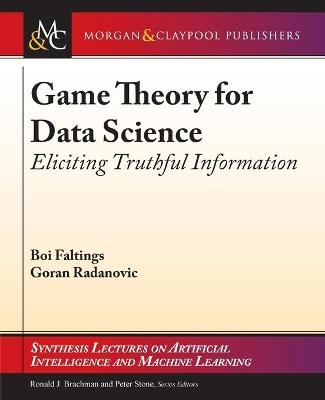
Game Theory for Data Science
Morgan and Claypool Life Sciences (Verlag)
978-1-62705-729-5 (ISBN)
- Keine Verlagsinformationen verfügbar
- Artikel merken
We cover different settings and the assumptions they admit, including sensing, human computation, peer grading, reviews, and predictions. We survey different incentive mechanisms, including proper scoring rules, prediction markets and peer prediction, Bayesian Truth Serum, Peer Truth Serum, Correlated Agreement, and the settings where each of them would be suitable. As an alternative, we also consider reputation mechanisms. We complement the game-theoretic analysis with practical examples of applications in prediction platforms, community sensing, and peer grading.
Boi Faltings is a full professor at Ecole Polytechnique Federale de Lausanne (EPFL) and has worked in AI since 1983. He is one of the pioneers on the topic of mechanisms for truthful information elicitation, with the first work dating back to 2003. He has taught AI and multiagent systems to students at EPFL for 28 years. He is a fellow of AAAI and ECCAI and has served on program committee and editorial boards of the major conferences and journals in Artificial Intelligence. Goran Radanovic has been a post-doctoral fellow at Harvard University since 2016. He received his Ph.D. from the Swiss Federal Institute of Technology and has worked on the topic of mechanisms for information elicitation since 2011. His work has been published mainly at AI conferences.
Preface
Acknowledgments
Introduction
Mechanisms for Verifiable Information
Parametric Mechanisms for Unverifiable Information
Nonparametric Mechanisms: Multiple Reports
Nonparametric Mechanisms: Multiple Tasks
Prediction Markets: Combining Elicitation and Aggregation
Agents Motivated by Influence
Decentralized Machine Learning
Conclusions
Bibliography
Authors' Biographies
| Erscheinungsdatum | 07.10.2017 |
|---|---|
| Reihe/Serie | Synthesis Lectures on Artificial Intelligence and Machine Learning |
| Mitarbeit |
Herausgeber (Serie): Ronald Brachman, Peter Stone |
| Verlagsort | San Rafael, CA |
| Sprache | englisch |
| Maße | 191 x 235 mm |
| Gewicht | 300 g |
| Themenwelt | Informatik ► Theorie / Studium ► Künstliche Intelligenz / Robotik |
| Mathematik / Informatik ► Mathematik ► Angewandte Mathematik | |
| Mathematik / Informatik ► Mathematik ► Finanz- / Wirtschaftsmathematik | |
| ISBN-10 | 1-62705-729-3 / 1627057293 |
| ISBN-13 | 978-1-62705-729-5 / 9781627057295 |
| Zustand | Neuware |
| Informationen gemäß Produktsicherheitsverordnung (GPSR) | |
| Haben Sie eine Frage zum Produkt? |
aus dem Bereich