


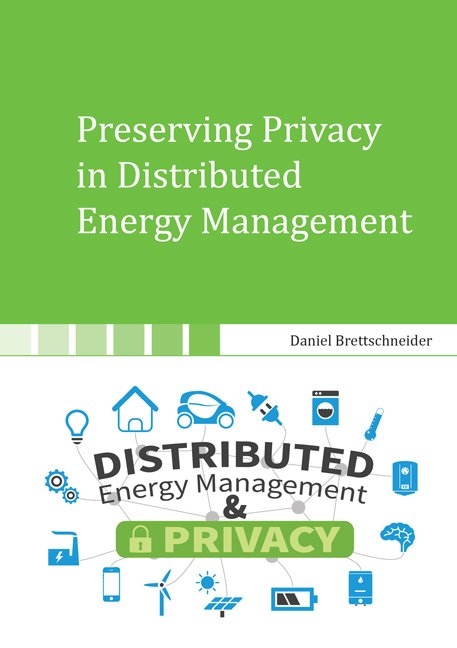
Preserving Privacy in Distributed Energy Management
Seiten
- Keine Verlagsinformationen verfügbar
- Artikel merken
The smart power grid transforms into a distributed system of manifold stakeholders by integrating communication technology into the former static power grid. Distributed Energy Management (DEM) will play a vital role in future demand supply matching. An important and often overlooked factor in this concept is privacy. This thesis presents PrivADE, a privacy-preserving algorithm for DEM. It utilises homomorphic encryption to privately gather aggregated data and perform energy management based on the max-min fairness principle. Simulation results show that PrivADE fulfils all evaluation criteria by bridging the gap between DEM and privacy, while offering considerable communicational properties and high-quality energy management. To aid in developing and testing novel DEM algorithms, while considering all required aspects of the smart grid, this thesis introduces SiENA, a simulation platform for DEM algorithms. It is capable of co-simulating power, heat, and communication. The modular architecture offers easy integration of new components and algorithms.
The smart power grid transforms into a distributed system of manifold stakeholders by integrating communication technology into the former static power grid. Distributed Energy Management (DEM) will play a vital role in stabilising energy consumption and generation. Thus, the rising share of renewable energy sources can be extended without the risk of blackouts. However, a crucial but often overlooked factor in this concept is privacy. Privacy resembles a key factor in the smart grid, because detailed consumption traces enable power signature analysis and thereby compromise the privacy of users.
This thesis introduces novel DEM algorithms following the privacy-by-design principle to bridge the gap between DEM and privacy. By applying a round-based procedure, participating households aggregate information about shiftable, switchable, and adaptable devices in a first round. Deviation from a DEM target is fairly distributed among them in the following rounds. First, the Privacy-Friendly Algorithm introduces the Bucket Encryption Scheme (BES), which adds encrypted noise during aggregation in a ring overlay network. After a round, only the server can subtract the decrypted noise from the aggregated data, without compromising the privacy of individual participants. Second, PrivADE introduces the Homomorphic Encryption Scheme (HES), where messages are encrypted and aggregated based on the Paillier cryptosystem. This concept performs all operations on ciphertext and allows for varying overlay networks, for example a tree overlay network used by PrivADE+.
To aid in developing and testing novel DEM algorithms, while considering all required aspects of the smart grid, this thesis introduces SiENA, a simulation platform for DEM algorithms. It is capable of co-simulating power, heat, and communication. Household appliances and future energy prosumers are modelled using a realistic data basis. It has a modular and scalable architecture for easy integration of new components and algorithms.
The introduced DEM algorithms are evaluated and compared to two well-known existing algorithms, COHDA and PowerMatcher. Simulation results show that only PrivADE and PrivADE+ fulfil all evaluation criteria by bridging the gap between DEM and privacy, while offering considerable communicational properties and high-quality energy management.
The smart power grid transforms into a distributed system of manifold stakeholders by integrating communication technology into the former static power grid. Distributed Energy Management (DEM) will play a vital role in stabilising energy consumption and generation. Thus, the rising share of renewable energy sources can be extended without the risk of blackouts. However, a crucial but often overlooked factor in this concept is privacy. Privacy resembles a key factor in the smart grid, because detailed consumption traces enable power signature analysis and thereby compromise the privacy of users.
This thesis introduces novel DEM algorithms following the privacy-by-design principle to bridge the gap between DEM and privacy. By applying a round-based procedure, participating households aggregate information about shiftable, switchable, and adaptable devices in a first round. Deviation from a DEM target is fairly distributed among them in the following rounds. First, the Privacy-Friendly Algorithm introduces the Bucket Encryption Scheme (BES), which adds encrypted noise during aggregation in a ring overlay network. After a round, only the server can subtract the decrypted noise from the aggregated data, without compromising the privacy of individual participants. Second, PrivADE introduces the Homomorphic Encryption Scheme (HES), where messages are encrypted and aggregated based on the Paillier cryptosystem. This concept performs all operations on ciphertext and allows for varying overlay networks, for example a tree overlay network used by PrivADE+.
To aid in developing and testing novel DEM algorithms, while considering all required aspects of the smart grid, this thesis introduces SiENA, a simulation platform for DEM algorithms. It is capable of co-simulating power, heat, and communication. Household appliances and future energy prosumers are modelled using a realistic data basis. It has a modular and scalable architecture for easy integration of new components and algorithms.
The introduced DEM algorithms are evaluated and compared to two well-known existing algorithms, COHDA and PowerMatcher. Simulation results show that only PrivADE and PrivADE+ fulfil all evaluation criteria by bridging the gap between DEM and privacy, while offering considerable communicational properties and high-quality energy management.
| Erscheinungsdatum | 06.11.2017 |
|---|---|
| Reihe/Serie | Berichte aus der Informatik |
| Verlagsort | Aachen |
| Sprache | englisch |
| Maße | 148 x 210 mm |
| Gewicht | 282 g |
| Themenwelt | Mathematik / Informatik ► Informatik ► Netzwerke |
| Schlagworte | distributed energy management • IT-Security • privacy • Smart Grid |
| ISBN-13 | 9783844055672 / 9783844055672 |
| Zustand | Neuware |
| Informationen gemäß Produktsicherheitsverordnung (GPSR) | |
| Haben Sie eine Frage zum Produkt? |
Mehr entdecken
aus dem Bereich


aus dem Bereich
das umfassende Buch zum Nachschlagen
Buch | Softcover (2025)
Markt + Technik (Verlag)
CHF 27,90
Praktische Übungen für die Vorlesungen und Praktika
Buch (2025)
Hanser (Verlag)
CHF 83,95


