


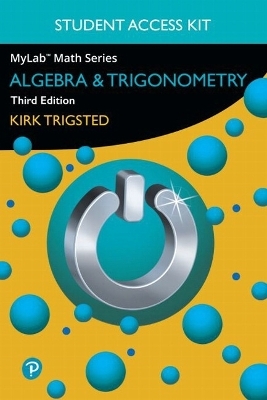
MyLab Math with Pearson eText Access Code (24 Months) for Algebra & Trigonometry
Pearson (Hersteller)
978-0-13-475159-7 (ISBN)
- Titel erscheint in neuer Auflage
- Artikel merken
Used books, rentals, and purchases made outside of Pearson
If purchasing or renting from companies other than Pearson, the access codes for the MyLab platform may not be included, may be incorrect, or may be previously redeemed. Check with the seller before completing your purchase.
For courses in Algebra & Trigonometry.
This package includes MyLab Math.
Completely clickable eTexts — with a consistent author voice throughout
Recognizing that today’s students start with the homework instead of reading the text, Kirk Trigsted has created an online learning environment that is a seamless mix of exposition, videos, interactive animations, tutorials, and assessment–designed for the way students think and behave online.
Each title in the Trigsted Precalculus Series is created from the ground up within MyLab Math — and all multimedia elements, exercises, feedback, and content are written by the author himself, ensuring a consistent, reassuring author presence throughout for students. This approach leverages the power of MyLab Math, and fosters student interaction with course materials in a way that is proving to be more effective.
Reach every student with MyLab Math
MyLab™ Math is the teaching and learning platform that empowers instructors to reach every student. By combining trusted author content with digital tools and a flexible platform, MyLab personalizes the learning experience and improves results for each student.
0134751590 / 9780134751597 MyLab Math for Trigsted Algebra & Trigonometry -- Access Kit, 3/e
About our author Kirk Trigsted teaches Precalculus at the University of Idaho, with 2000 students each year in a combined classroom and laboratory setting. He has been Director of the Polya Mathematics Center at the University of Idaho since its inception in 2001. Kirk has served as a consultant and redesign scholar for various projects through the National Center for Academic Transformation (NCAT). He is the lead author of an interactive, completely clickable series built from the ground up within MyLab Math. The series offers content spanning from Basic Math to Precalculus and Trigonometry.
BRIEF TABLE OF CONTENTS
NOTE: Both brief and comprehensive tables of contents are listed below.
Review Chapter
Equations, Inequalities, and Applications
The Rectangular Coordinate System, Lines, and Circles
Functions
Polynomial and Rational Functions
Exponential and Logarithmic Functions and Equations
An Introduction to Trigonometric Functions
The Graphs of Trigonometric Functions
Trigonometric Identities, Formulas, and Equations
Applications of Trigonometry
Polar Equations, Complex Numbers, and Vectors
Conic Sections and Parametric Equations
Systems of Equations and Inequalities
Matrices
Sequences and Series; Counting and Probability
Appendices
A. Degree, Minute, Second Form and Degree Decimal Form
B. Conic Section Proofs
COMPREHENSIVE TABLE OF CONTENTS
R. Review Chapter
R.1 Real Numbers
R.2 The Order of Operations and Algebraic Expressions
R.3 The Laws of Exponents; Radicals
R.4 Polynomials
R.5 Operations with Radicals (New Section)
R.6 Factoring Polynomials
R.7 Rational Expressions
Equations, Inequalities, and Applications
1.1 Linear and Rational Equations
1.2 Applications of Linear Equations and Rational Equation
1.3 Complex Numbers
1.4 Quadratic Equations
1.5 Applications of Quadratic Equations
1.6 Other Types of Equations
1.7 Linear Inequalities in One Variable
1.8 Absolute Value Equations and Inequalities
1.9 Polynomial and Rational Inequalities
The Rectangular Coordinate System, Lines, and Circles
2.1 The Rectangular Coordinate System
2.2 Circles
2.3 Lines
2.4 Parallel and Perpendicular Lines
Functions
3.1 Relations and Functions
3.2 Properties of a Function’s Graph
3.3 Graphs of Basic Functions; Piecewise Functions
3.4 Transformations of Functions
3.5 The Algebra of Functions; Composite Functions
3.6 One-to-One Functions; Inverse Functions
Polynomial and Rational Functions
4.1 Quadratic Functions
4.2 Applications and Modeling of Quadratic Functions
4.3 The Graphs of Polynomial Functions
4.4 Synthetic Division; The Remainder and Factor Theorems
4.5 The Zeros of Polynomial Functions; The Fundamental Theorem of Algebra
4.6 Rational Functions and Their Graphs
4.7 Variation
Exponential and Logarithmic Functions and Equations
5.1 Exponential Functions
5.2 Logarithmic Functions
5.3 Properties of Logarithms
5.4 Exponential and Logarithmic Equations
5.5 Applications of Exponential and Logarithmic Functions
An Introduction to Trigonometric Functions
6.1 An Introduction to Angles: Degree and Radian Measure
6.2 Applications of Radian Measure
6.3 Triangles
6.4 Right Triangle Trigonometry
6.5 Trigonometric Functions of General Angles
6.6 The Unit Circle
The Graphs of Trigonometric Functions
7.1 The Graphs of Sine and Cosine
7.2 More on Graphs of Sine and Cosine; Phase Shift
7.3 The Graphs of the Tangent, Cotangent , Cosecant, and Secant Functions
7.4 Inverse Trigonometric Functions I
7.5 Inverse Trigonometric Functions II
Trigonometric Identities, Formulas, and Equations
8.1 Trigonometric Identities
8.2 The Sum and Difference Formulas
8.3 The Double-Angle and Half-Angle Formulas
8.4 The Product-to-Sum and Sum-to-Product Formulas
8.5 Trigonometric Equations
Applications of Trigonometry
9.1 Right Triangle Applications
9.2 The Law of Sines
9.3 The Law of Cosines
9.4 Area of Triangles
Polar Equations, Complex Numbers, and Vectors
10.1 Polar Coordinates and Polar Equations
10.2 Graphing Polar Equations
10.3 Complex Numbers in Polar Form; DeMoivre’s Theorem
10.4 Vectors
10.5 The Dot Product
Conic Sections and Parametric Equations
11.1 Introduction to Conic Sections
11.2 The Parabola
11.3 The Ellipse
11.4 The Hyperbola
11.5 Conic Sections in Polar Form
11.6 Parametric Equations
Systems of Equations and Inequalities
12.1 Solving Systems of Linear Equations in Two Variables
12.2 Solving Systems of Linear Equations in Three Variables Using the Elimination Method
12.3 Solving Systems of Linear Equations in Three Variables Using Gaussian Elimination and Gauss-Jordan Elimination
12.4 Partial Fraction Decomposition
12.5 Systems of Nonlinear Equations
12.6 Systems of Inequalities
Matrices
13.1 Matrix Operations
13.2 Inverses of Matrices and Matrix Equations
13.3 Determinants and Cramer’s Rule
Sequences and Series; Counting and Probability
14.1 Introduction to Sequences and Series
14.2 Arithmetic Sequences and Series
14.3 Geometric Sequences and Series
14.4 The Binomial Theorem
14.5 Mathematical Induction
14.6 The Theory of Counting
14.7 An Introduction to Probability
Appendices
A. Degree, Minute, Second Form and Degree Decimal Form
B. Conic Section Proofs
| Sprache | englisch |
|---|---|
| Themenwelt | Mathematik / Informatik ► Mathematik |
| ISBN-10 | 0-13-475159-0 / 0134751590 |
| ISBN-13 | 978-0-13-475159-7 / 9780134751597 |
| Zustand | Neuware |
| Informationen gemäß Produktsicherheitsverordnung (GPSR) | |
| Haben Sie eine Frage zum Produkt? |


