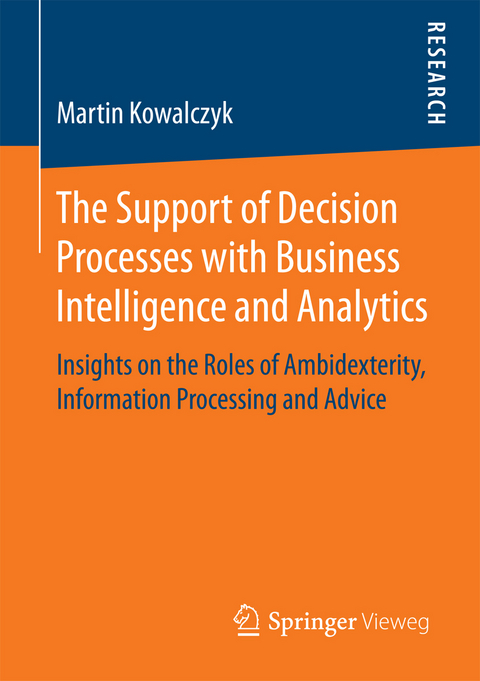
The Support of Decision Processes with Business Intelligence and Analytics (eBook)
XVII, 146 Seiten
Springer Fachmedien Wiesbaden (Verlag)
978-3-658-19230-3 (ISBN)
In his research, Martin Kowalczyk empirically investigates the challenges of designing and establishing successful decision support with Business Intelligence and Analytics (BI&A). The results from his work elucidate organizational and individual perspectives of BI&A support in decision processes. The organizational perspective considers the processual aspects of decision making and addresses process phases, roles and their interactions. The individual perspective reflects upon decision making of human individuals including their cognition and behaviors involved in decision making. The support of managerial decision making with BI&A gains increasing priority for many businesses in their desire to achieve better decision outcomes and improved organizational performance.
Dr. Martin Kowalczyk obtained his doctoral degree at the Chair of Information Systems, Software Business & Information Management at Technische Universität Darmstadt, Germany.
Dr. Martin Kowalczyk obtained his doctoral degree at the Chair of Information Systems, Software Business & Information Management at Technische Universität Darmstadt, Germany.
Foreword 5
Acknowledgements 7
Contents 8
List of Figures 12
List of Tables 13
List of Acronyms 14
1 Introduction 15
1.1 Scientific Relevance and Problem Characterization 16
1.2 Research Context and Fundamentals 17
1.2.1 Business Intelligence and Analytics 18
1.2.2 Decision Processes and Organizational Information Processing 21
1.2.3 Decision Making and Individual Information Processing 22
1.3 Research Goals and Questions 23
1.4 Thesis Structure and Outline 25
2 Study A: A Structured Literature Review on Business Intelligence and Analytics from a Decision Process Perspective 29
2.1 Introduction 29
2.2 Decision Support and Decision Processes 30
2.2.1 DSS Background and Technological Conceptualization 31
2.2.2 Decision Process Background and Research Framework 31
2.3 Review Method 33
2.3.1 Review Scope 33
2.3.2 Search Terms 34
2.3.3 Inclusion and Exclusion Criteria 34
2.3.4 Data Sources and Search Process 35
2.3.5 Data Extraction and Analysis Procedures 36
2.4 Results of the Structured Literature Review 37
2.4.1 Studies on the General Support of Decision Processes 37
2.4.2 Studies on the Specific Effects on Decision Processes 37
2.5 Discussion of Results 41
2.6 Research Opportunities 42
2.7 Conclusion 43
3 Study B: Big Data and Information Processing in Organizational Decision Processes 44
3.1 Introduction 44
3.2 Theoretical Background 45
3.2.1 Big Data and BI& A
3.2.2 Information Processing Theory and Decision Processes 46
3.2.3 Data-centric and Organizational Information Processing Mechanisms 47
3.3 Research Approach 48
3.3.1 Research Design 48
3.3.2 Data Collection 49
3.3.3 Overview of Cases 50
3.3.4 Data Analysis 53
3.4 Empirical Results 54
3.4.1 Big Data in Different Decision Contexts 54
3.4.2 Data-centric and Organizational Information Processing Mechanisms 55
3.4.3 Information Processing Mechanisms in Different Decision Contexts 57
3.4.4 Dynamics of Information Processing Mechanism Composition 59
3.5 Discussion of Results and Conclusion 62
3.5.1 Theoretical Implications 63
3.5.2 Practical Implications 64
3.5.3 Limitations and Directions for Future Research 65
4 Study C: Perspectives on Collaboration Procedures and Politics during the Support of Decision Processes with Business Intelligence and Analytics 66
4.1 Introduction 66
4.2 Theoretical Background 68
4.2.1 Business Intelligence and Analytics (BI& A) and Information Quality
4.2.2 Political Behavior and Procedural Rationality in Decision Processes 69
4.2.3 Collaboration Procedures and Ambidexterity in Decision Processes 70
4.3 Research Method 71
4.3.1 Research Design 72
4.3.2 Data Collection 72
4.3.3 Case Overview 73
4.3.4 Data Analysis 74
4.4 Results 75
4.4.1 Impact of Political Behavior and Procedural Rationality 75
4.4.2 Decision Process Rigor and Agility as Dimensions of Ambidexterity 78
4.4.3 Complementarity of Information Quality and Ambidexterity 80
4.5 Discussion and Conclusion 82
4.5.1 Discussion of Key Findings 82
4.5.2 Limitations and Future Research 83
5 Study D: An Ambidextrous Perspective on Business Intelligence and Analytics Support in Decision Processes 85
5.1 Introduction 85
5.2 Theoretical Background 87
5.2.1 Data-centric Decision Support with Business Intelligence and Analytics 87
5.2.2 Conceptions of Decision Making in Management and Cognitive Sciences 88
5.2.3 Decision Processes and Challenges for Effective BI& A Support
5.2.4 Ambidexterity and Decision Processes 91
5.3 Research Method 92
5.3.1 Research Design 93
5.3.2 Data Collection 93
5.3.3 Case Overview 94
5.3.4 Data Analysis 95
5.4 Results 96
5.4.1 Tensions and Tactics 96
5.4.1.1 Method and domain specialization 97
5.4.1.2 Method flexibility and stability 98
5.4.1.3 Data source flexibility and stability 99
5.4.1.4 Advanced and basic analytic elaboration 100
5.4.1.5 Broad and focused analytic scope 102
5.4.1.6 Open and focused problem and solution space 102
5.4.2 Ambidexterity in BI& A-Supported Decision Processes
5.4.2.1 Ambidexterity and the quality of decision process outcomes 104
5.4.2.2 Procedural rationality and intuition in decision processes 105
5.4.2.3 A theory of ambidexterity in decision support 105
5.5 Discussion and Conclusions 107
5.5.1 Implications for Research 107
5.5.2 Implications for Practice 109
5.5.3 Limitations and Future Research Directions 109
6 Study E: Business Intelligence and Analytics – Decision Quality and Insights on Analytics Specialization and Information Processing Modes 111
6.1 Introduction 111
6.2 Theoretical Background 113
6.2.1 Business Intelligence & Analytics
6.2.2 Specialization in BI& A-Supported Decision Processes
6.2.3 Heuristic–Systematic Model of Information Processing 114
6.3 Research Model and Hypotheses 116
6.3.1 BI& A Characteristics and Decision Makers’ Information Processing
6.3.2 Determinants of Information Processing 118
6.3.3 Advice Utilization and Determinants of Decision Quality 119
6.4 Methodology 121
6.4.1 Data Collection and Sample 121
6.4.2 Operationalization and Measurement Properties 122
6.5 Results 125
6.6 Discussion 126
6.6.1 Implications for Research 126
6.6.2 Implications for Practice 127
6.6.3 Limitations and Future Research 128
7 Conclusion and Summary of Contributions 129
7.1 Theoretical Implications 130
7.2 Practical Implications 134
7.3 Conclusion 136
References 138
Appendix 149
A1. Studies Included in the Literature Review (Study A) 149
A.2 Scales and Items (Study E) 151
| Erscheint lt. Verlag | 22.8.2017 |
|---|---|
| Zusatzinfo | XVII, 146 p. 18 illus., 4 illus. in color. |
| Verlagsort | Wiesbaden |
| Sprache | englisch |
| Themenwelt | Mathematik / Informatik ► Informatik ► Netzwerke |
| Schlagworte | Advisory • Ambidexterity • Big Data • Data Science • Data Scientist • Decision Making • Decision Processes • Information Processing |
| ISBN-10 | 3-658-19230-5 / 3658192305 |
| ISBN-13 | 978-3-658-19230-3 / 9783658192303 |
| Informationen gemäß Produktsicherheitsverordnung (GPSR) | |
| Haben Sie eine Frage zum Produkt? |
 PDF (Wasserzeichen)
DRM: Digitales Wasserzeichen
Dieses eBook enthält ein digitales Wasserzeichen und ist damit für Sie personalisiert. Bei einer missbräuchlichen Weitergabe des eBooks an Dritte ist eine Rückverfolgung an die Quelle möglich.
Dateiformat: PDF (Portable Document Format)
Mit einem festen Seitenlayout eignet sich die PDF besonders für Fachbücher mit Spalten, Tabellen und Abbildungen. Eine PDF kann auf fast allen Geräten angezeigt werden, ist aber für kleine Displays (Smartphone, eReader) nur eingeschränkt geeignet.
Systemvoraussetzungen:
PC/Mac: Mit einem PC oder Mac können Sie dieses eBook lesen. Sie benötigen dafür einen PDF-Viewer - z.B. den Adobe Reader oder Adobe Digital Editions.
eReader: Dieses eBook kann mit (fast) allen eBook-Readern gelesen werden. Mit dem amazon-Kindle ist es aber nicht kompatibel.
Smartphone/Tablet: Egal ob Apple oder Android, dieses eBook können Sie lesen. Sie benötigen dafür einen PDF-Viewer - z.B. die kostenlose Adobe Digital Editions-App.
Buying eBooks from abroad
For tax law reasons we can sell eBooks just within Germany and Switzerland. Regrettably we cannot fulfill eBook-orders from other countries.
aus dem Bereich