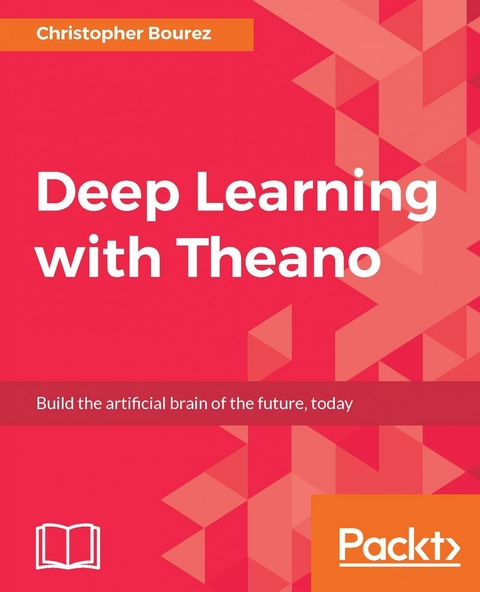
Deep Learning with Theano (eBook)
300 Seiten
Packt Publishing (Verlag)
978-1-78646-305-0 (ISBN)
Develop deep neural networks in Theano with practical code examples for image classification, machine translation, reinforcement agents, or generative models.
About This Book
- Learn Theano basics and evaluate your mathematical expressions faster and in an efficient manner
- Learn the design patterns of deep neural architectures to build efficient and powerful networks on your datasets
- Apply your knowledge to concrete fields such as image classification, object detection, chatbots, machine translation, reinforcement agents, or generative models.
Who This Book Is For
This book is indented to provide a full overview of deep learning. From the beginner in deep learning and artificial intelligence, to the data scientist who wants to become familiar with Theano and its supporting libraries, or have an extended understanding of deep neural nets.
Some basic skills in Python programming and computer science will help, as well as skills in elementary algebra and calculus.
What You Will Learn
- Get familiar with Theano and deep learning
- Provide examples in supervised, unsupervised, generative, or reinforcement learning.
- Discover the main principles for designing efficient deep learning nets: convolutions, residual connections, and recurrent connections.
- Use Theano on real-world computer vision datasets, such as for digit classification and image classification.
- Extend the use of Theano to natural language processing tasks, for chatbots or machine translation
- Cover artificial intelligence-driven strategies to enable a robot to solve games or learn from an environment
- Generate synthetic data that looks real with generative modeling
- Become familiar with Lasagne and Keras, two frameworks built on top of Theano
In Detail
This book offers a complete overview of Deep Learning with Theano, a Python-based library that makes optimizing numerical expressions and deep learning models easy on CPU or GPU.
The book provides some practical code examples that help the beginner understand how easy it is to build complex neural networks, while more experimented data scientists will appreciate the reach of the book, addressing supervised and unsupervised learning, generative models, reinforcement learning in the fields of image recognition, natural language processing, or game strategy.
The book also discusses image recognition tasks that range from simple digit recognition, image classification, object localization, image segmentation, to image captioning. Natural language processing examples include text generation, chatbots, machine translation, and question answering. The last example deals with generating random data that looks real and solving games such as in the Open-AI gym.
At the end, this book sums up the best -performing nets for each task. While early research results were based on deep stacks of neural layers, in particular, convolutional layers, the book presents the principles that improved the efficiency of these architectures, in order to help the reader build new custom nets.
Style and approach
It is an easy-to-follow example book that teaches you how to perform fast, efficient computations in Python. Starting with the very basics-NumPy, installing Theano, this book will take you to the smooth journey of implementing Theano for advanced computations for machine learning and deep learning.
Develop deep neural networks in Theano with practical code examples for image classification, machine translation, reinforcement agents, or generative models.About This BookLearn Theano basics and evaluate your mathematical expressions faster and in an efficient mannerLearn the design patterns of deep neural architectures to build efficient and powerful networks on your datasetsApply your knowledge to concrete fields such as image classification, object detection, chatbots, machine translation, reinforcement agents, or generative models.Who This Book Is ForThis book is indented to provide a full overview of deep learning. From the beginner in deep learning and artificial intelligence, to the data scientist who wants to become familiar with Theano and its supporting libraries, or have an extended understanding of deep neural nets.Some basic skills in Python programming and computer science will help, as well as skills in elementary algebra and calculus.What You Will LearnGet familiar with Theano and deep learningProvide examples in supervised, unsupervised, generative, or reinforcement learning.Discover the main principles for designing efficient deep learning nets: convolutions, residual connections, and recurrent connections.Use Theano on real-world computer vision datasets, such as for digit classification and image classification.Extend the use of Theano to natural language processing tasks, for chatbots or machine translationCover artificial intelligence-driven strategies to enable a robot to solve games or learn from an environmentGenerate synthetic data that looks real with generative modelingBecome familiar with Lasagne and Keras, two frameworks built on top of TheanoIn DetailThis book offers a complete overview of Deep Learning with Theano, a Python-based library that makes optimizing numerical expressions and deep learning models easy on CPU or GPU.The book provides some practical code examples that help the beginner understand how easy it is to build complex neural networks, while more experimented data scientists will appreciate the reach of the book, addressing supervised and unsupervised learning, generative models, reinforcement learning in the fields of image recognition, natural language processing, or game strategy.The book also discusses image recognition tasks that range from simple digit recognition, image classification, object localization, image segmentation, to image captioning. Natural language processing examples include text generation, chatbots, machine translation, and question answering. The last example deals with generating random data that looks real and solving games such as in the Open-AI gym.At the end, this book sums up the best -performing nets for each task. While early research results were based on deep stacks of neural layers, in particular, convolutional layers, the book presents the principles that improved the efficiency of these architectures, in order to help the reader build new custom nets.Style and approachIt is an easy-to-follow example book that teaches you how to perform fast, efficient computations in Python. Starting with the very basics-NumPy, installing Theano, this book will take you to the smooth journey of implementing Theano for advanced computations for machine learning and deep learning.
| Erscheint lt. Verlag | 31.7.2017 |
|---|---|
| Sprache | englisch |
| Themenwelt | Mathematik / Informatik ► Informatik ► Netzwerke |
| ISBN-10 | 1-78646-305-9 / 1786463059 |
| ISBN-13 | 978-1-78646-305-0 / 9781786463050 |
| Informationen gemäß Produktsicherheitsverordnung (GPSR) | |
| Haben Sie eine Frage zum Produkt? |
 EPUB (Adobe DRM)
Kopierschutz: Adobe-DRM
Adobe-DRM ist ein Kopierschutz, der das eBook vor Mißbrauch schützen soll. Dabei wird das eBook bereits beim Download auf Ihre persönliche Adobe-ID autorisiert. Lesen können Sie das eBook dann nur auf den Geräten, welche ebenfalls auf Ihre Adobe-ID registriert sind.
Details zum Adobe-DRM
Dateiformat: EPUB (Electronic Publication)
EPUB ist ein offener Standard für eBooks und eignet sich besonders zur Darstellung von Belletristik und Sachbüchern. Der Fließtext wird dynamisch an die Display- und Schriftgröße angepasst. Auch für mobile Lesegeräte ist EPUB daher gut geeignet.
Systemvoraussetzungen:
PC/Mac: Mit einem PC oder Mac können Sie dieses eBook lesen. Sie benötigen eine
eReader: Dieses eBook kann mit (fast) allen eBook-Readern gelesen werden. Mit dem amazon-Kindle ist es aber nicht kompatibel.
Smartphone/Tablet: Egal ob Apple oder Android, dieses eBook können Sie lesen. Sie benötigen eine
Geräteliste und zusätzliche Hinweise
Buying eBooks from abroad
For tax law reasons we can sell eBooks just within Germany and Switzerland. Regrettably we cannot fulfill eBook-orders from other countries.
aus dem Bereich