


Container Fleet Management in Closed-Loop Supply Chains.
Seiten
- Titel ist leider vergriffen;
keine Neuauflage - Artikel merken
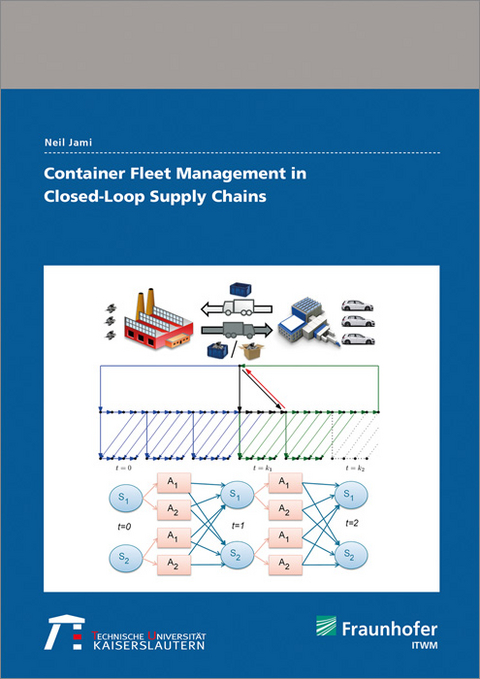
The objective of this thesis is to develop models and algorithms to plan the purchasing of reusable containers in a closed-loop supply chain where the demand is increasing. Our model is similar to a lot-sizing problem with return of every item after a fixed duration. We study both cases of a deterministic demand as well as a stochastic demand. The thesis concludes with an application on a real-life supply chain.
The objective of this thesis is to develop models and algorithms to plan the purchasing of reusable containers in a closed-loop supply chain where the demand is increasing. We restrict our study to a periodic review process between a single manufacturer and a single supplier. Each item is transported either in a reusable container or in a single-use disposable. Furthermore, a setup cost is paid every time new containers are purchased. Consequently, our model is similar to a lot-sizing problem with return of every item after a fixed duration. We study both cases of a deterministic demand as well as a stochastic demand. In the deterministic setting, we use dynamic programming and minimum linear-cost flows to generate polynomial time algorithms. When the demand is stochastic, we use the Markov decision process framework to develop pseudo-polynomial time heuristics for four different strategies. We show the L-natural-convexity of the cost functions for three strategies to speed up the computations. The thesis concludes with an application on a real-life supply chain.
The objective of this thesis is to develop models and algorithms to plan the purchasing of reusable containers in a closed-loop supply chain where the demand is increasing. We restrict our study to a periodic review process between a single manufacturer and a single supplier. Each item is transported either in a reusable container or in a single-use disposable. Furthermore, a setup cost is paid every time new containers are purchased. Consequently, our model is similar to a lot-sizing problem with return of every item after a fixed duration. We study both cases of a deterministic demand as well as a stochastic demand. In the deterministic setting, we use dynamic programming and minimum linear-cost flows to generate polynomial time algorithms. When the demand is stochastic, we use the Markov decision process framework to develop pseudo-polynomial time heuristics for four different strategies. We show the L-natural-convexity of the cost functions for three strategies to speed up the computations. The thesis concludes with an application on a real-life supply chain.
| Erscheinungsdatum | 04.08.2017 |
|---|---|
| Zusatzinfo | num. illus. and tab. |
| Verlagsort | Stuttgart |
| Sprache | englisch |
| Maße | 148 x 210 mm |
| Themenwelt | Mathematik / Informatik ► Informatik |
| Mathematik / Informatik ► Mathematik ► Angewandte Mathematik | |
| Schlagworte | B • combinatorics & graph theory • discrete mathematic • Discrete Mathematics • Diskrete Mathematik • Fraunhofer ITWM • Graphentheorie • Kombinatorik • Kombinatorik und Graphentheorie • Mathematiker • Optimierung • Optimization • Politik • transport planning & policy • Transportplanung • Transportplanung und Politik • Wirtschaftswissenschaftler |
| ISBN-10 | 3-8396-1210-1 / 3839612101 |
| ISBN-13 | 978-3-8396-1210-1 / 9783839612101 |
| Zustand | Neuware |
| Informationen gemäß Produktsicherheitsverordnung (GPSR) | |
| Haben Sie eine Frage zum Produkt? |
Mehr entdecken
aus dem Bereich



aus dem Bereich
Buch | Softcover (2025)
Springer Vieweg (Verlag)
CHF 62,95
Buch | Softcover (2025)
Springer Fachmedien Wiesbaden (Verlag)
CHF 69,95
Buch | Softcover (2024)
Springer Vieweg (Verlag)
CHF 53,15


