Mechanical Vibration (eBook)
John Wiley & Sons (Verlag)
978-1-118-92758-8 (ISBN)
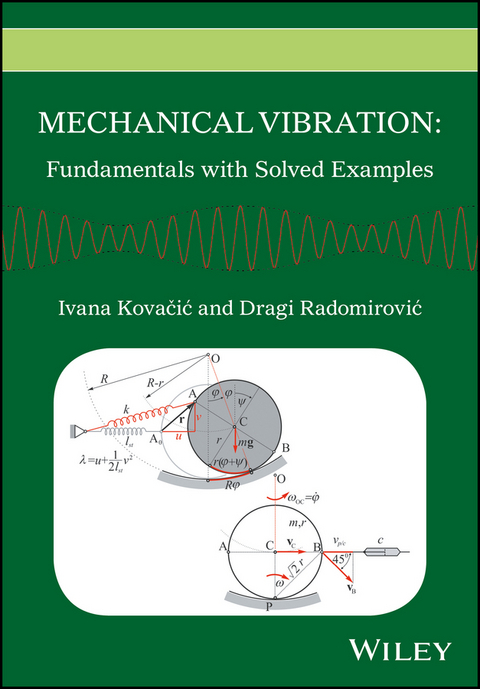
Mechanical oscillators in Lagrange's formalism - a thorough problem-solved approach
This book takes a logically organized, clear and thorough problem-solved approach at instructing the reader in the application of Lagrange's formalism to derive mathematical models for mechanical oscillatory systems, while laying a foundation for vibration engineering analyses and design.
Each chapter contains brief introductory theory portions, followed by a large number of fully solved examples. These problems, inherent in the design and analysis of mechanical systems and engineering structures, are characterised by a complexity and originality that is rarely found in textbooks.
Numerous pedagogical features, explanations and unique techniques that stem from the authors' extensive teaching and research experience are included in the text in order to aid the reader with comprehension and retention. The book is rich visually, including numerous original figures with high-standard sketches and illustrations of mechanisms.
Key features:
- Distinctive content including a large number of different and original oscillatory examples, ranging from simple to very complex ones.
- Contains many important and useful hints for treating mechanical oscillatory systems.
- Each chapter is enriched with an Outline and Objectives, Chapter Review and Helpful Hints.
Mechanical Vibration: Fundamentals with Solved Examples is essential reading for senior and graduate students studying vibration, university professors, and researchers in industry.
Ivana Kova?i?, University of Novi Sad, Serbia
Ivana Kova?i? graduated in Mechanical Engineering from the Faculty of Technical Sciences (FTN), University of Novi Sad, Serbia. She obtained her MSc and PhD in the Theory of Nonlinear Vibrations at the FTN. She is currently a Full Professor of Mechanics at the FTN and the head of the Centre of Excellence for Vibro-Acoustic Systems and Signal Processing CEVAS at the same faculty. Kova?i? is the Subject Editor of three academic journals: the Journal of Sound and Vibration, the European Journal of Mechanics A/Solids and Meccanica. Her research involves the use of quantitative and qualitative methods to study differential equations arising from nonlinear dynamics problems mainly in mechanical engineering, and recently also in biomechanics and tree vibrations.
Dragi Radomirovi?, University of Novi Sad, Serbia
Dragi Radomirovi? graduated in Mechanical Engineering from the Faculty of Technical Sciences (FTN), University of Novi Sad (UNS), Serbia. He obtained his MSc and PhD in Analytical Mechanics at the FTN. He is a Full Professor of Mechanics at the Faculty of Agriculture, UNS. His research interests are directed towards Mechanical Vibrations and Analytical Mechanics.
Ivana Kovacic, University of Novi Sad, Serbia Ivana Kovacic graduated in Mechanical Engineering from the Faculty of Technical Sciences (FTN), University of Novi Sad, Serbia. She obtained her MSc and PhD in the Theory of Nonlinear Vibrations at the FTN. She is currently a Full Professor of Mechanics at the FTN and the head of the Centre of Excellence for Vibro-Acoustic Systems and Signal Processing CEVAS at the same faculty. Kovacic is the Subject Editor of three academic journals: the Journal of Sound and Vibration, the European Journal of Mechanics A/Solids and Meccanica. Her research involves the use of quantitative and qualitative methods to study differential equations arising from nonlinear dynamics problems mainly in mechanical engineering, and recently also in biomechanics and tree vibrations. Dragi Radomirovic, University of Novi Sad, Serbia Dragi Radomirovic graduated in Mechanical Engineering from the Faculty of Technical Sciences (FTN), University of Novi Sad (UNS), Serbia. He obtained his MSc and PhD in Analytical Mechanics at the FTN. He is a Full Professor of Mechanics at the Faculty of Agriculture, UNS. His research interests are directed towards Mechanical Vibrations and Analytical Mechanics.
About the Authors ix
Preface xi
1 Preliminaries 1
Chapter Outline 1
Chapter Objectives 1
1.1 From Statics 1
1.1.1 Mechanical Systems and Equilibrium Equations 1
1.1.2 Constraints and Free-Body Diagrams 1
1.1.3 Equilibrium Condition Via Virtual Work 2
1.2 From Kinematics 4
1.2.1 Kinematics of Particles 4
1.2.2 Kinematics of Rigid Bodies 5
1.2.3 Kinematics of Particles in Compound Motion 7
1.3 From Kinetics 8
1.3.1 Kinetics of Particles 8
1.3.2 Kinetics of Rigid Bodies 9
1.4 From Strength of Materials 13
1.4.1 Axial Loading 13
1.4.2 Torsion 14
1.4.3 Bending 14
2 Lagrange's Equation for Mechanical Oscillatory Systems 17
Chapter Outline 17
Chapter Objectives 17
2.1 About Lagrange's Equation of the Second Kind 17
2.2 Kinetic Energy in Mechanical Oscillatory Systems 19
2.3 Potential Energy in Mechanical Oscillatory Systems 21
2.3.1 Gravitational Potential Energy 22
2.3.2 Potential Energy of a Spring (Elastic Potential Energy) 24
2.4 Generalised Forces in Mechanical Oscillatory Systems 27
2.5 Dissipative Function in Mechanical Oscillatory Systems 28
References 30
3 Free Undamped Vibration of Single-Degree-of-Freedom Systems 31
Chapter Outline 31
Chapter Objectives 31
Theoretical Introduction 31
4 Free Damped Vibration of Single-Degree-of-Freedom Systems 67
Chapter Outline 67
Chapter Objectives 67
Theoretical Introduction 67
5 Forced Vibration of Single-Degree-of-Freedom Systems 101
Chapter Outline 101
Chapter Objectives 101
Theoretical Introduction 101
6 Free Undamped Vibration of Two-Degree-of-Freedom Systems 127
Chapter Outline 127
Chapter Objectives 127
Theoretical Introduction 127
7 Forced Vibration of Two-Degree-of-Freedom Systems 153
Chapter Outline 153
Chapter Objectives 153
Theoretical Introduction 153
8 Vibration of Systems with Infinite Number of Degrees of Freedom 183
Chapter Outline 183
Chapter Objectives 183
8.1 Theoretical Introduction: Longitudinal Vibration of Bars 183
8.2 Theoretical Introduction: Torsional Vibration of Shafts 197
8.3 Theoretical Introduction: Transversal Vibration of Beams 207
9 Additional Topics 225
Chapter Outline 225
Chapter Objectives 225
9.1 Theoretical Introduction 225
9.2 Equivalent Two-Element System for Concurrent Springs and Dampers 226
9.2.1 Concurrent Springs 227
9.2.2 Concurrent Dampers 231
9.3 Nonlinear Springs in Series 238
9.3.1 Purely Nonlinear Springs in Series 239
9.3.2 Equal Duffing Springs in Series 239
9.3.3 Two Different Nonlinear Springs 240
9.4 On the Deflection and Potential Energy of Nonlinear Springs: Approximate Expressions 242
9.4.1 Duffing-Type Spring Deformed in the Static Equilibrium Position 242
9.4.2 Duffing-Type Spring Undeformed in the Static Equilibrium Position 242
9.5 Corrections of Stiffness Properties of Certain Oscillatory Systems 244
9.5.1 One-Degree-of-Freedom Systems 245
9.5.2 Two-Degree-of-Freedom Systems 248
Appendix: Mathematical Topics 255
A.1 Geometry 255
A.2 Trigonometry 257
A.3 Algebra 258
A.4 Vectors 258
A.5 Derivatives 259
A.6 Variation (Virtual Displacements) 260
A.7 Series 260
Index 261
1
Preliminaries
Chapter Outline
This chapter provides theoretical fundamentals for the considerations presented in the subsequent chapters. It is divided into four sections, containing some key concepts, facts and expressions from Statics, Kinematics, Kinetics and Strength of Materials.
Chapter Objectives
- To present preliminaries from Statics, Kinematics, Kinetics and Strength of Materials
- To focus only on the key concepts, facts and expressions of interest for the considerations presented in this book
- To provide help to readers to enable them to use this book on a stand‐alone basis
1.1 From Statics
1.1.1 Mechanical Systems and Equilibrium Equations
Of interest here is the equilibrium of different systems of forces and torques lying in one plane. They are given separately in Table 1.1.1 together with the corresponding equilibrium equations and their descriptions. Note that before writing these equations, one must create a free‐body diagram for the object under consideration if it is not free. The way to do this is described in Table 1.1.2.
| Type | Mechanical model | Equilibrium equations |
| Concurrent forces |
| Sum of the projections of all forces on two orthogonal axes is equal to zero. |
| Parallel forces and torques in the same plane |
| Sum of the projections of forces on the axis parallel to the direction of the forces is equal to zero. Sum of the moments about any point A on or off the body is equal to zero. |
| Arbitrary forces and torques in one plane | Sum of the projections of all forces on two orthogonal axes is equal to zero.Sum of the moments about any point A on or off the body is equal to zero. The alternative equilibrium equations are:
|
| Type | Schematics | Description |
| Smooth surface | Contact force is compressive and is normal to the tangent at the point of contact. |
| Weightless straight rod | Force exerted is the direction of the straight rod, but it can be tensile or compressive. |
| Rope/ Cable | Force exerted is always a tension away from the body in the direction of the rope. |
| Pin connection | Force exerted lies in the plane normal to the pin axis; this force is usually shown in terms of two orthogonal components (for example, horizontal and vertical). |
| Roller/ Rocker/ Ball support | Compressive force normal to the supporting surface/guide. |
| Fixed or built‐in support | Two orthogonal components of a force and a torque. |
1.1.2 Constraints and Free‐Body Diagrams
When considering the equilibrium of an object or combinations of objects via equations of motion, it is essential to isolate them from all surrounding bodies. This isolation is accomplished by the free‐body diagram, which shows all active forces and active torques acting on the object or combinations of objects as well as forces and torques that exist due to mechanical contacts with surrounding bodies, which represent the so‐called mechanical constraints. There are several common types that can exist in a plane, and they are collected and described in Table 1.1.2. Note that these forces and torques are also called passive forces and passive torques.
1.1.3 Equilibrium Condition Via Virtual Work
Besides the approach based on the equilibrium equation, one can determine and investigate equilibria based on the principle of virtual work.
The virtual work of a force is the scalar product of the vector of the force and the virtual displacement of the point at which it acts. This can be further expressed in the rectangular/Cartesian coordinate system as follows:
The virtual work of a torque on the virtual rotation can be defined as
where the plus sign corresponds to the case when the torque helps to increase of the angle of rotation, while the minus sign holds in the opposite case.
For the case of a system of forces and torques, the overall virtual work is the sum of the virtual work of each of them:
If the position of the mechanical system is depicted by N generalised coordinates qi (i = 1,…, N), one can express Equation (1.1.3) in the form
where the coefficients represent the so‐called generalised forces (see Section 2.4). In the equilibrium position, the generalised forces are equal to zero:
Note that the number of homogeneous algebraic equations (1.1.5) is equal to the number of generalised coordinates, that is, the number of degrees of freedom. For example, if the system has one degree of freedom, there is one generalised force and one equation (1.1.5) to determine the equilibrium or any other parameter that yields it. For two‐degree‐of‐freedom systems, two equations (1.1.5) exist, and so on.
It should also be noted that in the case of ideal constraints (see Table 1.1.2), the virtual work of the corresponding forces and torques is equal to zero. This implies that when solving the examples related to static equilibria, one does not need to introduce reactions of ideal constraints as their virtual work is zero.
1.2 From Kinematics
Kinematics deals with the geometrical aspects of motion of particles and rigid bodies, as well as with the mathematical description of their motion and certain velocities and accelerations they have over time.
1.2.1 Kinematics of Particles
A particle moving in a plane is shown in Figure 1.2.1. To study its motion, different coordinates can be used. For example, a set of two mutually orthogonal axes x and y with the origin O can be arbitrary chosen, but the axes must be fixed (Figure 1.2.1a). The unit vectors are, respectively, i and j. The position vector is directed from the origin to the particle and is defined by:
where x and y, in general, change over time t, that is, and .
The particle’s velocity v and acceleration a are defined by:
where the overdot indicates differentiation with respect to time.
Besides this, one can use polar coordinates (Figure 1.2.1b) and with the moveable unit vectors r0 and c0. The velocity of the particle has two components:
1.2.2 Kinematics of Rigid Bodies
1.2.2.1 Rigid Body in Translatory Motion
During translatory motion every line in the body remains parallel to its original position at all times. One can distinguish rectilinear translation (Figure 1.2.2), when all points move along parallel straight lines, and curvilinear translation (Figure 1.2.3), when all points move along congruent curves. During translatory motion all points have the same velocity as noted in Figures 1.2.2 and 1.2.3. Thus, specifying the motion of one point enables one to describe completely the translation of the whole body.
1.2.2.2 Rigid Body in Fixed‐Axis Rotation
During rotation about a fixed axis (Figure 1.2.4) all points in a rigid body (other than those on the axis) move along concentric circular paths around the axis of rotation. Note that the axis of rotation in Figure 1.2.4 passes through the point O and is perpendicular to the plane of the figure. The position of the body is defined by the angle between the fixed line and a line attached to the body (this angle is labelled by ϕ in Figure 1.2.4) and the angular velocity of the body is . The velocity of each point is proportional to it, as well as to its distance with respect to the axis of rotation. Referring again to Figure 1.2.4, one can write
1.2.2.3 Rigid Body in General Plane Motion
General plane motion of a rigid body is a combination of translation and rotation around the axis perpendicular to the plane in which the translation takes place. Thus, the velocities of any two points of the body are mutually related by the expression (see Figure...
| Erscheint lt. Verlag | 25.7.2017 |
|---|---|
| Sprache | englisch |
| Themenwelt | Informatik ► Weitere Themen ► CAD-Programme |
| Technik ► Maschinenbau | |
| Schlagworte | Bauingenieur- u. Bauwesen • Baustatik • Baustatik u. Baumechanik • Beating oscillations • Civil Engineering & Construction • Damped oscillations • Equation of Motion • Equivalent stiffness' Dynamic absorber • Festkörpermechanik • Forced Vibrations • Lagrange's equation of the second kind • Maschinenbau • Maschinenbau - Entwurf • mechanical engineering • Mechanical Engineering - Design • Mechanical oscillators • potential energy • solid mechanics • Structural Theory & Structural Mechanics • Transversal vibrations • Vibration |
| ISBN-10 | 1-118-92758-3 / 1118927583 |
| ISBN-13 | 978-1-118-92758-8 / 9781118927588 |
| Informationen gemäß Produktsicherheitsverordnung (GPSR) | |
| Haben Sie eine Frage zum Produkt? |
 EPUB (Adobe DRM)
Kopierschutz: Adobe-DRM
Adobe-DRM ist ein Kopierschutz, der das eBook vor Mißbrauch schützen soll. Dabei wird das eBook bereits beim Download auf Ihre persönliche Adobe-ID autorisiert. Lesen können Sie das eBook dann nur auf den Geräten, welche ebenfalls auf Ihre Adobe-ID registriert sind.
Details zum Adobe-DRM
Dateiformat: EPUB (Electronic Publication)
EPUB ist ein offener Standard für eBooks und eignet sich besonders zur Darstellung von Belletristik und Sachbüchern. Der Fließtext wird dynamisch an die Display- und Schriftgröße angepasst. Auch für mobile Lesegeräte ist EPUB daher gut geeignet.
Systemvoraussetzungen:
PC/Mac: Mit einem PC oder Mac können Sie dieses eBook lesen. Sie benötigen eine
eReader: Dieses eBook kann mit (fast) allen eBook-Readern gelesen werden. Mit dem amazon-Kindle ist es aber nicht kompatibel.
Smartphone/Tablet: Egal ob Apple oder Android, dieses eBook können Sie lesen. Sie benötigen eine
Geräteliste und zusätzliche Hinweise
Buying eBooks from abroad
For tax law reasons we can sell eBooks just within Germany and Switzerland. Regrettably we cannot fulfill eBook-orders from other countries.
aus dem Bereich