


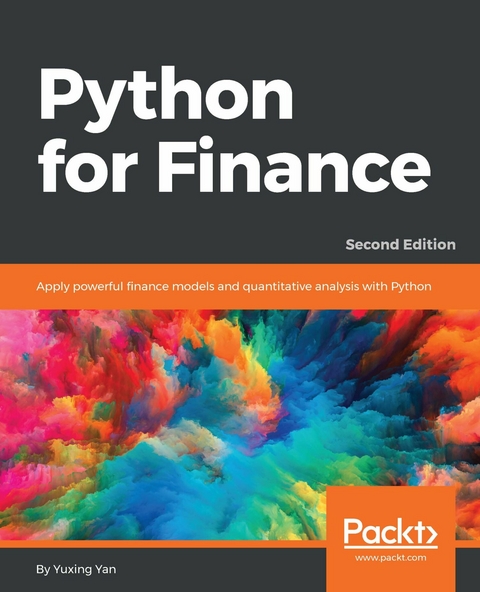
Python for Finance - Second Edition (eBook)
586 Seiten
Packt Publishing (Verlag)
978-1-78712-502-5 (ISBN)
This book uses Python as its computational tool. Since Python is free, any school or
organization can download and use it.
This book is organized according to various finance subjects. In other words, the first edition focuses more on Python, while the second edition is truly trying to apply Python to finance.
The book starts by explaining topics exclusively related to Python. Then we deal with critical parts of Python, explaining concepts such as time value of money stock and bond evaluations, capital asset pricing model, multi-factor models, time series analysis, portfolio theory,
options and futures.
This book will help us to learn or review the basics of quantitative finance and apply Python to solve various problems, such as estimating IBM's market risk,
running a Fama-French 3-factor, 5-factor, or Fama-French-Carhart 4 factor model, estimating the VaR of a 5-stock portfolio, estimating the optimal portfolio, and constructing the efficient frontier for a 20-stock portfolio with real-world stock, and with Monte Carlo Simulation. Later, we will also learn how to replicate the famous Black-Scholes-Merton option model and how to price exotic options such as the average price call option.
Learn and implement various Quantitative Finance concepts using the popular Python librariesAbout This BookUnderstand the fundamentals of Python data structures and work with time-series dataImplement key concepts in quantitative finance using popular Python libraries such as NumPy, SciPy, and matplotlibA step-by-step tutorial packed with many Python programs that will help you learn how to apply Python to financeWho This Book Is ForThis book assumes that the readers have some basic knowledge related to Python. However, he/she has no knowledge of quantitative finance. In addition, he/she has no knowledge about financial data.What You Will LearnBecome acquainted with Python in the first two chaptersRun CAPM, Fama-French 3-factor, and Fama-French-Carhart 4-factor modelsLearn how to price a call, put, and several exotic optionsUnderstand Monte Carlo simulation, how to write a Python program to replicate the Black-Scholes-Merton options model, and how to price a few exotic optionsUnderstand the concept of volatility and how to test the hypothesis that volatility changes over the yearsUnderstand the ARCH and GARCH processes and how to write related Python programsIn DetailThis book uses Python as its computational tool. Since Python is free, any school or organization can download and use it.This book is organized according to various finance subjects. In other words, the first edition focuses more on Python, while the second edition is truly trying to apply Python to finance.The book starts by explaining topics exclusively related to Python. Then we deal with critical parts of Python, explaining concepts such as time value of money stock and bond evaluations, capital asset pricing model, multi-factor models, time series analysis, portfolio theory, options and futures.This book will help us to learn or review the basics of quantitative finance and apply Python to solve various problems, such as estimating IBM's market risk, running a Fama-French 3-factor, 5-factor, or Fama-French-Carhart 4 factor model, estimating the VaR of a 5-stock portfolio, estimating the optimal portfolio, and constructing the efficient frontier for a 20-stock portfolio with real-world stock, and with Monte Carlo Simulation. Later, we will also learn how to replicate the famous Black-Scholes-Merton option model and how to price exotic options such as the average price call option.Style and approachThis book takes a step-by-step approach in explaining the libraries and modules in Python, and how they can be used to implement various aspects of quantitative finance. Each concept is explained in depth and supplemented with code examples for better understanding.
| Erscheint lt. Verlag | 30.6.2017 |
|---|---|
| Sprache | englisch |
| Themenwelt | Mathematik / Informatik ► Informatik ► Datenbanken |
| Mathematik / Informatik ► Informatik ► Web / Internet | |
| ISBN-10 | 1-78712-502-5 / 1787125025 |
| ISBN-13 | 978-1-78712-502-5 / 9781787125025 |
| Informationen gemäß Produktsicherheitsverordnung (GPSR) | |
| Haben Sie eine Frage zum Produkt? |
 EPUB (Ohne DRM)
Digital Rights Management: ohne DRM
Dieses eBook enthält kein DRM oder Kopierschutz. Eine Weitergabe an Dritte ist jedoch rechtlich nicht zulässig, weil Sie beim Kauf nur die Rechte an der persönlichen Nutzung erwerben.
Dateiformat: EPUB (Electronic Publication)
EPUB ist ein offener Standard für eBooks und eignet sich besonders zur Darstellung von Belletristik und Sachbüchern. Der Fließtext wird dynamisch an die Display- und Schriftgröße angepasst. Auch für mobile Lesegeräte ist EPUB daher gut geeignet.
Systemvoraussetzungen:
PC/Mac: Mit einem PC oder Mac können Sie dieses eBook lesen. Sie benötigen dafür die kostenlose Software Adobe Digital Editions.
eReader: Dieses eBook kann mit (fast) allen eBook-Readern gelesen werden. Mit dem amazon-Kindle ist es aber nicht kompatibel.
Smartphone/Tablet: Egal ob Apple oder Android, dieses eBook können Sie lesen. Sie benötigen dafür eine kostenlose App.
Geräteliste und zusätzliche Hinweise
Buying eBooks from abroad
For tax law reasons we can sell eBooks just within Germany and Switzerland. Regrettably we cannot fulfill eBook-orders from other countries.
aus dem Bereich


