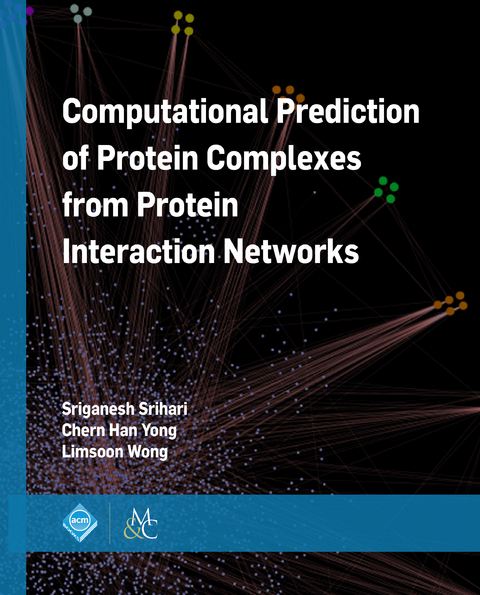
Computational Prediction of Protein Complexes from Protein Interaction Networks (eBook)
295 Seiten
Association for Computing Machinery and Morgan & Claypool Publishers (Verlag)
978-1-970001-54-9 (ISBN)
Complexes of physically interacting proteins constitute fundamental functional units that drive almost all biological processes within cells. A faithful reconstruction of the entire set of protein complexes (the "complexosome") is therefore important not only to understand the composition of complexes but also the higher level functional organization within cells. Advances over the last several years, particularly through the use of high-throughput proteomics techniques, have made it possible to map substantial fractions of protein interactions (the "interactomes") from model organisms including Arabidopsis thaliana (a flowering plant), Caenorhabditis elegans (a nematode), Drosophila melanogaster (fruit fly), and Saccharomyces cerevisiae (budding yeast). These interaction datasets have enabled systematic inquiry into the identification and study of protein complexes from organisms. Computational methods have played a significant role in this context, by contributing accurate, efficient, and exhaustive ways to analyze the enormous amounts of data. These methods have helped to compensate for some of the limitations in experimental datasets including the presence of biological and technical noise and the relative paucity of credible interactions.
In this book, we systematically walk through computational methods devised to date (approximately between 2000 and 2016) for identifying protein complexes from the network of protein interactions (the protein-protein interaction (PPI) network). We present a detailed taxonomy of these methods, and comprehensively evaluate them for protein complex identification across a variety of scenarios including the absence of many true interactions and the presence of false-positive interactions (noise) in PPI networks. Based on this evaluation, we highlight challenges faced by the methods, for instance in identifying sparse, sub-, or small complexes and in discerning overlapping complexes, and reveal how a combination of strategies is necessary to accurately reconstruct the entire complexosome.
Table of Contents: Preface / 1. Introduction to Protein Complex Prediction / 2. Constructing Reliable Protein-Protein Interaction (PPI) Networks / 3. Computational Methods for Protein Complex Prediction from PPI Networks / 4. Evaluating Protein Complex Prediction Methods / 5. Open Challenges in Protein Complex Prediction / 6. Identifying Dynamic Protein Complexes / 7. Identifying Evolutionarily Conserved Protein Complexes / 8. Protein Complex Prediction in the Era of Systems Biology / 9. Conclusion / References / Authors' Biographies
| Erscheint lt. Verlag | 30.5.2017 |
|---|---|
| Reihe/Serie | ACM Books | ACM Books |
| Mitarbeit |
Herausgeber (Serie): M. Tamer Ozsu |
| Verlagsort | San Rafael |
| Sprache | englisch |
| Themenwelt | Mathematik / Informatik ► Informatik ► Theorie / Studium |
| Naturwissenschaften ► Biologie ► Zellbiologie | |
| ISBN-10 | 1-970001-54-2 / 1970001542 |
| ISBN-13 | 978-1-970001-54-9 / 9781970001549 |
| Informationen gemäß Produktsicherheitsverordnung (GPSR) | |
| Haben Sie eine Frage zum Produkt? |
 EPUB (Adobe DRM)
Kopierschutz: Adobe-DRM
Adobe-DRM ist ein Kopierschutz, der das eBook vor Mißbrauch schützen soll. Dabei wird das eBook bereits beim Download auf Ihre persönliche Adobe-ID autorisiert. Lesen können Sie das eBook dann nur auf den Geräten, welche ebenfalls auf Ihre Adobe-ID registriert sind.
Details zum Adobe-DRM
Dateiformat: EPUB (Electronic Publication)
EPUB ist ein offener Standard für eBooks und eignet sich besonders zur Darstellung von Belletristik und Sachbüchern. Der Fließtext wird dynamisch an die Display- und Schriftgröße angepasst. Auch für mobile Lesegeräte ist EPUB daher gut geeignet.
Systemvoraussetzungen:
PC/Mac: Mit einem PC oder Mac können Sie dieses eBook lesen. Sie benötigen eine
eReader: Dieses eBook kann mit (fast) allen eBook-Readern gelesen werden. Mit dem amazon-Kindle ist es aber nicht kompatibel.
Smartphone/Tablet: Egal ob Apple oder Android, dieses eBook können Sie lesen. Sie benötigen eine
Geräteliste und zusätzliche Hinweise
Buying eBooks from abroad
For tax law reasons we can sell eBooks just within Germany and Switzerland. Regrettably we cannot fulfill eBook-orders from other countries.
aus dem Bereich