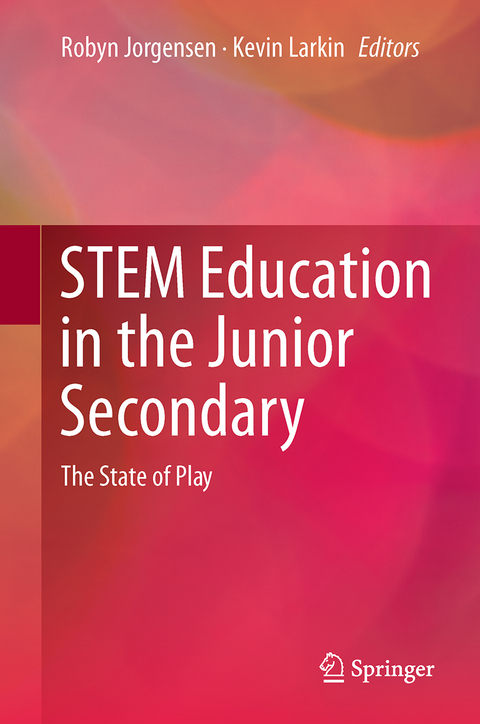
STEM Education in the Junior Secondary
Springer Verlag, Singapore
978-981-10-5447-1 (ISBN)
While developing this book, the editors drew on two main premises: Firstly, STEM is seen as the integrated study of science, technology, engineering and mathematics in a coherent learning paradigm that is based on real-world applications. Secondly, it is important to integrate digital technologies into STEM education beyond the superficial use of ICTs seen in many schools.
The book also addresses the challenges within STEM education – many of which are long-standing. To this end, it includes chapters o
n marginalised and diverse communities, ensuring that a broad range of perspectives on STEM education is included.
Robyn Jorgensen (Zevenbergen) has an extensive track record in the study of classroom practice and the implications for equity – particularly for low-SES, indigenous and rural students. She has studied practice in mathematics education and has produced a number of publications in this area. She is internationally recognised as a leader in the study of practice and equity. Kevin Larkin is a prominent member of the Australian mathematics community and is a member of the MERGA board as VP of Communications. He is an active reviewer for a number of mathematics journals including Mathematics Education Research Journal (MERJ), Mathematics Teaching and Educational Development (MTED), Australian Primary Mathematics Classroom (APMC) and the International Journal for Science and Mathematics Education (IJMTL). He has a strong reputation in the field of digital technologies in Mathematics Education, has presented research on this topic at the last two MERGA conferences, and has been published in this area in books and mathematical journals.
Introduction.- What is unique about Junior STEM?.- STEM and Affect in Adolescence: A Cultural-Historical Approach .- Supporting Students’ Productive Collaboration and Mathematics Learning in Online Environments .- Representation Construction: A Guided Inquiry Approach for Science Education .- Making STEM Curriculum Useful, Relevant and Motivating for Students .- Innovations in Teacher Preparation for STEM: The value of the theory-practice nexus .- Successful Students-STEM Program: Teacher learning through a multi-faceted vision for STEM education .- The Importance of Diagrams, Graphics and Other Visual Representations in STEM Teaching .- Digital Technologies and Junior Secondary: Learning with and about Digital Technologies.- STEM Education in the Brazilian Context: An Ethnomathematical Perspective .- Enlivening STEM education through school-community partnerships .- Inserting Critical Mathematics into STEM Education.
| Erscheinungsdatum | 08.09.2017 |
|---|---|
| Zusatzinfo | 23 Illustrations, color; 19 Illustrations, black and white; VI, 294 p. 42 illus., 23 illus. in color. |
| Verlagsort | Singapore |
| Sprache | englisch |
| Maße | 155 x 235 mm |
| Themenwelt | Mathematik / Informatik ► Mathematik |
| Naturwissenschaften | |
| Sozialwissenschaften ► Pädagogik ► Erwachsenenbildung | |
| Sozialwissenschaften ► Pädagogik ► Vorschulpädagogik | |
| Schlagworte | Digital technologies • Engineering Education • Inclusive Education • junior secondary • mathematics education • middle school education • middle years education • science education • STEM Education • STEM innovation • STEM pedagogy • Technology Education |
| ISBN-10 | 981-10-5447-9 / 9811054479 |
| ISBN-13 | 978-981-10-5447-1 / 9789811054471 |
| Zustand | Neuware |
| Informationen gemäß Produktsicherheitsverordnung (GPSR) | |
| Haben Sie eine Frage zum Produkt? |
aus dem Bereich