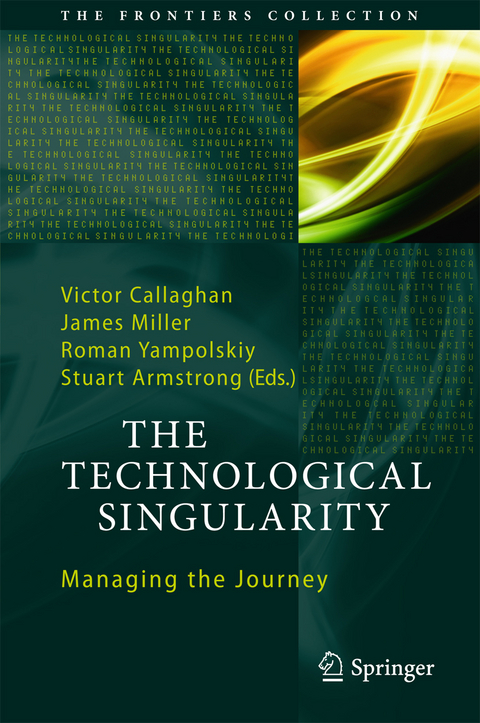
The Technological Singularity (eBook)
XII, 261 Seiten
Springer Berlin Heidelberg (Verlag)
978-3-662-54033-6 (ISBN)
This volume contains a selection of authoritative essays exploring the
central questions raised by the conjectured technological singularity.
In informed yet jargon-free contributions written by active research
scientists, philosophers and sociologists, it goes beyond philosophical
discussion to provide a detailed account of the risks that the singularity
poses to human society and, perhaps most usefully, the possible actions
that society and technologists can take to manage the journey to any
singularity in a way that ensures a positive rather than a negative
impact on society. The discussions provide perspectives that cover technological,
political and business issues. The aim is to bring clarity and rigor
to the debate in a way that will inform and stimulate both experts and
interested general readers.
Victor Callaghan is Professor of Computer Science at the University of Essex where he founded the Robotics and Intelligent Environments research groups, publishing over 300 related articles. He is president of the Association for the Advancement of Intelligent Environments, director the Creative Science Foundation and a founding board member of Sapience, organizations which all study the impact of artificial intelligence on our futures.
James D. Miller is Associate Professor of Economics at Smith College. He has a Ph.D. in Economics from the University of Chicago and a law degree from Stanford. The author of the books Singularity Rising and Game Theory at Work, he is interested in how increases in human and artificial intelligences will influence the economy.
Roman V. Yampolskiy is a Tenured Associate Professor in the department of Computer Engineering and Computer Science at the University of Louisville. He is the founding and current director of the Cyber Security Lab and an author of many books including Artificial Superintelligence: a Futuristic Approach. Dr. Yampolskiy's main areas of interest are Artificial Intelligence Safety and Cybersecurity
Stuart Armstrong is, an Alexander Tamas research fellow at the Future of Humanity Institute, works on formal decision theory, general existential risk, the risks and possibilities of Artificial Intelligence (AI), how AIs can learn humane values, assessing expertise and predictions, and anthropic (self-locating) probability. His booklet 'Smarter than Us: the rise of machine intelligence' lays out some the challenges in this area.
Victor Callaghan is Professor of Computer Science at the University of Essex where he founded the Robotics and Intelligent Environments research groups, publishing over 300 related articles. He is president of the Association for the Advancement of Intelligent Environments, director the Creative Science Foundation and a founding board member of Sapience, organizations which all study the impact of artificial intelligence on our futures. James D. Miller is Associate Professor of Economics at Smith College. He has a Ph.D. in Economics from the University of Chicago and a law degree from Stanford. The author of the books Singularity Rising and Game Theory at Work, he is interested in how increases in human and artificial intelligences will influence the economy. Roman V. Yampolskiy is a Tenured Associate Professor in the department of Computer Engineering and Computer Science at the University of Louisville. He is the founding and current director of the Cyber Security Lab and an author of many books including Artificial Superintelligence: a Futuristic Approach. Dr. Yampolskiy’s main areas of interest are Artificial Intelligence Safety and Cybersecurity Stuart Armstrong is, an Alexander Tamas research fellow at the Future of Humanity Institute, works on formal decision theory, general existential risk, the risks and possibilities of Artificial Intelligence (AI), how AIs can learn humane values, assessing expertise and predictions, and anthropic (self-locating) probability. His booklet “Smarter than Us: the rise of machine intelligence” lays out some the challenges in this area.
Introduction.- Type of Singularity.- Theories of the future.- A New Kind of Intelligence.- Limits in understanding AI.- The Energy Singularity.- What Could The Singularity Be?.- The Methuselarity.- Nature and Timing of the Singularity.- Transhumanism and Posthumanism.- The Technology of the Singularity.- Embodied and distributed cognition.- Singularity Architectures.- Quantum Computing as a mechanism for human intelligence.- An ambient singularity.- The Singularity - More Than Technology.- Transhuman ethics.- Communication with Super-Intelligence.- The Singularity morality.- The Singularity business.- Leon - Emotional or rational beings?.- Psychoanalysis post singularity.- Would Super-AIs be Conscious? Ethical? Social?.
| Erscheint lt. Verlag | 22.5.2017 |
|---|---|
| Reihe/Serie | The Frontiers Collection | The Frontiers Collection |
| Zusatzinfo | XII, 261 p. 11 illus., 8 illus. in color. |
| Verlagsort | Berlin |
| Sprache | englisch |
| Themenwelt | Geisteswissenschaften ► Philosophie |
| Informatik ► Theorie / Studium ► Künstliche Intelligenz / Robotik | |
| Schlagworte | Engineered Negligible Senescence • Futures Studies • Intelligence explosion • intelligent machines • Technological singularity • Technology acceleration • Technology Forecasting • Transhumanism and Posthumanism |
| ISBN-10 | 3-662-54033-9 / 3662540339 |
| ISBN-13 | 978-3-662-54033-6 / 9783662540336 |
| Informationen gemäß Produktsicherheitsverordnung (GPSR) | |
| Haben Sie eine Frage zum Produkt? |
 PDF (Wasserzeichen)
DRM: Digitales Wasserzeichen
Dieses eBook enthält ein digitales Wasserzeichen und ist damit für Sie personalisiert. Bei einer missbräuchlichen Weitergabe des eBooks an Dritte ist eine Rückverfolgung an die Quelle möglich.
Dateiformat: PDF (Portable Document Format)
Mit einem festen Seitenlayout eignet sich die PDF besonders für Fachbücher mit Spalten, Tabellen und Abbildungen. Eine PDF kann auf fast allen Geräten angezeigt werden, ist aber für kleine Displays (Smartphone, eReader) nur eingeschränkt geeignet.
Systemvoraussetzungen:
PC/Mac: Mit einem PC oder Mac können Sie dieses eBook lesen. Sie benötigen dafür einen PDF-Viewer - z.B. den Adobe Reader oder Adobe Digital Editions.
eReader: Dieses eBook kann mit (fast) allen eBook-Readern gelesen werden. Mit dem amazon-Kindle ist es aber nicht kompatibel.
Smartphone/Tablet: Egal ob Apple oder Android, dieses eBook können Sie lesen. Sie benötigen dafür einen PDF-Viewer - z.B. die kostenlose Adobe Digital Editions-App.
Buying eBooks from abroad
For tax law reasons we can sell eBooks just within Germany and Switzerland. Regrettably we cannot fulfill eBook-orders from other countries.
aus dem Bereich