


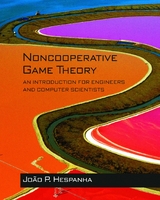
Noncooperative Game Theory (eBook)
Princeton University Press (Verlag)
978-1-4008-8544-2 (ISBN)
João P. Hespanha is a professor in the Department of Electrical and Computer Engineering at the University of California, Santa Barbara. He is the author of Linear Systems Theory (Princeton).
João P. Hespanha is a professor in the Department of Electrical and Computer Engineering at the University of California, Santa Barbara. He is the author of Linear Systems Theory (Princeton).
| Erscheint lt. Verlag | 13.6.2017 |
|---|---|
| Verlagsort | Princeton |
| Sprache | englisch |
| Themenwelt | Mathematik / Informatik ► Informatik ► Theorie / Studium |
| Mathematik / Informatik ► Mathematik ► Angewandte Mathematik | |
| Schlagworte | A0 • action • action space • Addition • additive white Gaussian noise • admissible Nash equilibrium • advertising campaign • Almost surely • alternate play • average security level • battle of the sexes • behavioral policy • behavioral saddle-point equilibrium • Bell number • best-response equivalent games • Big O notation • bilateral symmetric game • bimatrix game • bimatrix potential • Boundary value problem • Chicken Game • Circuit Design • Compact space • completely mixed Nash equilibrium • Computation • Computational Complexity • computer network • Computer Science • congestion game • continuous function • continuous time cost-to-go • continuous time differential • continuous time dynamic • continuous time dynamic programming • Control Theory • Conversion Factor • Convex Analysis • convex hull • convex set • coordinate system • corollary • Cost curve • data structure • Decision-Making • Decision rule • Decision Tree • decoupled game • Degrees of freedom (statistics) • Designer • Design Methodology • Differentiable function • differential equation • differential game • Direct proof • discrete time cost-to-go • discrete time dynamic • discrete time dynamic programming • Distributed resource allocation • dummy game • dynamic game • Dynamic Programming • Economics • economist • Engineering • expected value • extensive form game representation • feedback game • fictitious play • finite one-player • Game Theory • GNU General Public License • Graphical method • hyperplane • identical interests • Inequality (mathematics) • information structure • Iteration • John von Neumann • Large Numbers • Lecture • linear algebra • linear program • Linear Programming • linear quadratic dynamic • Marginal cost • Mathematical Optimization • MATLAB • matrix games • Maxima and minima • Mechanism Design • minimax theorem • Minimum • mixed action space • mixed Nash equilibrium • mixed policy • mixed saddle-point equilibrium • mixed security policy • Monotonic Function • multi-agent system • multi-stage game • Nash Equilibrium • National Science Foundation • network routing • Noncooperative game theory • non-feedback game • non-zero-sum • Notation • N-player game • Numerical analysis • Open-loop • open-loop policy • optimization-based design • optimization problem • Optimization Toolbox • order interchangeability property • Outcome (game theory) • Outcome (probability) • Parameter • Pareto Efficiency • percentage • Policy • Potential Game • price of anarchy • Pricing • Probability • Probability Distribution • pure N-player game • pure policy • Pursuit-evasion • Quadratic • quadratic form • Quantity • Randomization • randomness • Random Variable • Recursion • recursive computation • regret • Reinhard Selten • Requirement • Resource Allocation • result • Robust Design • rock-paper-scissors • rope-pulling • Saddle point • saddle-point equilibrium • security level • security policy • Separating Hyperplane Theorem • Shannon–Hartley theorem • Shapley Value • simultaneous play • single-stage game • Special case • state feedback information structure • state-feedback policy • State Space • stochastic • stochastic policy • Strategy (game theory) • strictly dominating policy • Subset • subtraction • Sudoku puzzle • Suggestion • Summation • symmetry game • Tax • Theorem • Tic-Tac-Toe • transpose • tree structure • Uncertainty • Unexpected events • Variable (mathematics) • variable termination time • Verbosity • War of attrition • weakly dominating policy • Website • Weierstrass Theorem • zebra in the lake • zero-sum • zero sum dynamic • zero-sum matrix • zero-sum two-person |
| ISBN-10 | 1-4008-8544-2 / 1400885442 |
| ISBN-13 | 978-1-4008-8544-2 / 9781400885442 |
| Informationen gemäß Produktsicherheitsverordnung (GPSR) | |
| Haben Sie eine Frage zum Produkt? |
 PDF (Wasserzeichen)
Größe: 1,3 MB
DRM: Digitales Wasserzeichen
Dieses eBook enthält ein digitales Wasserzeichen und ist damit für Sie personalisiert. Bei einer missbräuchlichen Weitergabe des eBooks an Dritte ist eine Rückverfolgung an die Quelle möglich.
Dateiformat: PDF (Portable Document Format)
Mit einem festen Seitenlayout eignet sich die PDF besonders für Fachbücher mit Spalten, Tabellen und Abbildungen. Eine PDF kann auf fast allen Geräten angezeigt werden, ist aber für kleine Displays (Smartphone, eReader) nur eingeschränkt geeignet.
Systemvoraussetzungen:
PC/Mac: Mit einem PC oder Mac können Sie dieses eBook lesen. Sie benötigen dafür einen PDF-Viewer - z.B. den Adobe Reader oder Adobe Digital Editions.
eReader: Dieses eBook kann mit (fast) allen eBook-Readern gelesen werden. Mit dem amazon-Kindle ist es aber nicht kompatibel.
Smartphone/Tablet: Egal ob Apple oder Android, dieses eBook können Sie lesen. Sie benötigen dafür einen PDF-Viewer - z.B. die kostenlose Adobe Digital Editions-App.
Buying eBooks from abroad
For tax law reasons we can sell eBooks just within Germany and Switzerland. Regrettably we cannot fulfill eBook-orders from other countries.
PDF (Adobe DRM)Kopierschutz: Adobe-DRM
Adobe-DRM ist ein Kopierschutz, der das eBook vor Mißbrauch schützen soll. Dabei wird das eBook bereits beim Download auf Ihre persönliche Adobe-ID autorisiert. Lesen können Sie das eBook dann nur auf den Geräten, welche ebenfalls auf Ihre Adobe-ID registriert sind.
Details zum Adobe-DRM
Dateiformat: PDF (Portable Document Format)
Mit einem festen Seitenlayout eignet sich die PDF besonders für Fachbücher mit Spalten, Tabellen und Abbildungen. Eine PDF kann auf fast allen Geräten angezeigt werden, ist aber für kleine Displays (Smartphone, eReader) nur eingeschränkt geeignet.
Systemvoraussetzungen:
PC/Mac: Mit einem PC oder Mac können Sie dieses eBook lesen. Sie benötigen eine
eReader: Dieses eBook kann mit (fast) allen eBook-Readern gelesen werden. Mit dem amazon-Kindle ist es aber nicht kompatibel.
Smartphone/Tablet: Egal ob Apple oder Android, dieses eBook können Sie lesen. Sie benötigen eine
Geräteliste und zusätzliche Hinweise
Buying eBooks from abroad
For tax law reasons we can sell eBooks just within Germany and Switzerland. Regrettably we cannot fulfill eBook-orders from other countries.
aus dem Bereich


