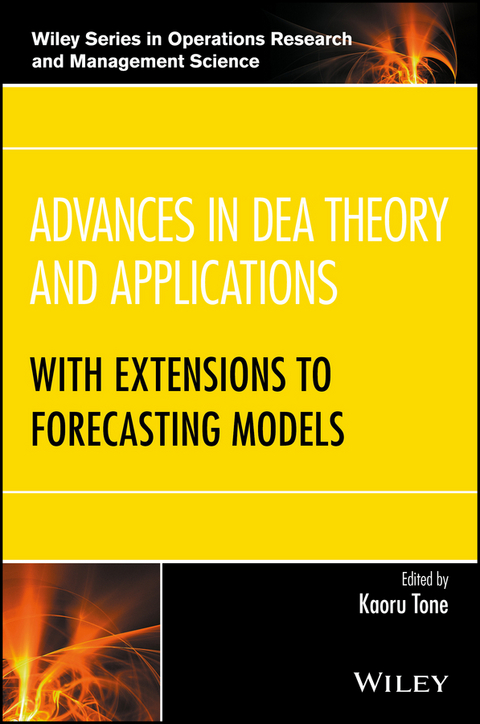
Advances in DEA Theory and Applications (eBook)
John Wiley & Sons (Verlag)
978-1-118-94670-1 (ISBN)

A key resource and framework for assessing the performance of competing entities, including forecasting models
Advances in DEA Theory and Applications provides a much-needed framework for assessing the performance of competing entities with special emphasis on forecasting models. It helps readers to determine the most appropriate methodology in order to make the most accurate decisions for implementation. Written by a noted expert in the field, this text provides a review of the latest advances in DEA theory and applications to the field of forecasting.
Designed for use by anyone involved in research in the field of forecasting or in another application area where forecasting drives decision making, this text can be applied to a wide range of contexts, including education, health care, banking, armed forces, auditing, market research, retail outlets, organizational effectiveness, transportation, public housing, and manufacturing. This vital resource:
- Explores the latest developments in DEA frameworks for the performance evaluation of entities such as public or private organizational branches or departments, economic sectors, technologies, and stocks
- Presents a novel area of application for DEA; namely, the performance evaluation of forecasting models
- Promotes the use of DEA to assess the performance of forecasting models in a wide area of applications
- Provides rich, detailed examples and case studies
Advances in DEA Theory and Applications includes information on a balanced benchmarking tool that is designed to help organizations examine their assumptions about their productivity and performance.
KAORU TONE is with the National Graduate Institute for Policy Studies, Japan. His contribution to DEA has a variety of attainments. He authored a classical book Data Envelopment Analysis: A Comprehensive Text with Models, Applications, References and DEA-Solver Software under the co-authorship with Professor Cooper (University of Texas) and Professor Seiford (University of Michigan). He also published many papers on DEA in international journals. Kaoru Tone opened a new avenue for performance evaluation, called Slacks-based Measure (SBM) that is widely utilized over the world. His recent innovations include Network SBM, Dynamic SBM, Dynamic DEA with Network Structure, Congestion, Returns-to-growth in DEA, Ownership-specified Network DEA, Non-convex Frontier DEA, Past-Present-Future Inter-temporal DEA, Resampling DEA and SBM-Max.
A key resource and framework for assessing the performance of competing entities, including forecasting models Advances in DEA Theory and Applications provides a much-needed framework for assessing the performance of competing entities with special emphasis on forecasting models. It helps readers to determine the most appropriate methodology in order to make the most accurate decisions for implementation. Written by a noted expert in the field, this text provides a review of the latest advances in DEA theory and applications to the field of forecasting. Designed for use by anyone involved in research in the field of forecasting or in another application area where forecasting drives decision making, this text can be applied to a wide range of contexts, including education, health care, banking, armed forces, auditing, market research, retail outlets, organizational effectiveness, transportation, public housing, and manufacturing. This vital resource: Explores the latest developments in DEA frameworks for the performance evaluation of entities such as public or private organizational branches or departments, economic sectors, technologies, and stocks Presents a novel area of application for DEA; namely, the performance evaluation of forecasting models Promotes the use of DEA to assess the performance of forecasting models in a wide area of applications Provides rich, detailed examples and case studies Advances in DEA Theory and Applications includes information on a balanced benchmarking tool that is designed to help organizations examine their assumptions about their productivity and performance.
KAORU TONE is with the National Graduate Institute for Policy Studies, Japan. His contribution to DEA has a variety of attainments. He authored a classical book Data Envelopment Analysis: A Comprehensive Text with Models, Applications, References and DEA-Solver Software under the co-authorship with Professor Cooper (University of Texas) and Professor Seiford (University of Michigan). He also published many papers on DEA in international journals. Kaoru Tone opened a new avenue for performance evaluation, called Slacks-based Measure (SBM) that is widely utilized over the world. His recent innovations include Network SBM, Dynamic SBM, Dynamic DEA with Network Structure, Congestion, Returns-to-growth in DEA, Ownership-specified Network DEA, Non-convex Frontier DEA, Past-Present-Future Inter-temporal DEA, Resampling DEA and SBM-Max.
Title Page 5
Copyright Page 6
Contents 9
List of Contributors 22
About the Authors 24
Preface 34
Part 1 DEA Theory 37
Chapter 1 Radial DEA Models 39
1.1 Introduction 39
1.2 Basic Data 39
1.3 Input-Oriented CCR Model 40
1.3.1 The CRS Model 42
1.4 The Input-Oriented BCC Model 42
1.4.1 The VRS Model 43
1.5 The Output-Oriented Model 43
1.6 Assurance Region Method 44
1.7 The Assumptions behind Radial Models 44
1.8 A Sample Radial Model 44
References 46
Chapter 2 Non-Radial DEA Models 47
2.1 Introduction 47
2.2 The SBM Model 48
2.2.1 Input-Oriented SBM 49
2.2.2 Output-Oriented SBM 50
2.2.3 Non-Oriented SBM 50
2.3 An Example of an SBM Model 51
2.4 The Dual Program of the SBM Model 53
2.5 Extensions of the SBM Model 53
2.5.1 Variable-Returns-to-Scale (VRS) Model 53
2.5.2 Weighted-SBM Model 54
2.6 Concluding Remarks 54
References 55
Chapter 3 Directional Distance DEA Models 56
3.1 Introduction 56
3.2 Directional Distance Model 56
3.3 Variable-Returns-to-Scale DD Models 59
3.4 Slacks-Based DD Model 59
3.5 Choice of Directional Vectors 61
References 62
Chapter 4 Super-Efficiency DEA Models 64
4.1 Introduction 64
4.2 Radial Super-Efficiency Models 64
4.2.1 Input-Oriented Radial Super-Efficiency Model 64
4.2.2 Output-Oriented Radial Super-Efficiency Model 65
4.2.3 Infeasibility Issues in the VRS Model 65
4.3 Non-radial Super-Efficiency Models 65
4.3.1 Input-Oriented Non-Radial Super-Efficiency Model 66
4.3.2 Output-Oriented Non-Radial Super-Efficiency Model 66
4.3.3 Non-Oriented Non-Radial Super-Efficiency Model 66
4.3.4 Variable-Returns-to-Scale Models 67
4.4 An Example of a Super-Efficiency Model 67
References 68
Chapter 5 Determining Returns to Scale in the VRS DEA Model 69
5.1 Introduction 69
5.2 Technology Specification and Scale Elasticity 70
5.2.1 Technology 70
5.2.2 Measure of Scale Elasticity 71
5.2.3 Scale Elasticity in DEA Models 71
5.3 Summary 73
References 73
Chapter 6 Malmquist Productivity Index Models 76
6.1 Introduction 76
6.2 Radial Malmquist Model 79
6.3 Non-Radial and Oriented Malmquist Model 81
6.4 Non-Radial and Non-Oriented Malmquist Model 83
6.5 Cumulative Malmquist Index (CMI) 84
6.6 Adjusted Malmquist Index (AMI) 85
6.7 Numerical Example 86
6.7.1 DMU A 90
6.7.2 DMU B 90
6.7.3 DMU C 91
6.7.4 DMU D 91
6.8 Concluding Remarks 91
References 91
Chapter 7 The Network DEA Model 93
7.1 Introduction 93
7.2 Notation and Production Possibility Set 94
7.3 Description of Network Structure 95
7.3.1 Inputs and Outputs 95
7.3.2 Links 96
7.4 Objective Functions and Efficiencies 97
7.4.1 Input-Oriented Case 97
7.4.2 Output-Oriented Case 98
7.4.3 Non-Oriented Case 98
Reference 99
Chapter 8 The Dynamic DEA Model 100
8.1 Introduction 100
8.2 Notation and Production Possibility Set 101
8.3 Description of Dynamic Structure 103
8.3.1 Inputs and Outputs 103
8.3.2 Carry-Overs 103
8.4 Objective Functions and Efficiencies 105
8.4.1 Input-Oriented Case 105
8.4.2 Output-Oriented Case 106
8.4.3 Non-Oriented Case 107
8.5 Dynamic Malmquist Index 107
8.5.1 Dynamic Catch-up Index 108
8.5.2 Dynamic Frontier Shift Effect 108
8.5.3 Dynamic Malmquist Index 108
8.5.4 Dynamic Cumulative Malmquist Index 108
8.5.5 Dynamic Adjusted Malmquist Index 109
References 109
Chapter 9 The Dynamic Network DEA Model 110
9.1 Introduction 110
9.2 Notation and Production Possibility Set 111
9.2.1 Notation 111
9.3 Description of Dynamic Network Structure 113
9.3.1 Inputs and Outputs 113
9.3.2 Links 113
9.3.3 Carry-Overs 114
9.4 Objective Function and Efficiencies 116
9.4.1 Overall Efficiency 116
9.4.2 Period and Divisional Efficiencies 117
9.5 Dynamic Divisional Malmquist Index 118
9.5.1 Dynamic Divisional Catch-up Index 118
9.5.2 Dynamic Divisional Frontier Shift Effect 118
9.5.3 Dynamic Divisional Malmquist Index 118
9.5.4 Dynamic Divisional Cumulative Malmquist Index 119
9.5.5 Dynamic Divisional Adjusted Malmquist Index 119
9.5.6 Overall Dynamic Malmquist Index 119
References 120
Chapter 10 Stochastic DEA: The Regression-Based Approach 121
10.1 Introduction 121
10.2 Review of Literature on Stochastic DEA 123
10.2.1 Random Sampling 124
10.2.2 Imprecise Measurement of Data 124
10.2.3 Uncertainty in the Membership of Observations 126
10.2.4 Random Production Possibility Sets 127
10.2.5 Random Noise 129
10.3 Conclusions 132
References 132
Chapter 11 A Comparative Study of AHP and DEA 136
11.1 Introduction 136
11.2 A Glimpse of Data Envelopment Analysis 136
11.3 Benefit/Cost Analysis by Analytic Hierarchy Process 138
11.3.1 Three-Level Perfect Graph Case 138
11.3.2 General Cases 139
11.4 Efficiencies in AHP and DEA 140
11.4.1 Input x and Output y 140
11.4.2 Weights 140
11.4.3 Efficiency 140
11.4.4 Several Propositions 141
11.5 Concluding Remarks 141
References 142
Chapter 12 A Computational Method for Solving DEA Problems with Infinitely Many DMUs 143
12.1 Introduction 143
12.2 Problem 144
12.3 Outline of the Method 145
12.4 Details of the Method When Z is One-Dimensional 146
12.4.1 Initial Discretization and Subdivision Parameter 146
12.4.2 Solving (Dh) 146
12.4.3 Deletion/Subdivision Rules 147
12.4.4 Solving the New LP 148
12.4.5 Convergence Check 148
12.5 General Case 149
12.5.1 Initial Discretization 149
12.5.2 Deletion and Subdivision (Bisection) Rules 149
12.5.3 Solving New LPs and Checking Convergence 151
12.6 Concluding Remarks (by Tone) 151
Appendix 12.A Proof of Theorem 12.1 151
Appendix 12.B Proof of Theorem 12.2 151
Reference 152
Part 2 DEA Applications (Past–Present Scenario) 153
Chapter 13 Examining the Productive Performance of Life Insurance Corporation of India 155
13.1 Introduction 155
13.2 Nonparametric Approach to Measuring Scale Elasticity 157
13.2.1 Technology and Returns to Scale 158
13.2.2 Qualitative Information on Returns to Scale 159
13.2.3 Quantitative Information on Returns to Scale 160
13.2.4 An Alternative Measure of Scale Elasticity 162
13.3 The Dataset for LIC Operations 164
13.4 Results and Discussion 166
13.4.1 Production-Based Analysis 168
13.4.2 Cost-Based Analysis 169
13.4.3 Returns-to-Scale Issue 169
13.4.4 Sensitivity Analysis 171
13.5 Concluding Remarks 172
References 172
Chapter 14 An Account of DEA-Based Contributions in the Banking Sector 177
14.1 Introduction 177
14.2 Performance Evaluation of Banks: A Detailed Account 178
14.3 Current State of the Art Summarized 190
14.4 Conclusion 199
References 205
Chapter 15 DEA in the Healthcare Sector 208
15.1 Introduction 208
15.2 Method and Data 210
15.2.1 Previous Literature 210
15.2.2 Formulas for Efficiency Estimation by DN DEA Model 212
15.2.3 Formulas for Malmquist Index by DN DEA Model 215
15.2.4 Empirical Data 215
15.3 Results 220
15.3.1 Estimated Efficiency Scores 220
15.3.2 Estimated Malmquist Index Scores 220
15.4 Discussion 224
15.4.1 Estimation Results and Policy Implications 224
15.4.2 Further Research Questions 225
Acknowledgements 225
References 226
Chapter 16 DEA in the Transport Sector 228
16.1 Introduction 228
16.2 DNDEA in Transport 230
16.2.1 The Production Technology for the Production Process 232
16.2.2 The Production Technology for the Service Process 233
16.3 Extension 236
16.3.1 The Production Technology for HB Activity 238
16.3.2 The Production Technology for UB Activity 239
16.3.3 The Production Technology for the Service Process 240
16.4 ApplicationAdapted from Yu et al. . 243
16.4.1 Input and Output Variables 243
16.4.2 Empirical Results 245
16.5 Conclusions 248
References 248
Chapter 17 Dynamic Network Efficiency of Japanese Prefectures 252
17.1 Introduction 252
17.2 Multiperiod Dynamic Multiprocess Network 253
17.3 Efficiency/Productivity Measurement 257
17.4 Empirical Application 258
17.4.1 Prefectural Production and Data 258
17.4.2 Efficiency Estimates and Their Determinants 261
17.5 Conclusions 265
References 265
Chapter 18 A Quantitative Analysis of Market Utilization in Electric Power Companies 267
18.1 Introduction 267
18.2 The Functions of the Trading Division 268
18.3 Measuring the Effect of Energy Trading 271
18.3.1 Definition of Transaction Volumes and Prices 271
18.3.2 Constraints on Internal Transactions 273
18.3.3 Profit Maximization 274
18.3.4 Exogenous Variables 276
18.4 DEA Calculation 278
18.5 Empirical Results 279
18.5.1 Results of Profit Maximization 279
18.5.2 Results of DEA 282
18.6 Concluding Remarks 284
References 285
Chapter 19 DEA in Resource Allocation 286
19.1 Introduction 286
19.2 Centralized DEA in Resource Allocation 288
19.2.1 Minor Adjustment 289
19.2.2 Moderate Adjustment 292
19.2.3 Major Adjustment 295
19.3 Applications of Centralized DEA in Resource Allocation 297
19.3.1 Human Resource Rightsizing in Airports6 297
19.3.2 Resource Allocation in Container Terminal OperationsAdapted from Chang et al. . 300
19.4 Extension 301
19.4.1 Phase I 302
19.4.2 Phase II 303
19.5 Conclusions 304
References 304
Chapter 20 How to Deal with Non-convex Frontiers in Data Envelopment Analysis 307
20.1 Introduction 307
20.2 Global Formulation 309
20.2.1 Notation and Basic Tools 309
20.2.2 Uniqueness of Slacks 310
20.2.3 Decomposition of CRS Slacks 311
20.2.4 Scale-Independent Dataset 311
20.3 In-cluster Issue: Scale- and Cluster-Adjusted DEA Score 312
20.3.1 Clusters 312
20.3.2 Solving the CRS Model in the Same Cluster 313
20.3.3 Scale- and Cluster-Adjusted Score 314
20.3.4 Summary of the SAS Computation 315
20.3.5 Global Characterization of SAS-Projected DMUs 316
20.4 An Illustrative Example 317
20.5 The Radial-Model Case 320
20.5.1 Decomposition of CCR Slacks 321
20.5.2 Scale-Adjusted Input and Output 321
20.5.3 Solving the CCR Model in the Same Cluster 322
20.5.4 Scale- and Cluster-Adjusted Score 322
20.6 Scale-Dependent Dataset and Scale Elasticity 323
20.6.1 Scale-Dependent Dataset 323
20.6.2 Scale Elasticity 324
20.7 Application to a Dataset Concerning Japanese National Universities 325
20.7.1 Data 325
20.7.2 Adjusted Score (SAS) 327
20.7.3 Scale Elasticity 327
20.8 Conclusions 330
Appendix 20.A Clustering Using Returns to Scale and Scale Efficiency 331
Appendix 20.B Proofs of Propositions 331
References 334
Chapter 21 Using DEA to Analyze the Efficiency of Welfare Offices and Influencing Factors: The Case of Japan’s Municipal Public Assistance Programs 336
21.1 Introduction 336
21.2 Institutional Background, DEA, and Efficiency Scores 337
21.2.1 DMUs 338
21.2.2 Outputs and Inputs 338
21.2.3 Efficiency Scores 339
21.3 External Effects on Efficiency 340
21.3.1 Adjustments for Environmental/External Factors 340
21.3.2 The Second-Stage Regression Model 341
21.3.3 Econometric Issues 342
21.3.4 Estimation Results 343
21.4 Quantile Regression Analysis 345
21.4.1 Different Responses along the Quantiles of Efficiency 345
21.4.2 Results 346
21.5 Concluding Remarks 348
AcknowledgEments 348
References 348
Chapter 22 DEA as a Kaizen Tool: SBM Variations Revisited 351
22.1 Introduction 351
22.2 The SBM-Min Model 352
22.2.1 Production Possibility Set 353
22.2.2 Non-Oriented SBM 353
22.3 The SBM-Max Model 354
22.4 Observations 357
22.4.1 Distance and Choice of the Set Rh 357
22.4.2 The Role of Programs and 357
22.4.3 Computational Amount 358
22.4.4 Consistency with the Super-Efficiency SBM Measure 358
22.4.5 Addition of Weights to Input and Output Slacks 359
22.5 Numerical Examples 359
22.5.1 An Illustrative Example 359
22.5.2 Japanese Municipal Hospitals 362
22.6 Conclusions 366
References 366
Part 3 DEA for Forecasting and Decision-Making (Past–Present–Future Scenario) 367
Chapter 23 Corporate Failure Analysis Using SBM 369
23.1 Introduction 369
23.2 Literature Review 370
23.2.1 Beaver´s Univariate Model 371
23.2.2 Altman´s Multivariate Model 372
23.2.3 Subsequent Models 373
23.3 Methodology 376
23.3.1 Slacks-Based Measure 376
23.3.2 Model Development 378
23.4 Application to Bankruptcy Prediction 379
23.4.1 Data Acquisition 380
23.4.2 Analysis of Results 381
23.5 Conclusions 388
References 390
Chapter 24 Ranking of Bankruptcy Prediction Models under Multiple Criteria 393
24.1 Introduction 393
24.2 An Overview of Bankruptcy Prediction Models 395
24.2.1 Discriminant Analysis Models 396
24.2.2 Probability Models 396
24.2.3 Survival Analysis Models 399
24.2.4 Stochastic Models 400
24.3 A Slacks-Based Super-Efficiency Framework for Assessing Bankruptcy Prediction Models 402
24.3.1 What Are the Units To Be Assessed, or DMUs? 402
24.3.2 What Are the Inputs and the Outputs? 404
24.3.3 What Is the Appropriate DEA Formulation To Solve? 404
24.4 Empirical Results from Super-Efficiency DEA 408
24.5 Conclusion 412
References 413
Chapter 25 DEA in Performance Evaluation of Crude Oil Prediction Models 417
25.1 Introduction 417
25.2 An Overview of Crude Oil Prices and Their Volatilities 421
25.3 Assessment of Prediction Models of Crude Oil Price Volatility 424
25.3.1 Forecasting Models of Crude Oil Volatility – DMUs 425
25.3.2 Performance Criteria and Their Measures: Inputs and Outputs 426
25.3.3 Slacks-Based Super-Efficiency Analysis 426
25.3.4 Empirical Results from Slacks-Based Super-Efficiency DEA 432
25.4 Conclusion 437
References 438
Chapter 26 Predictive Efficiency Analysis 440
26.1 Introduction 440
26.2 Modeling of Predictive Efficiency 441
26.3 Study of US Hospitals 444
26.4 Forecasting, Benchmarking, and Frontier Shifting 448
26.4.1 Effect of Forecast on Effectiveness 448
26.4.2 Benchmarks 448
26.4.3 Technical Progress 450
26.5 Conclusions 452
References 453
Chapter 27 Efficiency Prediction Using Fuzzy Piecewise Autoregression 455
27.1 Introduction 455
27.2 Efficiency Prediction 456
27.3 Modeling and Formulation 459
27.3.1 Notation 459
27.3.2 Phase I: Efficiency Evaluation 460
27.3.3 Phase II: CIE 462
27.3.4 Phase III: Fuzzy Piecewise Regression 462
27.3.5 Phase IV: Validating and Forecasting 467
27.4 Illustrating the Application 469
27.4.1 Efficiency Evaluations 469
27.4.2 Validation 472
27.4.3 Forecasting 473
27.5 Discussion 474
27.6 Conclusion 476
References 477
Chapter 28 Time Series Benchmarking Analysis for New Product Scheduling 479
28.1 Introduction 479
28.2 Methodology 481
28.2.1 Preliminaries 481
28.2.2 Conceptual Framework 482
28.2.3 Formulation 483
28.3 Application: Commercial Airplane Development 485
28.3.1 Research Framework 485
28.3.2 Analysis of the Current (2007) State of the Art 485
28.3.3 Risk Analysis 487
28.3.4 Proof of Concept 489
28.4 Conclusion and Matters for Future Work 490
References 491
Chapter 29 DEA Score Confidence Intervals with Past–Present and Past–Present–Future-Based Resampling 495
29.1 Introduction 495
29.2 Proposed Methodology 497
29.2.1 Past–Present-Based Framework 497
29.2.2 Past–Present–Future Time-Based Framework 501
29.3 An Application to Healthcare 501
29.3.1 Illustration of the Past–Present Framework 502
29.3.2 Illustration of the Past–Present–Future Framework 511
29.4 Conclusion 512
References 514
Chapter 30 DEA Models Incorporating Uncertain Future Performance 516
30.1 Introduction 516
30.2 Generalized Dynamic Evaluation Structures 518
30.3 Future Performance Forecasts 520
30.4 Generalized Dynamic DEA Models 523
30.4.1 Production Possibility Sets 524
30.4.2 DEA Models Incorporating Uncertain Future Performance 525
30.5 Empirical Study 531
30.5.1 Data Analysis 533
30.5.2 Analysis of Empirical Results 536
30.6 Conclusions 549
References 550
Chapter 31 Site Selection for the Next-Generation Supercomputing Center of Japan 552
31.1 Introduction 552
31.2 Hierarchical Structure and Group Decision by AHP 555
31.2.1 Hierarchical Structure 555
31.2.2 Evaluation of Candidate Sites with Respect to Criteria, and Importance of Criteria 556
31.2.3 Evaluation by Average Weights 556
31.3 DEA Assurance Region Approach 557
31.3.1 Use of Variable Weights 557
31.3.2 Evaluation of the ``Positives´´ of Each Site 557
31.3.3 Evaluation of the ``Negatives´´ of Each Site 558
31.4 Application to the Site Selection Problem 558
31.4.1 Preliminary Selection 559
31.4.2 Final Selection 559
31.5 Decision and Conclusion 563
References 563
Appendix A: DEA-Solver-Pro 565
A.1 Introduction 565
A.2 Platform 565
A.3 Notation 565
A.4 DEA Models Included 566
A.5 Typical Data Format 569
References 569
Index 571
EULA 578
| Erscheint lt. Verlag | 12.4.2017 |
|---|---|
| Reihe/Serie | Wiley Series in Operations Research and Management Science | Wiley Series in Operations Research and Management Science |
| Sprache | englisch |
| Themenwelt | Mathematik / Informatik ► Mathematik ► Statistik |
| Mathematik / Informatik ► Mathematik ► Wahrscheinlichkeit / Kombinatorik | |
| Technik | |
| Schlagworte | benchmarking service operations • benchmarking the performance of manufacturing • Betriebswirtschaft • Betriebswirtschaft u. Operationsforschung • Business & Management • Data envelopment analysis • Data-Envelopment-Analysis • DEA • DEA and benchmarking in operations management • DEA and economics • DEA and forecasting models • DEA and mathematical models • DEA and performance • DEA and productivity • DEA applications • DEA benchmarking tool • DEA operations research • Economics • Effizienz (Wirtsch.) • estimating production frontiers • evaluating DEA multiple performance measures or metrics • evaluating the performance of peers • Financial Economics • Finanzökonomie • Finanz- u. Wirtschaftsstatistik • Management Science/Operational Research • mathematical programming techniques • measuring productive efficiency of decision making units • measuring productive efficiency of DMUs • Operations Research • Statistics • Statistics for Finance, Business & Economics • Statistik • Unternehmensforschung • Volkswirtschaftslehre • Wirtschaft u. Management |
| ISBN-10 | 1-118-94670-7 / 1118946707 |
| ISBN-13 | 978-1-118-94670-1 / 9781118946701 |
| Informationen gemäß Produktsicherheitsverordnung (GPSR) | |
| Haben Sie eine Frage zum Produkt? |
 PDF (Adobe DRM)
Kopierschutz: Adobe-DRM
Adobe-DRM ist ein Kopierschutz, der das eBook vor Mißbrauch schützen soll. Dabei wird das eBook bereits beim Download auf Ihre persönliche Adobe-ID autorisiert. Lesen können Sie das eBook dann nur auf den Geräten, welche ebenfalls auf Ihre Adobe-ID registriert sind.
Details zum Adobe-DRM
Dateiformat: PDF (Portable Document Format)
Mit einem festen Seitenlayout eignet sich die PDF besonders für Fachbücher mit Spalten, Tabellen und Abbildungen. Eine PDF kann auf fast allen Geräten angezeigt werden, ist aber für kleine Displays (Smartphone, eReader) nur eingeschränkt geeignet.
Systemvoraussetzungen:
PC/Mac: Mit einem PC oder Mac können Sie dieses eBook lesen. Sie benötigen eine
eReader: Dieses eBook kann mit (fast) allen eBook-Readern gelesen werden. Mit dem amazon-Kindle ist es aber nicht kompatibel.
Smartphone/Tablet: Egal ob Apple oder Android, dieses eBook können Sie lesen. Sie benötigen eine
Geräteliste und zusätzliche Hinweise
Buying eBooks from abroad
For tax law reasons we can sell eBooks just within Germany and Switzerland. Regrettably we cannot fulfill eBook-orders from other countries.
aus dem Bereich