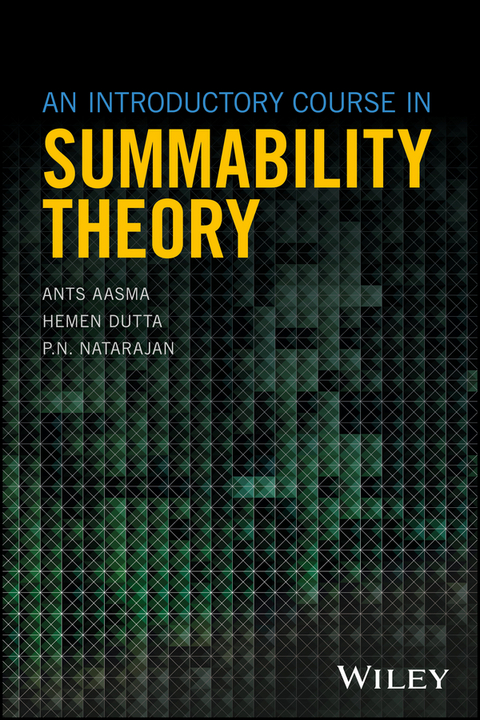
An Introductory Course in Summability Theory (eBook)
224 Seiten
John Wiley & Sons (Verlag)
9781119397779 (ISBN)
In creating this book, the authors' intent was to provide graduate students, researchers, physicists, and engineers with a reasonable introduction to summability theory. Over the course of nine chapters, the authors cover all of the fundamental concepts and equations informing summability theory and its applications, as well as some of its lesser known aspects. Following a brief introduction to the history of summability theory, general matrix methods are introduced, and the Silverman-Toeplitz theorem on regular matrices is discussed. A variety of special summability methods, including the Nörlund method, the Weighted Mean method, the Abel method, and the (C, 1) - method are next examined. An entire chapter is devoted to a discussion of some elementary Tauberian theorems involving certain summability methods. Following this are chapters devoted to matrix transforms of summability and absolute summability domains of reversible and normal methods; the notion of a perfect matrix method; matrix transforms of summability and absolute summability domains of the Cesàro and Riesz methods; convergence and the boundedness of sequences with speed; and convergence, boundedness, and summability with speed.
* Discusses results on matrix transforms of several matrix methods
* The only English-language textbook describing the notions of convergence, boundedness, and summability with speed, as well as their applications in approximation theory
* Compares the approximation orders of Fourier expansions in Banach spaces by different matrix methods
* Matrix transforms of summability domains of regular perfect matrix methods are examined
* Each chapter contains several solved examples and end-of-chapter exercises, including hints for solutions
An Introductory Course in Summability Theory is the ideal first text in summability theory for graduate students, especially those having a good grasp of real and complex analysis. It is also a valuable reference for mathematics researchers and for physicists and engineers who work with Fourier series, Fourier transforms, or analytic continuation.
ANTS AASMA, PhD, is Associate Professor of Mathematical Economics in the Department of Economics and Finance at Tallinn University of Technology, Estonia.
HEMEN DUTTA, PhD, is Senior Assistant Professor of Mathematics at Gauhati University, India.
P.N. NATARAJAN, PhD, is Formerly Professor and Head of the Department of Mathematics, Ramakrishna Mission Vivekananda College, Chennai, Tamilnadu, India.
Ants Aasma, PhD, is Associate Professor of Mathematical Economics in the Department of Economics and Finance at Tallinn University of Technology, Estonia. Hemen Dutta, PhD, is Senior Assistant Professor of Mathematics at Gauhati University, India. P.N. Natarajan, PhD, is Formerly Professor and Head of the Department of Mathematics, Ramakrishna Mission Vivekananda College, Chennai, Tamilnadu, India.
Preface ix
About the Authors xi
About the Book xiii
1 Introduction and General Matrix Methods 1
1.1 Brief Introduction 1
1.2 General Matrix Methods 2
1.3 Exercise 16
References 19
2 Special Summability Methods I 21
2.1 The Nörlund Method 21
2.2 The Weighted Mean Method 29
2.3 The Abel Method and the (C,1) Method 34
2.4 Exercise 44
References 45
3 Special Summability Methods II 47
3.1 The Natarajan Method and the Abel Method 47
3.2 The Euler and Borel Methods 53
3.3 The Taylor Method 59
3.4 The Hölder and Cesàro Methods 62
3.5 The Hausdorff Method 64
3.6 Exercise 73
References 74
4 Tauberian Theorems 75
4.1 Brief Introduction 75
4.2 Tauberian Theorems 75
4.3 Exercise 83
References 84
5 Matrix Transformations of Summability and Absolute Summability Domains: Inverse-Transformation Method 85
5.1 Introduction 85
5.2 Some Notions and Auxiliary Results 87
5.3 The Existence Conditions of Matrix Transform Mx 91
5.4 Matrix Transforms for Reversible Methods 95
5.5 Matrix Transforms for Normal Methods 102
5.6 Exercise 107
References 109
6 Matrix Transformations of Summability and Absolute Summability Domains: Peyerimhoff's Method 113
6.1 Introduction 113
6.2 Perfect Matrix Methods 113
6.3 The Existence Conditions of Matrix Transform Mx 117
6.4 Matrix Transforms for Regular Perfect Methods 121
6.5 Exercise 127
References 129
7 Matrix Transformations of Summability and Absolute Summability Domains: The Case of Special Matrices 131
7.1 Introduction 131
7.2 The Case of Riesz Methods 131
7.3 The Case of Cesàro Methods 139
7.4 Some Classes of Matrix Transforms 148
7.5 Exercise 151
References 154
8 On Convergence and Summability with Speed I
8.1 Introduction
8.2 The sets (m¯lambda, m¯mu), (c¯lambda, c¯mu) and (c¯lambda, m¯mu)
8.3 Matrix transforms from mA¯lambda into mB¯mu
8.4 On orders of approximation of Fourier expansions
8.5 Exercises
References
9 On Convergence and Summability with Speed II
9.1 Introduction
9.2 Some topological properties of m¯lambda, c¯lambda, cA¯lambda and mA¯lambda
9.3 Matrix transforms from cA¯lambda into cB¯mu or mB¯mu
9.4 Exercises
References
/An Introductory Course in Summability Theory is the ideal rst text in summability theory for graduate students, especially those having a good grasp of real and complex analysis. It is also a valuable reference for mathematics researchers and for physicists and engineers who work with Fourier series, Fourier transforms, or analytic continuation." Mathematical Reviews, Sept 2017
| Erscheint lt. Verlag | 5.4.2017 |
|---|---|
| Sprache | englisch |
| Themenwelt | Mathematik / Informatik ► Mathematik |
| Technik | |
| Schlagworte | Analysis • Angewandte Mathematik • Applied mathematics • Complex & Functional Analysis • Folge (Math.) • Komplexe Analysis u. Funktionalanalysis • Mathematics • Mathematik • Real analysis • reelle Analysis |
| ISBN-13 | 9781119397779 / 9781119397779 |
| Informationen gemäß Produktsicherheitsverordnung (GPSR) | |
| Haben Sie eine Frage zum Produkt? |
 EPUB (Adobe DRM)
Kopierschutz: Adobe-DRM
Adobe-DRM ist ein Kopierschutz, der das eBook vor Mißbrauch schützen soll. Dabei wird das eBook bereits beim Download auf Ihre persönliche Adobe-ID autorisiert. Lesen können Sie das eBook dann nur auf den Geräten, welche ebenfalls auf Ihre Adobe-ID registriert sind.
Details zum Adobe-DRM
Dateiformat: EPUB (Electronic Publication)
EPUB ist ein offener Standard für eBooks und eignet sich besonders zur Darstellung von Belletristik und Sachbüchern. Der Fließtext wird dynamisch an die Display- und Schriftgröße angepasst. Auch für mobile Lesegeräte ist EPUB daher gut geeignet.
Systemvoraussetzungen:
PC/Mac: Mit einem PC oder Mac können Sie dieses eBook lesen. Sie benötigen eine
eReader: Dieses eBook kann mit (fast) allen eBook-Readern gelesen werden. Mit dem amazon-Kindle ist es aber nicht kompatibel.
Smartphone/Tablet: Egal ob Apple oder Android, dieses eBook können Sie lesen. Sie benötigen eine
Geräteliste und zusätzliche Hinweise
Buying eBooks from abroad
For tax law reasons we can sell eBooks just within Germany and Switzerland. Regrettably we cannot fulfill eBook-orders from other countries.
aus dem Bereich